1 month ago
128
1 month ago
128
‘There might be a dead bird in the box room. We think it has been there for a couple of years,” says Bea Elton, raising her voice to be heard through her respirator. It is particularly robust, as she has a dust and cat hair allergy. “Not ideal,” in her line of work, the 28-year-old concedes.
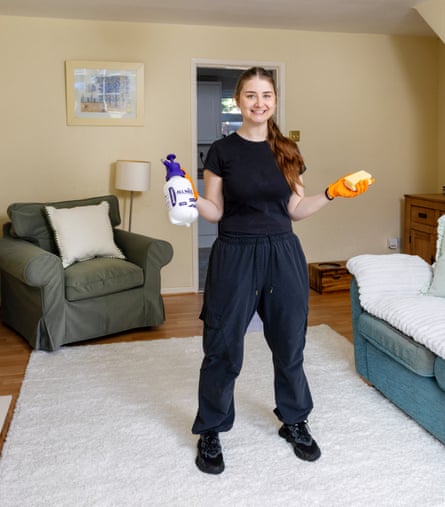
Knowing it would be difficult to talk on the job, we spoke before we arrived, struggling into hazmat suits, shoe covers, gloves and masks in the overgrown garden outside the front door. “I refer to myself as a cleaner. I would never refer to myself as a cleanfluencer,” says Elton. The slick videos on her platform, CleanWithBea, which record her transforming homes fallen into extreme dirt, decay and dilapidation, tell a different story. She has more than six million followers across YouTube, TikTok and Instagram, who have crowned her a celebrity of this genre, her audience keen to watch the imperfect made perfect in a world that feels increasingly out of control. Yet no matter how many of her polished videos you watch, nothing can prepare you for entering one of the homes she cleans in person.
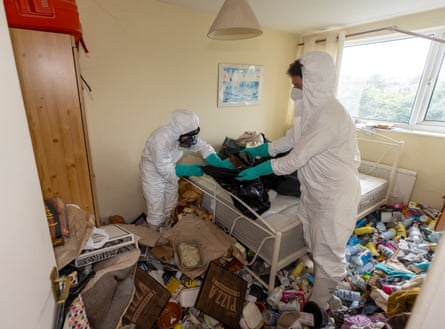
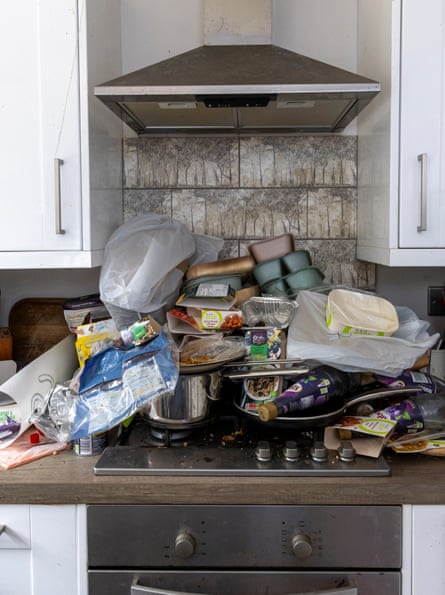
The owner warned Elton about the bird in their handover chat. Unperturbed, Elton goes on the hunt and uncovers it; a tiny, dry body still covered in downy grey feathers, stuck to kitchen paper. “She tried to look after it,” Elton explains. “Poor thing.” She’s talking about the baby bird, I think, but she could also mean the homeowner. Around three years ago, she appears to have stopped disposing of anything; to have simply stopped clearing up. Every carrier bag, carton, bottle – dead bird – has been left. There is now no floor visible, only an ever-sliding garbage carpet flowing from room to room.
It begins at the front door with takeaway leaflets, quickly meeting a bulkier torrent of crunchier junk which ebbs into the living room and then the kitchen. There’s a kaleidoscope of brand names: Oat So Simple, McCoys, Ribena. Jenga stacks of pizza boxes, some spilling crust crescents. The wrapper of a sandwich, which expired in November 2024, sticks to my shoe cover. And amid it all, the flotsam of life: trainers, an anorak, a tapas plate. As we crunch through, Elton explains that, at the very bottom, there will likely be long-lost jewellery.
Upstairs, it continues. Through the bathroom, where a broken toilet seat and shower head bob in a swamp of loo rolls, scrunched tissue balls and pantyliners, fluff and dust clinging to their adhesives. Then into the owner’s bedroom, where Charlie Bigham’s ready meal trays and This Is Food meal replacement cartons dominate, coated in a fuzz of cat hair.
The only clear space remaining is the bed. “The cleanest place in someone’s home …,” remarks Elton, calmly. “It’s a small corner that is elevated … When the living room gets bad they start eating up here, that’s why the rubbish comes up.” When the homeowner’s dishwasher and then boiler broke, she was too ashamed to allow a tradesperson in, so did without. She was forced to move out last December, her home no longer habitable.
Cleaner or cleanfluencer, it quickly becomes clear that Elton is doing something far more complex than those who proffer chirpy tips like laundry colour-coding. Her channels invite applications for cleans for free from those most desperate. And by desperate, she means truly broken – not only by the state of their home, although in the end they are, of course – but by life.
In under three years, Elton, who has a degree in classics and used to work in social media, has built an unlikely career in mould, maggots and excrement (which her singsong voiceovers refer to as “caca”), both animal and human. She has become an expert in the human psyche, developing a deep understanding of why a home could become this way.
This homeowner has depression and attention deficit hyperactivity disorder. There are signs that this was once a cosy sanctuary: Monet and Degas prints; decorative branches in a vase. Her descent into chaos started when the friend she was living with moved out. Her mental health unravelled. Eventually, she sought support and has worked hard to rebuild her life, yet still could not bring herself to admit the degradation of her home, until emailing Elton in February.
As Elton strides about in new wellies – “the last two cleans were welly chuckers” – she begins to scoop up the garbage with double-gloved hands, dust and cat hair rising, along with a warm smell of damp, disintegrating cardboard – and something else. “It’s upsetting we can’t recycle any of it, it’s covered in cat urine, it is a biohazard,” she explains. “And that’s poo,” she points. Also feline, it is now greyish and dried.
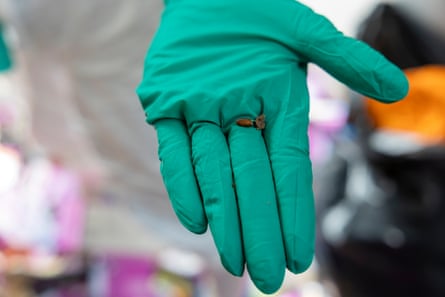
On the kitchen table, the same substance is crawling with caterpillars and centipedes, and scattered with maggot casings. Elton picks through it as if it were a science experiment. A specialist team will come to collect the bin bags. Elton has brought 20 rolls.
She has spent months talking to this homeowner, building trust. The videos do not reveal that Elton’s work involves this extraordinary investment in strangers long before the cleans begin, and often afterwards, too, which can mean liaising with their local authorities, support workers and therapists. “I’m not a mental health professional,” she reiterates, often.
How Elton, who grew up in Leicester, the daughter of NHS professionals, has arrived on this unorthodox career path still seems staggering, even to her. It all began in 2023 when she was made redundant. She and her boyfriend, Harry, were renting a London flat that was covered in mould. They wanted to leave, but Elton’s dog, Panda, made it difficult to get another place. Her recourse was full-scale cleaning. She has no natural love of it – “I don’t look forward to it.” But her drive is obsessive. “It was [a case of], OK, that product’s not worked, we’ll rinse it off, let’s go again; OK, that sponge isn’t getting there, let me try this puppy toothbrush, a toothpick …,” she explains. “I do think, then, it definitely was to regain a sense of control.”
She began posting videos to record her cleaning efforts in an attempt to “get my deposit back” when she and Harry did eventually find another place to go – she was worried her landlord might find a way not to refund it in full. But they gained traction, and soon she was being asked for help from others in the same situation.
Since Harry, a 28-year-old former report analyst she first met at university, joined Elton full-time around 18 months ago, she began singling out more extreme cases, usually accompanied by financial struggles. There would often be a pattern of mobility issues or old age in residents’ explanations, alongside mental health struggles, either as a trigger, or a repercussion, or both.
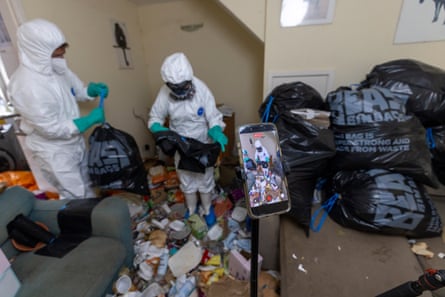
Her videos generated increasing revenue and product sponsorship, allowing her to pay herself and Harry a salary and cover cleaning costs, as well as pay for travel and accommodation both for themselves and for homeowners during the clean. She also employs services such as biohazard removal and sometimes even refurnishes homes and pays off residents’ debts.
She now receives an average of 160 applications a month, some from local authorities, carers and community workers, and berates herself harshly that she has only managed around 45 cleans to date. She’ll only really say no to body decomposition (and asks to be warned if there are needles). The issue is time: with cleans taking between three days to two weeks – plus months of prior discussion – she cannot do more.
She’s never surprised or horrified at what she encounters during a clean. “I don’t really get shocked,” she shrugs. She recalls one instance where the woman’s bath was full of excrement because her toilet had stopped working. Biohazard cleaners were needed to access the sewage system, but if the toilet had worked, Elton says she would have “scooped out the contents”.
Another had a spider infestation – “It was the worst webbing I’ve ever seen, and I’ve seen some pretty bad spider infestations.” At another, so many flies covered the floors that they appeared black.
Her empathy seems to be surprisingly immediate – but she doesn’t believe it’s so hard to understand. “A lot of the time, what we see with depression is your mind enters a survival mode. It’s simply wired to get through the day, and people become desensitised to their surroundings … Some people feel so completely overwhelmed that they are able to recognise how bad it is, but have absolutely no capacity or understanding of where to start.”
Humiliation then leads to isolation. “No matter what the situation is, a lot of it links back to shame, embarrassment and fear of judgment,” she says.
The lady with the bath? She had “lots of trauma within her childhood”, but was working through it with therapy until she lost her mum, dad and grandma within six months. Then she was sexually assaulted. When her toilet broke, she feared a male tradesperson coming to fix it. “There was no support network around, and the idea of inviting someone into her home was terrifying,” says Elton. “So she started using her bathtub, and she’d been using her bathtub for the past few years. It was completely full to the brim.”
The woman with the spider infestation? She was elderly, with lung disease. “She didn’t have the physical capability to deal with it … and as it got worse, her mental health got worse, and she got more shame.” She isolated; ended up with no heating or electricity. “Her children didn’t know until she fell over and broke her hip.”
But Elton’s understanding sounds intrinsic. When I ask if there was a moment when she recognised the link between mental health and environment, she speaks more cautiously. “If I’m honest, I kind of grew up knowing that.” She pauses. “I understood it because I was seeing patterns that I’d recognised in myself. I really struggled with my mental health from the age of 11.”
Her usually articulate voice peters out as she explains that she knows what it feels like to struggle. “I know what it’s like when your brain lies to you and convinces you that you don’t deserve better or that you’re worth your surroundings,” she says. “And I know how difficult it can be to be in a situation you’re not happy with, and to not be able to afford to get out of it, and to not have the motivation to seek help until things get quite extreme …”
She sounds wise beyond her years, but also, occasionally, angry. “Sometimes we get comments like, ‘I can’t even imagine living like this,’” she says. “And, it’s like … you’re really lucky you can’t imagine … I’m jealous of you, and I’m sure loads of people who live like this are jealous of you, that you don’t understand.”
Doing this work takes a toll. Her days can easily be 12 hours long, but the emotional burden is relentless. In January, Elton decided she needed to take a month off.
Even so, she has also taken up activism, campaigning on issues from renters’ to animal rights, inspired by the situations she encounters. She petitioned for tenants to have the right to request to keep pets, for example, and for domestic animal abusers to be banned from owning pets again.
Her motivation seems double-pronged. First, promoting empathy, which she strongly believes one should not need personal experience to feel. Anyone, she says, could fall into the living conditions of those she cleans for if their lives or mental health were upended. “I believe all of us are only one or two bad events away from that becoming a reality,” she insists. But perhaps most pressingly, she wants to enable fresh beginnings. “I want people to know that no matter how bad a situation gets, it is always fixable.”
At the Midlands home, there are 15 bin bags full by 11am. Elton and Harry shovel quickly, despite regular stops to adjust tripods holding a camera and an iPhone. They are largely silent. “When I’m cleaning, I don’t think of anything else. It’s like my brain goes quiet,” says Elton.
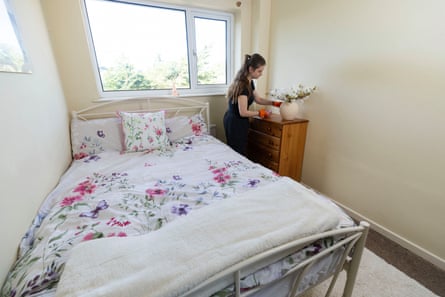
Slowly, a former life of self-care emerges from the mess – garden loppers, a vacuum, a yoga mat. Elton is confident that the house will gleam in five days. “Some people cry, some are stunned and silent,” Elton explains. The lady with the bathtub said they saved her life. She now has a job.
Elton stresses she never expects a “single free clean to permanently solve problems that have developed over lots of years.” She has even returned to one beneficiary and cleaned a second time. “I’m always happy to clean for people again … I want them to know there’s no shame in asking for help or needing help more than once,” she says. “I don’t see that as a failure.” But she says it is rare for residents to “revert back” because she aims to ensure they have the professional support in place so that their issues do not escalate again.
Overall, Elton believes 99% of her cleans herald a “full reset”. And perhaps for Elton, too? “I think it brings me a sense of purpose and a sense of fulfilment. I feel happy,” she says. “I feel like I am making younger me proud.”