2 months ago
103
2 months ago
103
Christmas may be associated with the aromas of oranges and mince pies but our towns and cities also boast special scents during the rest of the year. Now, one researcher is publishing an atlas attempting to capture these quirky “smellscapes”.
Dr Kate McLean-MacKenzie, a designer and researcher at the University of Kent, said she first became intrigued by the sense of smell 15 years ago.
“I realised that there was an enormous gap in the fact that we communicate what we see – and we can record that and we can share it via Instagram and photography and sketching – and we can record and share sounds digitally. But any way of recording and communicating smell was largely missing,” she said.
As a result, McLean-MacKenzie began mapping “smellscapes” in different locations, including many of the world’s cities.
This involves asking participants to take “smell walks” on the street – recording not only what they can smell but its intensity and duration, whether it is unexpected, whether they like it or not, and any associations the scent conjures up.
“I analyse that data and from it create visual maps and then a sort of cultural narrative about what smell tells you about those cities in response to what came out from the smell walks,” McLean-MacKenzie said. “So it’s all human interpretation, it’s largely subjective, and it’s about the stories that smells lead us to in cities.”
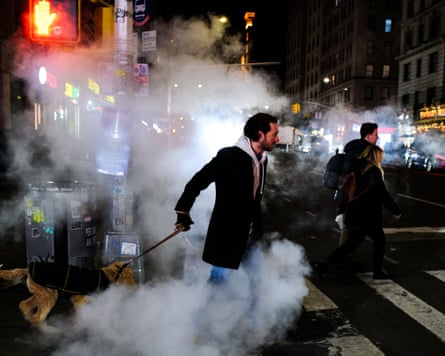
Among the cities that have been mapped since 2011 are Glasgow, Edinburgh, Canterbury, Amsterdam, Verona, Kyiv, Kolkata and Paris, with the atlas covering 40 locations.
While humans’ sense of smell compared with that of other animals has long been derided, recent research has shown it is not to be sniffed at: among other studies, scientists have found people can tell apart smells that arise just tens of milliseconds apart.
McLean-MacKenzie said the goal of the smell walks was not to identify a scent per se. “It’s about naming it and therefore giving those smells meaning in people’s lives.”
Among the examples, McLean-MacKenzie said one participant called a particular waft “the smell of shattered dreams”.
“That was somebody in New York who basically said … the smell of shattered dreams is the smell of stale beer on the sidewalk, walking home late at night, single still,” she said.
The maps, she added, capture the ephemeral nature of smells, showing the source of the odour on the day the smell walk took place, and where the scent may be blown.
“It’s like an impressionist painting of light. It’s a moment in time and the only way that you’ll get to experience it is by going out and smelling for yourself,” she said.
McLean-MacKenzie said the maps could become a useful historical record of how cities smell now, because future generations may have different experiences – as electric vehicles proliferate, for example.
She hopes the atlas will encourage readers to engage with all their senses when out walking, and in a physical as well as a digital way.
“By engaging with how other people smell spaces in ways that you might not, there’s a level of acceptance, tolerance and understanding of the fact that as individuals we are all very different and we do see things in different ways,” she added.
McLean-MacKenzie said even festival-related scents could depend on where in the world someone is.
“We can say [the] smells of Christmas are mince pies and Christmas pudding and turkey and fires and all the rest of it,” she said. “But in Kolkata they’re not, they’re smells of Chhena cake and lights and different things happening and different drinks and foods around. And the smell of cold for them is 20C, whereas for us it’s sub-zero.”
Smells can even bring surprises: McLean-MacKenzie said that when a participant who recorded smells in Antarctica came across a dead seal, they found it had a pleasant, leather-like odour.
“Just because something smells doesn’t mean it’s bad, and it’s only there temporarily,” she said. “So get over yourself and go and have a whiff and see what it’s like.”