3 months ago
146
3 months ago
146
‘They like to smoke,” says the publicist ahead of my interview with Paolo Sorrentino and Toni Servillo. That’s why the table and chairs have been hastily dragged outside. That’s why today’s audience will be conducted alfresco. We’re on the cramped sixth-floor balcony of a Venice hotel, overlooking the sea, beneath a tumult of dark clouds. The publicist points down at my recording device and asks: “Will it pick up what they say, or just the noise of the wind?”
They like to smoke – of course they do. The Italian film-maker and his muse are both men of old Europe: rigid and courtly and serenely unreconstructed; dignified at the core and a little rackety around the edges. They’ve made seven pictures together and dearly hope they’ll make an eighth. But who can predict? Even the best-laid plans can come a cropper. Sorrentino and Servillo know that time is finite and that the reassuring old order is slipping into the past. They’ve barely whipped out their cigars before the rain comes in sideways. We survive two minutes on the balcony and trundle back to the table indoors.
“The horizon is approaching,” says the pope to the hero in Sorrentino’s new movie, La Grazia, an elegant, elegiac drama about a statesman’s last six months in office. Servillo plays Mariano De Santis, the outgoing president of the Italian republic, confronted with a series of moral and ethical choices. De Santis isn’t perfect. He’s cautious and deliberate to the point of indecision. He struggles to square his Catholic faith with his legal training. But he’s a dedicated public servant, conceivably the last of his kind. One more bill to sign and then it’s over: he’s done – and what follows in his footsteps is anyone’s guess.
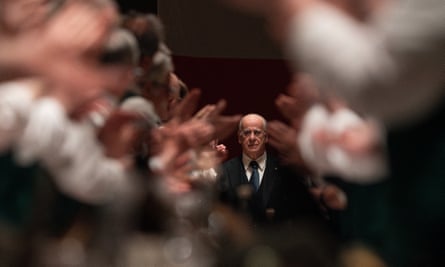
It’s not a political movie, Sorrentino insists. Yes, it’s about a man who works in politics, but he could have worked in finance, or the automotive industry. A straight political film would have bored him to tears. What’s interesting, he says, is the relationship between private life and public service, the ways in which one can impact on the other, and whether that’s healthy or not. He recently watched a prophetic 2011 interview with the American businessman Charlie Munger, who warned of the prospect of a Donald Trump presidency. “Munger said that this was a terrifying, unthinkable idea,” he recalls. “He said that if a man of that vanity – a man so greedy and eager for glory – ever becomes president, it will do huge and lasting damage to the world.”
Servillo nods grimly. In a previous era, he says, De Santis might have been regarded as a grey man of politics: sober, cerebral and fundamentally unexciting. Whereas today it’s those qualities that qualify him as a hero. This reminds Servillo of a line from a Bertolt Brecht play, Life of Galileo: “One character says, ‘Unhappy is the land that breeds no heroes.’ And the other says, ‘No. Unhappy is the land that needs a hero.’” He pours himself a glass of water, which he studies blankly for a spell. An assistant swoops in with a sachet of sodium bicarbonate.
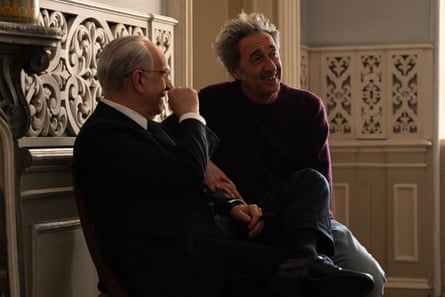
Servillo was an established stage actor, already in his 40s, when Sorrentino tapped him to play a fading club singer in 2001’s One Man Up. “At the time I was working on Molière’s The Misanthrope,” he says. “This annoying kid kept pushing his script on me and I kept setting it aside because I was a very serious stage actor, you see. I had this snobbish, arrogant dislike of cinema.” He sips his water. “So then Paolo resorted to a kind of trick. He said, ‘Oh fine, don’t read it, I’ll give it to some other actor.’ And that pricked the nerve of my vanity. I immediately sat down and read the annoying kid’s script.”
The two men have come up together, even as their best films played out as gorgeous dying falls. The Consequences of Love spotlighted the limbo-land afterlife of a mafia bagman; Il Divo charted the fraught comeuppance of Italian prime minister Giulio Andreotti. Biggest and brightest of all was Oscar-winning The Great Beauty, a Roman bonfire of the vanities that cast Servillo in the role of Jep Gambardella, the “king of the high life” who’s now on the slide. Servillo says that when he thinks back on his career milestones – the Academy Awards; his first time at the Cannes and Venice film festivals – it is always Sorrentino who has been by his side.
The actor is 67 and the director 55. But they could be cousins or siblings; they share the same cultural background. “The fact we both come from Naples, that has a big impact,” Servillo says. “But there are other, more personal reasons why we have this strong bond between us. It is very moving and not easy to explain. It is a private thing between us.”
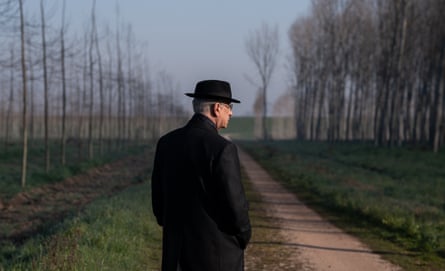
I look at Sorrentino. The director shakes his head. “I have nothing to add,” he says flatly. “I mean, I know what he’s talking about. But there are some things that have to stay between ourselves.”
The rain has now eased; the wind seems to be dropping. Sorrentino contemplates his cigar and redrafts his plan of action. Is it worth risking the balcony and braving the elements, or waiting a further half-hour in the hope of blue skies? “We wait,” he declares, as though he’s Napoleon in his tent.
It’s probably no surprise that La Grazia is far and away Sorrentino’s most satisfying film since 2013’s The Great Beauty. The director tends to work best when his mood is mordant and reflective; when he seems to view the world as a lavish, rain-wrecked wedding cake. He’s less successful when he’s sunny; when he’s concocting sentimental showboaters such as The Hand of God and Parthenope, or merrily grappling with English-language productions. He cast Sean Penn as a goth rocker in 2011’s This Must Be the Place; sent Michael Caine to the Alps in 2015’s Youth. He now regards both films as experiments – and possibly not much more than that.

“The language itself was never an obstacle,” he says. “My English isn’t fluent, but that’s OK. I rely on the musicality of the actor’s voice more than my understanding of the text. But I was really affected by a quote from Philip Roth, who is a writer I adore. He said that you have to know the culture of a place deep down, in your bones, and only then do you have the ability to tell the story of that world. And this is true, he’s correct, he made my mind up for me. That stopped my desire to tell different stories in another country.”
“The past is a burden and the future is a void,” says La Grazia’s dolorous pope, as the heroic old president prepares to quit the stage all together. It has reached the point, says De Santis, where he simply longs to go home and be with his books and his family, possibly in that order. Sorrentino often feels the same way. He says the first part of a career is all about the arrival. It’s about showing up, showing off, trying to make the world sit up and take notice. The second half, though, has one foot in the departure lounge. You’re already thinking of your legacy; you want to make a graceful exit. Also, the business changes under you, whether you want it to or not. It is no longer the playground that it was in your youth.
“So yes, I think about exiting,” Sorrentino says. “The world of cinema has changed. And I like making films less and less. But maybe I’m just saying that to trick myself. Maybe I need to think I’m about to quit this job in order to motivate myself to delve into it more fully.”
It’s a complicated situation. The man is a creature of appetites. He’s jaded but he’s greedy; he’s sated but he’s hungry. “Making cinema is like my relationship with food,” he says. “I try to be on a diet, but if you show me a fully laid-out table I’ll immediately want to savour everything that’s on it. With cinema it’s the same. In theory, I’m no longer interested. But show me the table and I’ll eat up every dish.”
I hit the wrong button after the interview wraps up and the lift drops me down from the sky lounge, past the lobby to the basement, where the big double doors open on to the beach. It seems that I’ve only just left Sorrentino and Servillo upstairs and yet they must have moved like greased lightning, because they’re already on the sand, strolling past the beach huts like a pair of old flaneurs. The waves are crashing and the sky is still spitting rain, but these men have waited long enough. They put their backs to the wind and send up twin plumes of white smoke.