3 months ago
178
3 months ago
178
In 1966, the year Patrick Rylands graduated from the Royal College of Art, the British toy industry was being conquered by a soldier. Action Man, complete with a macho painted-on scar and fatigues, won the battle for Toy of the Year.
But for Rylands, who has died aged 83 after suffering from vascular dementia, the future of children’s play was not to be found in camouflage or tiny guns, but in the translucent, jewel-toned geometry and simplicity of his first toy design, PlayPlax. A quiet revolution of simple interlocking squares – designed while he was still at college – it offered a defiant modernist “less” response to the toy world’s “more is more” approach.
While the mass market careered toward battery-operated dolls that spoke and cars that crashed, Rylands’s innovative focus on the abstract, rather than the literal, was rewarded in sales: by 1970, PlayPlax had sold more than a million units.
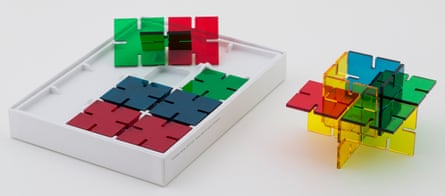
Throughout his career Rylands remained true to this vision. He continued to focus on condensing complex ideas into effortless simplicity. “A toy that does everything by itself, does nothing for the child,” he said. “The main purpose of a toy is to enable children to enter into a world of make-believe, as it is in this way that children relate to reality.”
Born in Hull, East Yorkshire, one of the five children of Ada (nee Cairns) and Leo Rylands, an engineer, Patrick was educated at the Marist college, a Catholic grammar school in the city. “I hated school,” he said later. “When I was about to leave my art master said: ‘You might get into art school if you try’ – the alternative was to join the police – I was the perfect height.”
He attended Hull College of Art before moving to London to pursue an MA in ceramics at the Royal College of Art. There he met Ljiljana Momcilovic, a fellow student, who was to become a skilled illustrator. The couple married in 1966 in the Serbian Orthodox church in Bradford, though they were to live for many decades in Belsize Park, London.
In 1970, Rylands became the youngest ever recipient of the Duke of Edinburgh’s prize for Elegant Design (now the Prince Philip Designers prize) for the range of toys he produced for the Trendon company, which included PlayPlax and the slotted LittleMen figures. The judges praised his ability to introduce young children to concepts of form, balance and transparency through objects that felt as good to hold as they looked.
In 1999, Rylands was elected a Royal Designer for Industry (RDI) by the Royal Society of Arts – the highest accolade for designers in the UK. It was a fitting acknowledgment of a “designers’ designer” who approached the engineering of a bath toy duck with the same rigour that another might afford a skyscraper.
Unusually, he worked without prototypes, moving straight from complex mechanical drawings to the final toolmakers. This precision and ability to condense complex materials and designs resulted in items such as his Bird and Fish bath toys – beautifully weighted sculptures in ABS plastic that he once described as “the least you can do to a bit of plastic and still make it usable”.

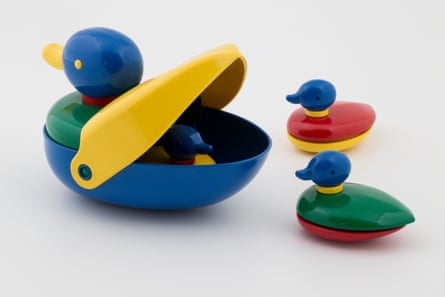
If Rylands had a design golden age, it began in 1976 when he joined the Dutch company Ambi Toys. For 30 years as chief designer, Rylands was the force behind the simple and yet profoundly influential aesthetic. He stuck to a limited palette of primary colours – red, blue, yellow and white – chosen because of their clarity to developing eyes.
HIs approach also stood out amongst the increasing “pinkification” of gendered toy aisles and toys powered by batteries and microchips. He was always a purist, and his most famous Ambi creations – including Duck Family, where three miniature ducks nest inside a larger one, and Tommy Toot, the simple, melodic whistle – were defined by smooth lines and intrinsic playability.
At home in Belsize Park, he was an obsessive and joyful collector, amassing an archive that celebrated the history of human ingenuity. It included a fine collection of Victorian glass marbles – their swirling transparent colours finding their echo in his PlayPlax designs – as well as 1930s American radios, intricate automatons and a 7ft-high music box. It was a collection driven by a lifelong fascination with how things were made, and a testament to his belief that even the smallest, most simple object deserved to be beautiful.

His work is held in the collections of the Young V&A in east London and MoMA in New York, and his designs were showcased as examples of the best of British innovation in the 2012 London Olympics.
After Ljiljana’s death in 2024, Rylands moved to Royal Leamington Spa to live near his sister, Josephine, who survives him. His three brothers, Michael, Tony and Paul, predeceased him.
In bathtubs and nurseries, his toys continue to float, rock and slide. “Toys should give children the freedom to play,” he said. His own designs demonstrated that if you give a child a simple, elegant tool, you are giving them the freedom to build their own world.