2 hours ago
8
2 hours ago
8
The international community was scrambling to get aid into flood-stricken parts of Nepal and Tibet on Thursday as authorities warned that a lake formed at the site where the deadly torrents occurred was rising and at risk of bursting.
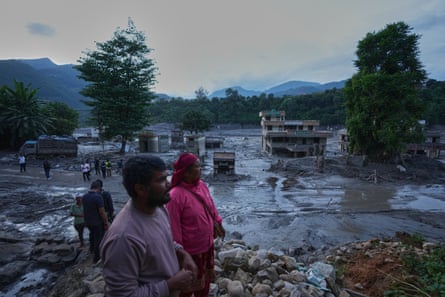
The catastrophic flash floods that hit Nepal and Tibet on Wednesday, thundering down valleys and obliterating entire villages, killed at least 359 people and left more than 1,300 missing.
Efforts to locate those unaccounted for – including hundreds of tourists from India, the US, Britain, Australia and Canada – have been complicated by the destruction of dozens of bridges and 25 miles (40km) of roads in the mountainous region, which is popular with trekkers and pilgrims.
Rescue teams reported finding bodies hundreds of miles downstream from the disaster zone in the Chitwan district of Nepal, near the Tibetan border. Dozens of injured people were transported to Kathmandu for advanced medical care and more than 100 people were rescued by Nepali army personnel in helicopters.
Videos from Wednesday’s disaster showed a massive wall of water crashing down on the border as people tried to flee. The power, volume and speed of the floods gave little time for escape.
Trucks were overturned and houses, roads and power plants were swept away in Nepal, while officials in Tibet said they feared “major casualties” after a mudslide hit a border crossing.
Tom Fletcher, the UN’s humanitarian chief, described the flood as “horrifying”. He said emergency teams had been mobilised and an initial $2m (£1.5m) of disaster funds allocated to cover emergency medical care, shelter and water.
Nepal’s disaster authority warned of continuing danger on Thursday, appealing to residents and rescuers to stay away from a swelling lake that had formed at the flood site. Chinese authorities said a barrier lake at the confluence of the Tsogyal and Purupqiangzangbu rivers was overflowing and could burst.
Girilal Budhathoki, 36, who lives in the Rasuwa district of Nepal’s Bagmati province, said the flood waters swept away his wife and four children while he was away from the family home.
“A huge surge of water came,” he said. “Everything turned completely black, and I couldn’t understand what was happening. Suddenly, something heavy crushed me and I fell down.”
Budhathoki realised what had happened only when he returned to the place where his house had stood. “I searched desperately for my wife and children but I couldn’t find them,” he said. “They didn’t make it out. My wife was swept away too. I am all alone now.”
Kamal Kharel, who works at a hydropower plant in Chilime, also in Rasuwa district, was in the office when the floods hit. “The whole place shook as if there had been a huge earthquake,” he said. “But when I went outside, I saw everything a storm and raging water.”
Kharel and some of his colleagues managed to climb a hill, where they stayed until they were rescued by the army on Thursday morning. He said: “I had never seen waves crashing that high. You only see waves like that in the sea.”
People from the hard-hit districts of Nuwakot and Dhading, in Bagmati province, were seen gathering outside an army training centre – the base for helicopter rescue operations – seeking information about missing family members.
Police were recording the names of the missing outside the barracks gate. Mobile phone torches were their only source of light as the area remained without electricity because of damaged hydroelectric infrastructure.
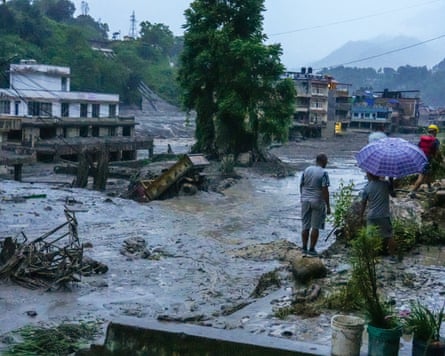
The village of Soley, in Nuwakot, which had about 25 homes, was almost wiped out, according to Nirajan Paudyal, a Kathmandu-based journalist whose parents and other relatives lived there. Desperate for information, he had travelled to the area on Thursday for news of his family. “There is no update till now,” he said. “I fear there won’t be any update.”
More than 500 foreigners were among 826 people missing in Nepal, police and tourism officials said. Among those unaccounted for were 177 from India, 90 from the US, 34 from Australia, 33 from Britain and 25 from Canada.
Chinese state media said at least 558 were missing on the Tibet side of the border, of whom at least 260 were foreign nationals.
Police in Nepal said 359 bodies had been recovered by Thursday afternoon local time, while Chinese state media reported three dead on the Tibet side of the border.
Many of the victims were on a pilgrimage to Kailash Mansarovar, a high-altitude site in Tibet revered by Hindus and Buddhists among others.
Early reports from Nepali officials suggested an earthquake could have caused the lower part of a glacier to collapse and trigger the floods. But the US Geological Survey later said what was initially reported as a 4.4-magnitude earthquake was a seismic shock generated by glacial rock and ice collapsing, and the flow of debris. “No earthquake had occurred,” it said.
Srijana Gurung, the acting Nepal director for the international NGO Plan International, said communities across the Himalayan country were facing “climate shock after shock” with hardly any time to recover.
“Floods and landslides have always happened in Nepal but the climate crisis is making them far more frequent and intense,” she said. “The priority now must be reaching those affected, supporting families searching for loved ones and ensuring vulnerable communities have the assistance they need.”
Gurung said children and families who had lost their homes and livelihoods would be in urgent need of medical help, food, shelter and hygiene kits. “There is also a risk of waterborne disease as access to clean water and sanitation is likely to have been damaged,” she said.
Scant information has emerged from the Chinese authorities about the scale of the destruction. Tibet is the most tightly controlled part of China even under normal circumstances. Foreign journalists cannot visit the region unless they are part of a government-controlled tour and the authorities have cracked down harshly on calls for greater autonomy from the Tibetan people. Tibetans have almost no contact with the international media because of fears of retribution.
Only brief, state-controlled media reports about the floods have been allowed to circulate in China and the authorities have confirmed only three deaths. Chinese reports have focused on rescue efforts.
Maya Wang, the deputy Asia director at Human Rights Watch, wrote on X: “The floods raise questions about whether Chinese authorities could’ve done more to reduce disaster risks, given longstanding concerns from Tibetan diaspora groups & experts about rapid, state-led development in areas where Tibetans have little say.”
She called on Beijing to “allow Tibetans access to information and international researchers and journalists unfettered access to the region, and conduct a rigorous investigation into the disaster”.