2 months ago
62
2 months ago
62
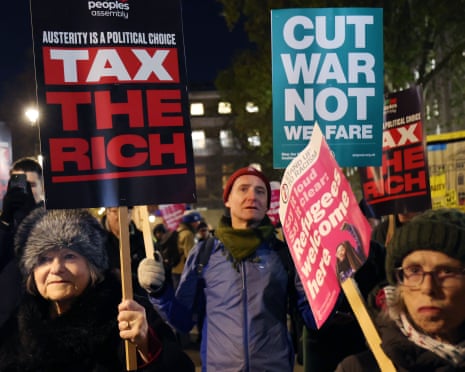
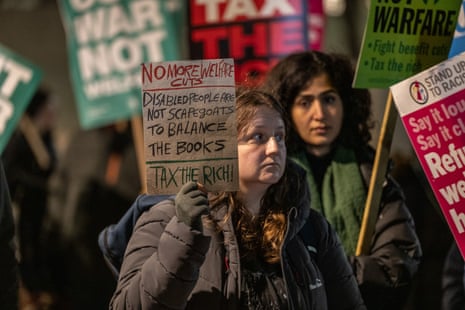
Protesters demonstrated outside Downing Street last night ahead of Rachel Reeves’ budget today. Photograph: Andy Rain/EPA
Show key events only Please turn on JavaScript to use this feature
Live feed
Introduction: Will tax-heavy budget reassure bond markets?
Good morning, and welcome to our rolling coverage of business, the financial markets and the world economy.
“You can please some of the people all of the time, you can please all of the people some of the time, but you can’t please all of the people all of the time,” as the old quote has it.
And today, chancellor Rachel Reeves faces the challenging task of pleasing (or at least not displeasing too badly) four different constituencies – Labour MPs, voters, businesses, and the bond market – with her budget announcement, which is likely to be heavy on taxes.
Reeves faces a tough task, given the £9.9bn headroom to keep within her fiscal rules has been eroded by higher borrowing costs, and welfare U-turns.
A downgraded OBR productivity forecast expected today adds to the chancellor’s challenge of remaining on track for the current budget to be in balance in 2029-30 (the government’s fiscal mandate).
Ideally, Reeves would like to end up with more headroom than before, to protect the UK against volatile government bond markets.
Investors will be watching closely to see how (and indeed if) she achieves this.
One option is to spend less. Labour MPs, though, are opposed to spending cuts, as shown by the revolt against the government’s welfare reforms.
Reeves tried to sweeten her party earlier this week, telling them the budget would include some measures they’ll like, and calling it “a package not a pick and mix … you can’t say I like the cola bottles but not the fruit salad”.
Potential tasty ‘cola bottle’ measures are the end of the two-child benefit cap, to fight poverty, and help on energy bills, to battle the cost of living squeeze.
Raising taxes is another lever, but Reeves appears to have lost her appetite for a manifesto-breaking rise in income tax. That means we may get a ‘smorgasbord’ of smaller tax rises, including a ‘stealth tax’ freeze on income tax thresholds.
Some will fall on businesses; gambling firms could face higher taxes, while a reported plan to tighten the rules on salary sacrifice schemes would cost employers and employees.
The third funding option is to borrow more, but that’s not practical when keeping within the fiscal rules. If bond traders sniff more debt is coming, they would demand higher rates of return when buying new bonds, and potentially rush to sell gilts they already hold, driving up bond yields.
To keep the bond markets calm, Reeves really needs to increase her headroom – perhaps to as much as £20bn, up from that £9.9bn figure. But that could require £30bn of tax rises and spending cuts, to address the erosion in the fiscal position since March’s spring statement.
As Peter Arnold, EY UK chief economist, explains:
“The Government is expected to need to find between £25-30bn in order to keep within its fiscal rules, presenting challenging tax and spending decisions, and it may seek to go even further to create additional fiscal headroom.
“A key priority for the Chancellor will likely be demonstrating a commitment to stability by maintaining the fiscal rules. Reassuring the financial markets in this way could reduce bond yields and, in turn, decrease debt interest payments, opening up headroom later down the line.
The Chancellor will also be mindful of the need to display a clear, consistent growth narrative and address the UK economy’s persistent sluggishness, so we may see announcements that involve a continued focus on planning reform, programmes to encourage people back into work, and reductions to the compliance burden on businesses.
Neil Wilson, UK investment strategist at Saxo Bank, warns that the markets could wobble if the budget doesn’t land well, saying:
And there is ample reason to think it won’t. For starters it’s hard to see how the Chancellor can pull off tax hikes that won’t crimp growth, forcing the Bank of England into more aggressive rate cuts (that’s the best outcome we can foresee).
At worst it’s going to be a currency-toxic combination of fiscal tightening of the most productive bits of the economy, sharp contraction in growth, deeper monetary easing and the cherry on the top of a political crisis as Labour MPs start to move on the Reevers/Starmer leadership.
If we see a sharp move up in gilt yields – say because the market doesn’t believe that spending restraint pencilled in for the end of the parliament is possible – this could precipitate a negative feedback to sterling as markets would price in political uncertainty re the leadership and inevitably start to fret over a more left-leaning govt and endless tax-and-spend.
Remember, Reeves has hung her hat on the bond market - her future is in the hands of the bond vigilantes. If Reeves threads the needle and delivers respectable tax cuts and the bond market continues to give her a pass as the only truly credible candidate as Chancellor, sterling could see a big pop in a relief rally.
So it could be a dramatic day in the City, as well as in Westminster.
The agenda:
-
12.30pm GMT: Rachel Reeves to present the budget
-
1.30pm GMT (approx): Office for Budget Responsibility to release its economic and fiscal outlook
-
1.30pm GMT US weekly jobless claims data
-
2.30pm GMT: OBR press conference
Key events Show key events only Please turn on JavaScript to use this feature
Reeves must avoid 'cold porridge' in Goldilocks budget
Patrick Farrell, chief investment officer at wealth managers Charles Stanley, says the chancellor needs to strike a tricky balance today:
“The Chancellor needs to deliver a Goldilocks Budget today – one with just the right balance between supporting growth, preserving fiscal credibility, and not overburdening households or businesses.
It’s a tough ask and bond markets could decide Rachel Reeves has served up a dose of cold porridge for taxpayers while not doing enough to tackle a yawning fiscal black hole. If the fiscal measures are considered too tight, as well as choking off growth, we could see political instability, which would be hard for bond markets to stomach. However, anything too expansionary would risk inflation and unsustainable borrowing.”
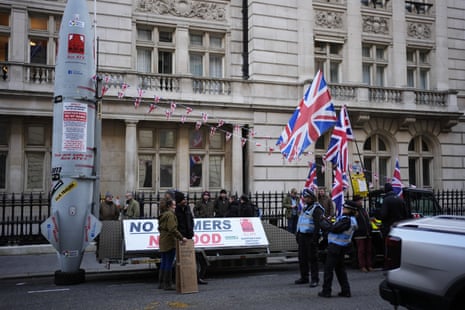
Farmers defy tractor ban in budget protest
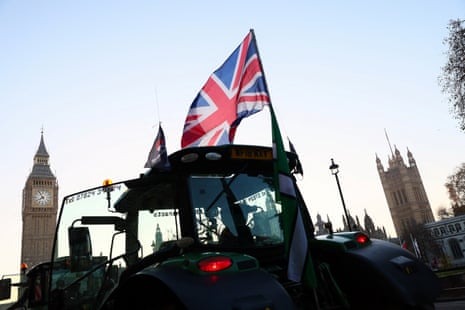
Farmers have brought their tractors to London today for a budget protest about inheritance tax changes, despite a police ban on the vehicles (see earlier post).
PA Media report that a number of tractors were seen driving through Westminster early on Wednesday, with police stopping around 20 of them in the vicinity.
This included a farmer dressed as Father Christmas, his tractor carrying a large spruce tree and bearing a sign that read:
“Farmer Christmas – the naughty list: Keir Starmer, Rachel Reeves, David Lammy, Diane Abbott, Angela Rayner & the BBC”.

PA Media adds:
Farmers have parked more than a dozen tractors, brought to Westminster in defiance of Met police restrictions prohibiting agricultural machinery from the area, around Trafalgar Square.
They repeatedly sounded the tractor horns while police stood watching, with rush-hour traffic brought to a standstill.
David Gunn, an arable farmer and agricultural contractor from near Sevenoaks in Kent, said he was protesting on Budget day for a number of reasons, including the Government move to put inheritance tax on larger farm businesses.
He said: “Inheritance tax is one reason, it’s going to cripple the farmers, the small family farmers.
“There’s all the other taxes they’ve been putting on us, and the prices we get for our produce and what it costs in the shop, we don’t make any money.
“Then there’s food security, farmers are going out of business.”
He said his message to Government was “sort the pledge out”.
“You said in the manifesto you would look after the farmers, which you totally haven’t, you’ve ruined the countryside,” he said.
Budget build-up: what the experts say
Reto Cueni, chief economist at Syz Group, reckons the government will want to “deliver the right message” to the financial markets with today’s budget.
That, Cueni says, means showing a fiscal consolidation of close to £30bn, likely extending the headroom against the fiscal rules closer to £15bn.
To achieve such an additional fiscal consolidation, the UK government will likely have to increase taxes – but will try to do so in the “non-inflationary” tax areas, such as tax threshold freezes, or smaller changes to pension taxes, higher council taxes or increasing the gambling taxes and reducing capital gain tax exemptions, while also looking to avoid inflationary instruments, such as duties or tax changes that would substantially raise costs for businesses.
The key for the government is to show that over the next 2 years the budget deficit will be reduced and the UK’s debt burden will finally move down, Cueni says, adding:
Therefore, the Debt to GDP ratio in the OBR’s forecast should be lower in the new release. By reducing the fiscal deficit over the next two years, the government can regain fiscal credibility and assure investors that the UK’s government is keeping control of the debt situation.
This would relax tensions in the gilts market and let yields grind lower. That, in turn, would support domestic oriented stocks in the UK’s equity market, namely homebuilders, utilities, or FTSE 250 in general. Otherwise, with a disappointing new budget, gilt yields would likely increase again, pushing domestic oriented stocks down and supporting internationally oriented stocks and (domestic) bank and financial stocks.
Building up the tension, Neil Wilson, UK investor strategist at Saxo Markets, says today will probably bring “the most consequential Budget in a generation”:
It’s make or break for the Chancellor and the embattled Starmer premiership. The litmus test for its success is the bond market reaction.
Wilson identifies key questions that will need answering.
-
to what extent are tax hikes going to drag on growth, which is antithetical to a self-declared pro-growth chancellor, which diminishes her ability to hit fiscal rules?
-
to what extent are tax hikes inflationary, which deepens cost of living problems and restricts manoeuvrability of Bank of England to cut rates?
-
to what degree are forecasts plausible - are they hinged on fiscal restraint in 29/30 that will depend on nebulous welfare reform and spending cuts, the kind of which the govt has signally failed to pass so far?
Simon French, chief economist at investment bank Panmure Gordon, says the downside risk is that the Budget unravels amidst Labour Party factionalism. That could lead the bond market to expect more debt to be issued, and inflation to be higher.
The upside risk is that Rachel Reeves manages to build a firebreak through to the next fiscal event, which would allow UK businesses and consumers to proceed without speculation about further tax rises, French explains.
Some of Labour’s newer MPs have taken to social media this week with some catchy videos to explain the thinking behing the budget.
Dr. Jeevun Sandher, Labour MP for Loughborough, produced one explaining how economic growth, inflation and political risk all influence the cost of borrowing (and why it matters):
But Gordon McKee, Labour MP for Glasgow South, umm ‘takes the biscuit’ with this tasty explanation of debt to gdp ratios…
Plus one on fiscal rules, and why a mansion tax would help:
The pound is marginally higher this morning, as the City awaits the budget announcement.
Sterling has crept up by a tenth of a cent against the US dollar, to $1.3177, a modest move.
It’s also a teensy bit higher (+0.08%) against the euro at €1.138.
The pound has been weakening in recent weeks, ahead of the budget, so the Treasury will be hoping we don’t see a repeat of the plunge after Liz Truss’s mini-budget three years ago.
Francesca Fornasari, head of currency at Insight Investment, has said:
“Sterling’s reaction to Wednesday’s budget remains highly uncertain, but much of the negative news is likely to be already reflected in current valuations. It wouldn’t surprise me to see the currency rally a little on the day once the scope for more bad news is over.
How to keep the bond market happy today
The bond market reaction will be crucial to how the Budget is perceived by investors, reports Kathleen Brooks, research director at brokerage XTB:
Ultimately the bond market wants to see cuts in government spending and revenue generators that do not stoke inflation. However, a higher than inflation rise in the national living wage, along with large spending increases may leave the bond market disappointed.
In the lead up to this Budget, yields have been falling. In the past week, the UK bond market has been the top performer bar the US, and 10-year Gilt yields have fallen by more than 10 bps. However, the bond market is unlikely to tolerate any increase in borrowing in this Budget, or any move from the Chancellor to distance herself from her own fiscal rules.
Fiscal headroom also needs to be higher than the £10bn last year. A figure between £15bn and £20bn could be warmly received by the bond market.
Brooks adds that the Budget needs to deliver three things to keep the bond market happy and sterling stable:
-
An increase in fiscal headroom.
-
Front loaded fiscal tightening, preferably with spending cuts.
-
A firm commitment from the Chancellor that this will be the last time that she uses the budget for tax raids. This could boost spending and confidence in the economy and help boost growth.
Rachel Reeves has also pledged to keep a ‘tight grip’ on the public finances.
In her video address ahead of the budget, the chancellor says:
I will take action to cut our debt and borrowing, by keeping a tight grip on the country’s finances
Ther is nothing progressive, nothing fair, about spending one in every 10 pounds of government spending just servicing the national debt.
UK inflation expectations fall sharply, teeing up date cuts
There’s good news for Rachel Reeves this morning – the British public’s expectations for inflation have fallen sharply this month.
Expectations for inflation over the next 12 months fell to 3.7% in November from 4.2% the previous month, a survey carried out by YouGov for the US bank Citi showed on Wednesday.
Citi said the reading could boost the chances of a December rate cut by the Bank of England’s monetary policy committee (MPC).
Long-term inflation expectations also fell to 3.9% in November from 4.2% in October.
Citi economists say:
“If this downgrade is replicated, both over time and across the various inflation expectation surveys, we think it could challenge the idea prevalent in the MPC that expectations are an ongoing barrier to both a lower terminal rate and a faster pace of cuts.”
UK interest rates have been on hold at 4% since August, but the City broadly expects a cut to 3.75% in December.
Deutsche Bank’s UK economist, Sanjay Raja, has predicted that Rachel Reeves will deliver a second “historic tax-raising budget”, although the scale won’t be as large as last year’s effort.
Raja predicts that macro-economic downgrades, policy u-turns, and a push to shore up fiscal resilience will probably lead the Chancellor to deliver nearly £35bn of fiscal consolidation.
That, Raja says, will includes an extension of the freeze in personal tax thresholds, as well as “measures targeting wealth, expanding the base for National Insurance contributions, and a slew of sector-specific taxes”, plus higher taxation on housing (either through changes to council tax, or via a mansion tax).
The budget in five charts
You can get up to speed ahead of today’s budget with our breakdown of five key charts that outline the fiscal backdrop:
For example, here’s one showing how the chancellor’s headroom has been eroded by welfare cut u-turns, and rising borrowing costs:
The chancellor is expected to cut the maximum amount people can put into tax-efficient cash individual savings accounts from £20,000 a year to £12,000 in Wednesday’s budget.
It’s part of the government’s push to help the London stock market, by encouraging people to funnel more of their cash into the stock market.
But finance bosses have warned that lowering this annual cash Isa limit by 40% could lead to higher mortgage rates and deter consumers from saving.
Reeves: I know people are angry and frustrated
Rachel Reeves has acknowledged people are “angry at unfairness” in the British economy ahead of unveiling her second Budget today.
In a filmed address ahead of the Budget, the Chancellor said the budget will cut the cost of living, hospital waiting lists, and the cost of the national debt.
She says the government had started to see results in the past year with “wages rising faster than inflation, hospital waiting lists coming down, and our economy growing faster and stronger than people expected”.
“But I know there is more to do,” she said, adding:
“I know that the cost of living is still bearing down on family finances, I know that people feel frustrated at the pace of change, or angry at the unfairness in our economy.
“I have to be honest that the damage done from austerity, a chaotic Brexit and the pandemic were worse than we thought.
“But I’m not going to duck those challenges, and nor will I accept that our past must define our future. It doesn’t have to.”
The chancellor says the budget will help create a fairer, stronger and more secure country.
And she denied bringing back austerity, saying:
“Today I’m going to take the fair and necessary choices to deliver on our promise of change.
I’m not going to return Britain back to austerity, nor will I lose control of public spending with more reckless borrowing.
Anti-austerity protests last night
There were protests outside Downing Street last night, ahead of the budget, organised by Stop the War Coalition and The People’s Assembly.
Carrying placards reading “Tax the rich”, “Cut War Not Welfare”, and “Welfare Not Warfare”, the gathering pushed the government to avoid an austerity agenda, resist cuts, invest in pubic services, and increase the tax burden on the wealthiest.
Farmers are planning to protest in Westminster today, over the changes to inheritance tax announced last year. However, they have been blocked from bringing their tractors by the Metropolitan Police… who say the protests can still go ahead otherwise.
Conditions have been placed on the farmers protest planned for tomorrow in Westminster.
People will still be able to demonstrate, however, conditions have been put in place to prevent protesters from bringing vehicles, including tractors or other agricultural vehicles, to the…
There are suggestions online that we’ve banned farmers from protesting tomorrow. That’s not correct.
Farmers are welcome to protest, but we must balance the impact protests have on the rights of all Londoners.
That is why we have put conditions in place to prevent serious…
Resolution Foundation: National wage rise for 18-20 year olds could backfire
The Resolution Foundation, the think tank set up to improve the living standards for those on low to middle incomes, has also voiced concerns about the minimum wage increase announced last night.
Resolution point out that raising the National Living Wage (NLW) by 4.1% next April will deliver a welcome boost to more than two million workers and their families.
However, they also fear the “unnecessarily big rise” of 8.5% in the rate for 18-20 year olds will make it harder for young people to find a job, at a time when more young people who are not in employment, education or training (NEET) (up 185,000 over the past year).
Nye Cominetti, principal economist at the Resolution Foundation, said:
“The latest rise in the National Living Wage – while small compared to recent history – will nonetheless deliver a welcome wage boost to more than two million workers and their families.
“Younger workers are set for an even bigger pay rises – but these steep increases risk causing more harm than good if they put firms off hiring and push up NEET rates.
“The minimum wage has good to claim to be Britain’s biggest policy success in a generation. But at its higher level the Government and Low Pay Commission need to act with more flexibility when setting rates so they can respond to changing labour market conditions.”
Hospitality industry warns minimum wage rise will push up prices
Last night, the UK learned that the minimum wage will rise by 4.1% next year, meaning a pay rise for millions of lower-paid workers.
The national living wage will rise from £12.21 to £12.71 an hour from April for over-21s, while the minimum wage for 18- to 20-year-olds will increase by 8.5% to £10.85 an hour, narrowing the gap with older workers.
Unions have hailed the move, with the GMB calling it “fantastic news for millions of low-paid workers across the country.”
Businesses, though, are warning that they may have to pass the cost onto customers through higher prices.
Kate Nicholls, chair of UKHospitality, said:
“Increases to minimum wage rates are yet another cost for hospitality businesses to balance, at a time when they are already being taxed out.
“These additional costs make action at the Budget to reduce hospitality’s tax burden even more important, especially if businesses are expected to sustain this level of annual wage increase.
“Hospitality businesses have reached their limit of absorbing seemingly endless additional costs. They will simply all be passed through to the consumer, ultimately fuelling inflation.
Possible tax rises today
Rather a lot of today’s budget statement has already been trailed in the media, in the long build up to today’s announcement.
Some of the tax rises Reeves is likely to opt for include:
-
Freezing income tax thresholds for an extra two years to 2030, bringing more people into higher tax bands as wages rise.
-
Making salary sacrifice schemes less generous, including those for pension contributions.
-
A pay-per-mile scheme on electric cars to help fill the tax gap from petrol duty as more people opt for green vehicles.
-
Bringing in higher tax on the most expensive properties, including a surcharge on the highest-value houses. The surcharge will reportedly be targeted at homes worth more than £2m, after worries that a lower £1.5m threshold would hit too many in the south-east.
The Daily Telegraph are reporting middle-class families face a “dirty dozen” tax rises in the Budget – if you include the charges on tourists visiting major cities announced yesterday, higher levies on the betting industry, and the closing of a loophole on Chinese imports that has been used by fast fashion giants such as Shein….
Goldman Sachs predicts £30bn of tax rises
Goldman Sachs have predicted that Rachel Reeves will increase her budget headroom to £15bn, from £10bn in the last budget, mainly through higher taxes.
Reminder, this is the flexibility to hit government’s first fiscal rule, to be on track to achieve a current budget surplus, where day-to-day spending is less than total revenues in 2029–30.
Goldman economist James Moberly predicted last week that the government heads into the budget with a £20bn deterioration in its headroom against the deficit rule (due to the expected downgrade of Britain’s economic prospects by the OBR, higher debt costs, and the reversal of planned welfare cuts).
In addition, potential measures such as freezing fuel duty (again) and lifting the child benefit cap (finally) would cost £8bn.
In that scenario, a gross consolidation of around £33bn would be needed to grow the headroom to £15bn.
Moberly explains:
We expect only modest spending cuts of around £3bn, implying that around £30bn of tax increases are likely required.
After the government reportedly reversed plans to raise income tax rates, an extension of threshold freezes combined with a series of smaller measures now looks the most likely avenue to raise revenues.
Introduction: Will tax-heavy budget reassure bond markets?
Good morning, and welcome to our rolling coverage of business, the financial markets and the world economy.
“You can please some of the people all of the time, you can please all of the people some of the time, but you can’t please all of the people all of the time,” as the old quote has it.
And today, chancellor Rachel Reeves faces the challenging task of pleasing (or at least not displeasing too badly) four different constituencies – Labour MPs, voters, businesses, and the bond market – with her budget announcement, which is likely to be heavy on taxes.
Reeves faces a tough task, given the £9.9bn headroom to keep within her fiscal rules has been eroded by higher borrowing costs, and welfare U-turns.
A downgraded OBR productivity forecast expected today adds to the chancellor’s challenge of remaining on track for the current budget to be in balance in 2029-30 (the government’s fiscal mandate).
Ideally, Reeves would like to end up with more headroom than before, to protect the UK against volatile government bond markets.
Investors will be watching closely to see how (and indeed if) she achieves this.
One option is to spend less. Labour MPs, though, are opposed to spending cuts, as shown by the revolt against the government’s welfare reforms.
Reeves tried to sweeten her party earlier this week, telling them the budget would include some measures they’ll like, and calling it “a package not a pick and mix … you can’t say I like the cola bottles but not the fruit salad”.
Potential tasty ‘cola bottle’ measures are the end of the two-child benefit cap, to fight poverty, and help on energy bills, to battle the cost of living squeeze.
Raising taxes is another lever, but Reeves appears to have lost her appetite for a manifesto-breaking rise in income tax. That means we may get a ‘smorgasbord’ of smaller tax rises, including a ‘stealth tax’ freeze on income tax thresholds.
Some will fall on businesses; gambling firms could face higher taxes, while a reported plan to tighten the rules on salary sacrifice schemes would cost employers and employees.
The third funding option is to borrow more, but that’s not practical when keeping within the fiscal rules. If bond traders sniff more debt is coming, they would demand higher rates of return when buying new bonds, and potentially rush to sell gilts they already hold, driving up bond yields.
To keep the bond markets calm, Reeves really needs to increase her headroom – perhaps to as much as £20bn, up from that £9.9bn figure. But that could require £30bn of tax rises and spending cuts, to address the erosion in the fiscal position since March’s spring statement.
As Peter Arnold, EY UK chief economist, explains:
“The Government is expected to need to find between £25-30bn in order to keep within its fiscal rules, presenting challenging tax and spending decisions, and it may seek to go even further to create additional fiscal headroom.
“A key priority for the Chancellor will likely be demonstrating a commitment to stability by maintaining the fiscal rules. Reassuring the financial markets in this way could reduce bond yields and, in turn, decrease debt interest payments, opening up headroom later down the line.
The Chancellor will also be mindful of the need to display a clear, consistent growth narrative and address the UK economy’s persistent sluggishness, so we may see announcements that involve a continued focus on planning reform, programmes to encourage people back into work, and reductions to the compliance burden on businesses.
Neil Wilson, UK investment strategist at Saxo Bank, warns that the markets could wobble if the budget doesn’t land well, saying:
And there is ample reason to think it won’t. For starters it’s hard to see how the Chancellor can pull off tax hikes that won’t crimp growth, forcing the Bank of England into more aggressive rate cuts (that’s the best outcome we can foresee).
At worst it’s going to be a currency-toxic combination of fiscal tightening of the most productive bits of the economy, sharp contraction in growth, deeper monetary easing and the cherry on the top of a political crisis as Labour MPs start to move on the Reevers/Starmer leadership.
If we see a sharp move up in gilt yields – say because the market doesn’t believe that spending restraint pencilled in for the end of the parliament is possible – this could precipitate a negative feedback to sterling as markets would price in political uncertainty re the leadership and inevitably start to fret over a more left-leaning govt and endless tax-and-spend.
Remember, Reeves has hung her hat on the bond market - her future is in the hands of the bond vigilantes. If Reeves threads the needle and delivers respectable tax cuts and the bond market continues to give her a pass as the only truly credible candidate as Chancellor, sterling could see a big pop in a relief rally.
So it could be a dramatic day in the City, as well as in Westminster.
The agenda:
-
12.30pm GMT: Rachel Reeves to present the budget
-
1.30pm GMT (approx): Office for Budget Responsibility to release its economic and fiscal outlook
-
1.30pm GMT US weekly jobless claims data
-
2.30pm GMT: OBR press conference
Explore more on these topics