3 months ago
187
3 months ago
187
Cam On is a film-making collective comprising some of the estimated 500 sex workers and their children who live in Boro Goli, the red light district in Kalighat, a desperately poor area on the southern edge of Kolkata. “The street holds many stories,” says Rabin, the son of a Nepalese woman who was sold by her uncle into sex work at 12. “Love and threat at every turn.” He is the director of the film the collective is making, Nupur: The Story of Two Sisters. It’s a fictionalised amalgam of many of the members’ real experiences and tells the tale of an older sister who hopes to escape the fate that seems set for her and a younger one who lacks hope that it is possible.
Redlight to Limelight is the documentary – part of the BBC’s award-winning Storyville strand – by Bipuljit Basu that follows them as they make their film, building art out of suffering, creating something worthwhile in an environment that seems hellbent on allowing nothing.
Meena Haldar (styled Mina in the credits) plays the sisters’ mother. Her life in Boro Goli began when she was beaten and thrown out of her marital home with her seven-month-old daughter. She had no money, but a taxi driver gave them a lift to the red light district, introduced her to some of the women there and said that they would look after her. She has been there ever since. She now has a teenage son, Bunty, who has started truanting from school. Although his face is a familiar mask of teenage derision, you can see it overlays a misery that most – thanks to accidents of birth, history and luck – will never have to face.
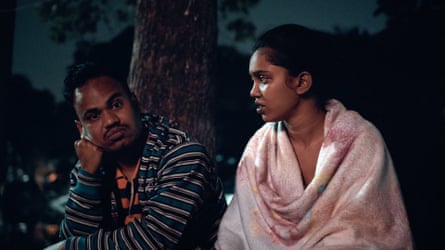
Srina Khatun – known in the community as Bilkis – plays the older sister. In life, too, she is resisting going to work in the brothels. She makes money by painstakingly decorating clay idols with tiny plastic jewels. A promised pay rise from the man who supplies them has not materialised. Afsara Khatun plays the younger sister, who largely keeps her own counsel: we do not come to know her well.
This problem dogs Redlight to Limelight. Basu’s film picks up many threads, notes the bare bones of stories, but rarely follows any to a conclusion. This presumably arises from the noble impulse not to let the women be defined by their seemingly universal experiences of sexual and other violence and desertion by husbands that has led them here. But so little information is given about each of the women that they threaten to become an anonymous mass.
It also means that, because the process of Cam On’s own film-making is given almost as much time as the real lives of Boro Goli’s inhabitants, and because the directing and editing largely fall to the men of the group (the women, of course, work at night and run households by day), their presence overwhelms the women’s.
They don’t, however, fare much better. Rabin’s story is appalling. He was the child of a sex worker who was taken in by his father’s father (“because I was a boy”) then kidnapped by his mother when he was 11 (she blindfolded him, so he couldn’t find his way home), but more details are never provided. How does he feel about his mother? How has he (apparently) avoided bitterness and channelled his rage into creativity rather than violence? In a film documenting a world shaped by men’s terrible actions, these are questions worth asking.
Redlight cannot help but be powerful and moving. The despair on every face and marrow-deep hopelessness written in the lines of everybody, bar rare moments of uplift, are a constant unspoken testimony to the extraordinary hardship of the women’s lives. But the lack of voice given to them makes it feel a wasted opportunity, too slight to do them justice.