2 months ago
114
2 months ago
114
‘You get there and the mountain is so big, you have no objective other than survive.” It was summer 1995, Roberto Martínez was 21, he had made one brief appearance for Real Zaragoza and just completed military service while playing regional football back in his home town of Balaguer. A complete unknown, he was heading to Wigan, wherever that was, and didn’t speak a word of English. He was also heading to the Third Division, where whatever they played it wasn’t football, not as he knew it. “There is fear: ‘No,’” he says. “But my attitude was always: ‘Why not?’”.
Martínez now stands in the hallway at the Portuguese federations’s base in Oeiras near Lisbon, arms out in a warm welcome. Trophies sit in cases, the Nations League the latest addition. Only one cup is not there, which is why Martínez is. Seventy-five days until the World Cup starts, he takes Portugal into their final pre-tournament international break with matches against two of the co-hosts, Mexico and the United States. The man whose favourite goal was against Scunthorpe at Springfield Park leads a team who are among the favourites to triumph this summer, willing to dream precisely because he never dreamed any of this.
“When I set out there were no role models, no Spanish players,” Martínez says. “Only Nayim, from Ceuta. England was unknown. It’s the Third Division. You’ve spent your whole life learning you have to look after the ball, then you get there and the first thing they say is: ‘Second ball’. The dressing room culture is so, so different. All you can do is go day by day. You go, learn, understand why things are as they are: the influence of rugby [league], say. And however hard, I never thought: ‘Ufff, this isn’t for me,’ never thought of abandoning. Just live it. The only objective I set was to learn English in two years. The only objective set, and I didn’t meet it!
“If in 95 I had targeted playing in the Premier League, coaching Belgium for seven years, winning the World Cup with Portugal, well, it’s impossible, but ... in 1966, before Portugal’s best World Cup, when Eusébio was top scorer, the coach Otto Glória was asked: ‘Can you win it?’ He said: ‘Let us dream,’ and I think that’s lovely. Why not embrace the expectation now? Build hope? Why not take on that responsibility; if people think this team can go a long way, go along with it.” It is what Martínez did, bringing him here via Wigan, Motherwell, Walsall, Swansea, Chester, Liverpool and Brussels. Now he leads one of the game’s all-time greats in Cristiano Ronaldo and some of the best players on the planet.
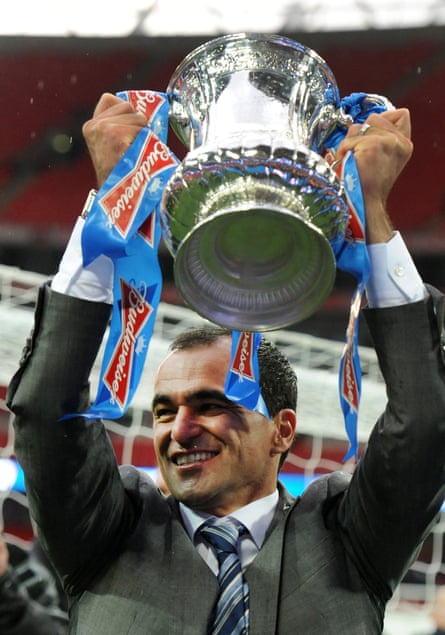
In 1995 he arrived in Wigan with two other Spaniards, inevitably dubbed the Three Amigos. Together they won the Third Division and the Football League Trophy. Isidro Díaz lives in Castro Urdiales, Cantabria; Jesús Seba is still here, working as Martínez’s assistant. In 1999, Wigan went to Wembley. Fourteen years later he took them back to win the FA Cup as head coach, another objective he never set.
Yet if coaching was something else Martínez didn’t plan, there had always been something there: an admirer of Johan Cruyff, John Toshack’s Real Madrid, Arrigo Sacchi’s Milan. Martínez says he was “always someone who asks why, thinks about processes” and recalls “conversations with my dad at seven, eight years old: ‘Why does that space appear?’” His second career started at Swansea and the “culture shock” was for his players this time, but it worked. After six years with Belgium, ranked the world’s No 1 team for much of that time, he took over Portugal in January 2023.
Here he has found a place, the enthusiasm apparent as he plays host, strolling from the offices to the pitches, down the back stairs and out into the rain. “Portugal is a football school,” Martínez says. “Ten million people and yet they fill the world’s best dressing rooms. It’s a country of navigation too. Ready to go, learn languages: open, looking to Europe. There’s a willingness to leave to complete their development, which helps them to be ultra-competitive but respectful, while the structure means that from 15-23 there are eight players per position following the same, elite methodology. Pedro Neto, Vitinha, João Neves, and Renato Veiga have all reached the XI since we came: that level of development is exemplary.”
The process Martínez put in place was worked backwards from the date of the World Cup’s opening game that, for Portugal, is mercifully late, affording them a little extra time. This week the penultimate phase begins, like all of it carefully planned: the decision to play the United States and Mexico at altitude and in a closed stadium is deliberate, a test run for the summer. But at heart there is something more basic.
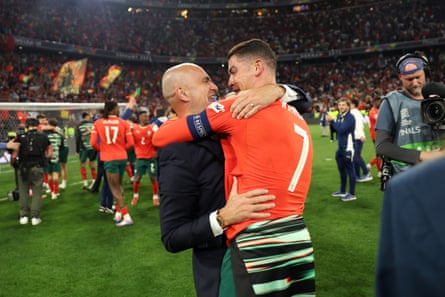
“When I announced my first Belgium squad, I got this very, very strange feeling that I was reading a lot of names of people I didn’t know, so when I joined Portugal I went to visit them all: 32 players,” Martínez explains. “I asked why they were in the national team. How do we get into football? Who are our heroes? Mine was my dad, following the 78 and 82 World Cups. There’s always some figure there that explains why they like to kick a ball. I asked who their idols were.”
And how many said Ronaldo? There’s a smile, if not actually a number. Some did, Martínez says, even if he claims he can’t remember who. Nor, he says, does he recall Ronaldo’s answer. “It’s so, so special, unique, to have a player who has given 21 years to the national team,” Martínez says. “Carlos Forbs [the Club Brugge and Portugal midfielder] was born in 2004, when Ronaldo was already in the national team, and when players who grew up watching him see what he gives every day, they follow.
“When I visited Ronaldo, I wanted to know how he felt. Players over 30 start to think that maybe the international break is a moment to breathe, regenerate. But Ronaldo’s attitude is always: ‘I’m here for the national team, whatever you need.’” A hamstring strain means Ronaldo is not involved in Portugal’s upcoming friendlies but Martínez is confident the captain’s injury is of little concern, a two-week pause before he is playing again.
Martínez inherited the squad at a time when there was an opportunity to begin a new era by asking Ronaldo to step aside. “No, no,” Martínez says in disagreement. He also thinks people miss the point when they see Ronaldo’s pursuit of 1,000 career goals as his primary motivation, a product more of the endless noise around him.
“We have to accept there’s a debate because there’s only one Ronaldo, a historic icon who changed football: get in a lift and the conversation is the weather or Ronaldo,” Martínez says. “Everyone has an opinion but it’s based on a perception of Ronaldo, a period of him. The biggest error people make is not analysing him today. After the Euros it was: ‘Portugal didn’t win because Cristiano’s playing.’ We win the Nations League and it’s: ‘What will Portugal do when Ronaldo retires?’
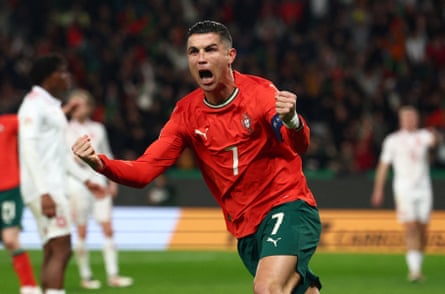
“I always thought it was the body that retires a player, but it’s the head. Cristiano’s head hasn’t taken that decision at 40, 41. An elite player is not the talent, it’s the mentality, the resilience. He’s not the Manchester United or Real Madrid winger; he’s a No 9 in the area. We depend on him to open spaces, score goals. Cristiano’s last three years in the national team were earned, day-by-day: he’s scored 25 in 30 games. I evaluate talent, experience, attitude today, and decisions are never taken in an office; they’re taken on a pitch, football takes them.”
Martínez says what awaits in June is “the only part I don’t enjoy: there are players who haven’t done anything to warrant being left out of the World Cup, but you leave them out”. How do you tell them? “Honestly,” he says. “And it’s worth reflecting on. The usual thing is to have a long list – 30, say – in case of injuries. Then you cut three or four, one per line. But the experience of doing that was so traumatic that I turned it around. That was another thing I learned. I’ll choose a list of 26 and four others who know they are on standby [but not publicly]. That way if there is news, it’s good news”. Martínez prefers to call it “26 and 1”: Diogo Jota, he says, is “the light whose example is always with us”. The late Liverpool forward had told the coach he would give everything in pursuit of the dream they now pursue for him too.
‘Then we’ll set up in Miami, giving us 15 days to acclimatise for the third game against Colombia,” Martínez adds. “There are some climatic things that are very aggressive: humidity, storms, interruptions. So we’re preparing for that. But we go into an unknown space; 48 teams, a tournament that’s so long. A player who wins the Champions League goes to a hotel, wins, and is home the next day; to win with the national team we ask for 50 days without seeing the family. No scientific study would deny a human is changed by that.
“This is my third World Cup and when you analyse it, the team that arrives in the best shape tends not to win. A winning team is made. It’s not like it once was when [just] having more talent meant you won it. You need to manage difficult moments, which doesn’t necessarily mean losing. Often you analyse a game and no one played badly. But maybe they played easy: the error can be not taking the risk, taking responsibility. You have to create an atmosphere where players can, even though they know a single mistake can mark them for the rest of their careers. The group is there to protect everyone in it, protect the error, the risk. A risk can decide a World Cup with very good teams: Argentina, Brazil, Germany, Spain, France, England ...
“You can’t create a space where you hear: ‘You have to win.’ Win, sure, but how? You have to create a habit, a culture, clarity in the players’ roles. Winning the Nations League was very good for us: the structure, the processes, winning a final against Spain, the world’s No 1, the European champions. I wouldn’t say there’s an anxiety in Portugal to win the World Cup; I would say it’s excitement, hope. That comes with these players. We’re talking about Cristiano Ronaldo. The Manchester United captain [Bruno Fernandes]. The Porto captain [Diogo Costa]. The Man[chester] City captain [Bernardo Silva]. Four important players at the European champions [Paris Saint-Germain]. That makes the Portuguese people feel good.
“We know we’ve never won the World Cup; that tells us it’s hard. We know things can change fast, that talent alone is not enough, that small details can go against you, and of course it’s a hammer blow when you don’t succeed, but let us dream. I think we can. And that’s the attitude I want our team to have. I’m not superstitious but I do like numerology. And that’s with me being born on 13 July.”
A Friday? Martínez laughs. “In England they always said: ‘Wow, bad luck!’ ‘What a day.’ No! I like it. And it’s lovely to think of the 2016 Euros … Eusébio: top scorer in 66, Ballon d’Or winner in 65 … 60 years since his World Cup. 2026. It’s all sixes. Let’s dream. Why not?”