3 months ago
121
3 months ago
121
Billed as the official home town of Santa Claus, or joulupukki as he is known in Finland, the city of Rovaniemi offers every imaginable Father Christmas-related experience – from a visit to his “office” on the Arctic Circle to reindeer sleigh rides. He even has his own branch of the Finnish design house Marimekko.
But this Christmas season, in addition to the hundreds of thousands of tourists from around the world coming in search of Santa, Finnish Lapland’s snow-covered capital is becoming an increasingly popular destination for international military visitors.
In recent weeks, thousands of Nato soldiers have been through Rovaniemi, which also has an airbase, for training exercises at nearby Rovajärvi, western Europe’s largest military exercise area, where they are preparing for a potential attack by Russia. Rovajärvi is about 55 miles from the Russian border.
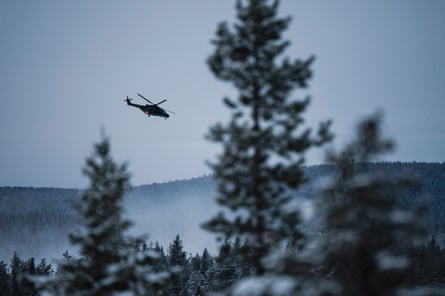
Rovaniemi, meanwhile, is soon expected to become a key base for Finland’s Forward Land Forces (FLF) – the Swedish-led Nato battlegroup intended to act as a deterrent on the eastern border.
The increase in military activity has not gone unnoticed by Rovaniemi’s tourists.
Donna Coyle and her daughter Lyla, holidaymakers from Scotland, were surprised to hear military aircraft while on reindeer safari. “We didn’t know anything about it,” said Donna.
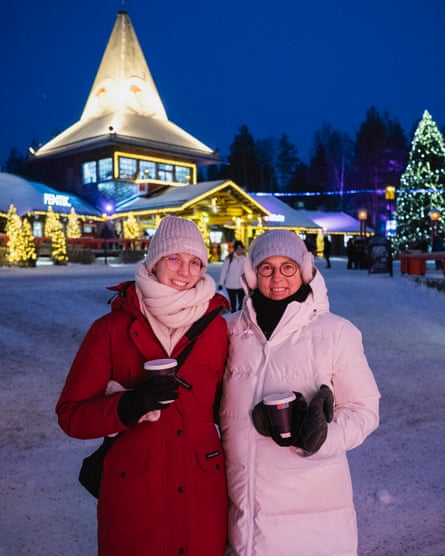
Hannah Schlicker, from Stuttgart, Germany, said it was impossible to get away from the reality of Europe at war – even in Santa’s home town.
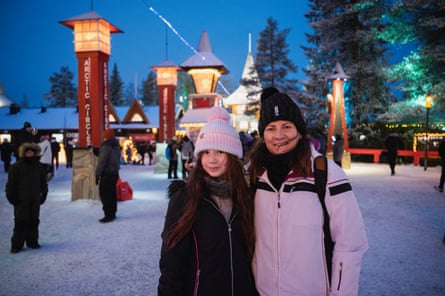
“This morning we took a reindeer tour and we just saw military planes going around,” she said. “We felt the presence of reality being here. You cannot hide from it.”
At Santa Park, the “home cavern of Santa Claus”, which is dug into a big mound, it is difficult to ignore the fact that it doubles up as a bomb shelter for the city’s residents.
Hannah said: “It’s actually scary to think about it, how close we actually are [to Russia]. But at the same time the Santa Park is a bunker … maybe it helps a little bit.”
There are growing tensions between Russia and western Europe, and last week Vladimir Putin said he was “ready” for war if Europe starts it amid stalled peace talks with Ukraine. In the event of a Russian invasion, Finland’s almost 900-mile-long border with Russia – 235 miles of which is in Lapland – is thought of as one of the potential routes of attack.
The Finnish military has warned that once the war in Ukraine is over, Russia is preparing to move more troops to the border with Finland, where it is in the process of building up presence and infrastructure to be a “more formidable force”.
Because of its geography and history with its eastern neighbour, Finland has long been prepared for war with Russia. The obligation to participate in national defence is enshrined in its constitution. But joining Nato in 2023 has resulted in considerable changes, including far more international cooperation and the opening of a new north-west Nato command centre in Mikkeli, south-eastern Finland, in October.
Last week, while the amusement park Santa Claus Village was full of excited children – and quite a few adults – flocking to meet Santa under falling snow, a short drive away at Rovajärvi, nearly 1,000 troops from Sweden, Finland and the UK were participating in Lapland Steel 25. The exercise was held immediately after another, Northern Strike 225, which brought more than 2,000 Finnish and Polish soldiers together to train there.
As part of Lapland Steel 25, which the Guardian was given access to, rifle-carrying Finnish conscripts and soldiers and Swedish soldiers manoeuvred tanks, cross-country skis and helicopters through pine forests and knee-deep snow in mock combat with one another.
“We are preparing for the worst,” said a Swedish soldier and tank driver, Alva Stormark, 19. “Because we know there is a war in Europe and we are close to the Russians.”
Joining the Swedish army about a year and a half ago was, she said, a “difficult decision” in light of geopolitical tensions, but she remains committed to the job. “Defending Sweden is one thing that I want to do.”
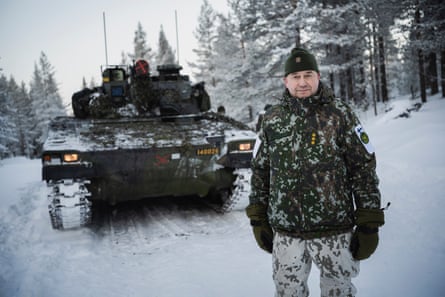
Although Maj Mikko Kuusisto, the chief of training for the Jaeger Brigade, which is Finland’s northernmost unit, said Lapland Steel was not following a “specific scenario”, a map of the exercise showed a big red arrow coming from the north-east in the direction of Russia.
He also noted that while the Arctic Circle “is moving all the time”, depending on how the Earth is moving, there is no doubt that Rovaniemi is the “real” home of Santa. “Where he spends most of the time of the year is here in Rovaniemi.”
after newsletter promotion
More than a quarter of Finland’s border with Russia – which has been closed for two years amid growing tensions – lies in Lapland, a sparsely populated area that is home to just 3% of the country’s population.
Jaeger Brigade’s commander, Col Marko Kivelä, said that because of Lapland’s proximity to Russia and the Kola peninsula, which has the world’s largest concentration of nuclear weapons, the region was of vital strategic importance.
Russia, he said, was “changing their posture” in the Kola peninsula and across the border from Finland with new divisions and a new army corps. “That means they are building up to command and control structure and also the infrastructure so that when war in Ukraine ends, the troops can return to the Finnish border,” he said. “And then they are also able to equip the troops and change their posture so that there would be a more formidable Russian force across our border.”
The motto for Jaeger Brigade, which specialises in Arctic training and ground-based air defence, is pohjoinen pitää – “the north holds”.
Kivelä described the current tensions as a “new cold war”. “It’s a time when we have war in Ukraine, it’s a time when the Arctic is more and more interesting because the ice is melting, there are natural resources that are more readily available,” he said.
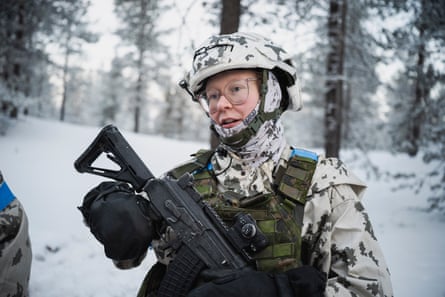
“Russia is now building up its military structure in the Arctic – first of all to protect their strategic capabilities as a nuclear deterrent but also to protect the economic resources which are opening up. So in a way this base building is something that took place in the cold war and now they are doing more or less a bit the same thing.”
As a woman, the Finnish conscript Rebekka Bruun, 23, volunteered to do military service. While long marches can be gruelling – including her equipment, gun and bag, she is often carrying half her bodyweight – she does not regret signing up, despite the increasing threat of war. “I wouldn’t say ‘I wouldn’t change a day’ because I would, but I don’t regret the choice that I joined the army.”
While escalating tensions on the border sometimes cross her mind, she feels prepared for potential war. “We have trained well. So I’m not nervous.”
“Someone has to do it,” said Joona Lahtelin, 20, a fellow conscript standing beside Bruun. “We are mostly here of our own volition anyway, so it’s not that big of a step to join the army for real when wartime comes.”
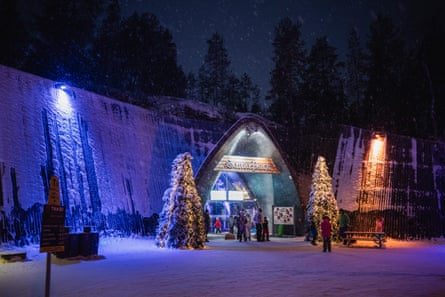
Last week, representatives of the Swedish, Finnish and Norwegian armed forces met in Rovaniemi to discuss plans for the establishment of Finland’s FLF, which the city will act as a base for. The battle groups, said the Swedish army brigadier general and 1st Division commander Michael Carlén, would come from over the Swedish border in Boden, Norrbotten.
FLF Finland will, he said, play an “important component of strengthening the eastern flank” of Nato. “We have a geographical area with very challenging terrain, there are few roads, there is very little infrastructure, it’s a climate that is marked in winter by very severe cold.”
The international training exercises, he said, were aimed at “showing our ability and deterrence”. He added: “Violence is to be avoided with Russia by demonstrating our ability.”
In a joint statement released last week [1 December], the Finnish and Swedish prime ministers, Petteri Orpo and Ulf Kristersson, said they planned to “deepen bilateral cooperation” – including across defence and civil preparedness.