3 months ago
166
3 months ago
166
It is 19 years since Alice Coltrane’s death and more than half a century since her best known albums, yet only now is her first biography, Andy Beta’s Cosmic Music, being published. The first major exhibition dedicated to her took place last year in LA, too, and she’s championed by musicians from mainstream to left field, to the point there’s now even an abundance of cosmic jazz harpists on festival lineups. “For so long it seemed like her contributions were overlooked,” says her grandnephew Steven Ellison, AKA the psychedelic electronic and hip-hop musician Flying Lotus, who’s worked with the likes of Kendrick Lamar, Snoop Dogg, Thom Yorke and Herbie Hancock alongside his own acclaimed solo material. “As I was growing up, it seemed like everyone just wanted to ask her about John Coltrane.”
Of course John Coltrane was a musical titan. But, as Cosmic Music spells out, Alice was integral to the radicalism of her husband’s late, gamechanging period from the masterpiece A Love Supreme onwards. Not only did they create a sense of stability from 1963 in raising a family and marrying, post his quitting heroin, but they were partners in spiritual and musical exploration. She was a formidable musician before she met him, too. As pianist Alice McLeod, she was “known as a badass on the scene”, says Carlos Niño, longtime California “beat scene” colleague of Flying Lotus and, lately, producer of André 3000’s avowedly Alice-inspired New Blue Sun album; her skills honed in Detroit’s gospel churches and playing Stravinsky and Rachmaninov for pleasure by her mid-teens.
After her husband’s death at 40 in 1967, her solo work expanded in all directions, further incorporating global instrumentation and Hindu meditational discipline but also bringing lavish orchestral arrangement and her newly adopted tool, the harp, into a vastly ambitious and immersive sound world. “With Alice Coltrane,” explains the Welsh harpist Amanda Whiting, “the music, the chords, it just isn’t moving around so much, and there’s much more room for layers, it creates soundscapes. The harp is used, in operas or films or whatever, for moments of liminality – the point between waking and sleeping, living and dying, passages of time – and she made the most of that association.” Or, as the American composer Adrian Younge says: “Alice Coltrane took the harp, an instrument of angels and orchestras, and made it sound like the cosmos breathing.”
Commentators, though, from Amiri Baraka to Robert Christgau, were dismissive of her, often in terms of her diluting the supposed purity of John’s noble vision. Phrases such as “soft-headed and incoherent rambling” (Richard Cook’s Jazz Encyclopedia) are absolutely rife in contemporary assessments, the gendered assumptions about softness and prettiness not even concealed. The (practically entirely male) critical establishment simply didn’t allow her into the canon in the way they did John’s peers such as Yusef Lateef and Pharoah Sanders. When, at the end of the 70s, she detached herself from the music industry to focus entirely on her Shanti Anantam ashram, thereafter recording only for cassettes circulated within this spiritual community (later released on David Byrne’s Luaka Bop label), she seemed destined to be a footnote, her influence within jazz remaining almost entirely in the more spiritual, devotional or new age-adjacent margins.
For a long time, her most visible champions were outside that world entirely. The Grateful Dead’s Jerry Garcia covered her and Carlos Santana – then one of the world’s biggest rock stars – recorded an album with her. Bands such as Sonic Youth absorbed her experimentalism and Jonny Greenwood has spoken of lifting specific recording techniques and string arrangements for Amnesiac-era Radiohead tracks. By the 2000s, she was getting namechecks on tracks as diverse as Paul Weller’s dreamy Song for Alice and the doom-drone of Sunn O)))’s Alice.
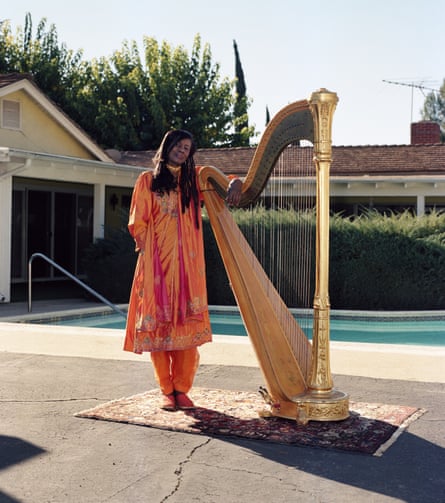
Niño considers it entirely natural she might appeal to rock stars and freaks. “Because she was so beyond genre or style or anything,” he says, “if I try to think who was that bold, who expressed and emoted like that and talked like that, she’s more like a Jimi Hendrix – in the sense that you couldn’t encapsulate her as one thing any more than you could encapsulate Jimi Hendrix as the blues.”
Herbie Hancock was one notable champion in jazz, and took her sonic ambition into funk, electro and beyond. Her records got absorbed into DJ culture, reaching hip-hop – she was even sampled by Cypress Hill – trip-hop and broken beat. Drum’n’bass artist Adam F positively crackles with enthusiasm about her “emotional and spiritual force … The way she blended jazz, devotion and total experimentation echoes through so many generations of musicians.”
XL Recordings svengali Richard Russell even credits her pivotal Journey to Satchidananda album with rewiring his life – and therefore the label – as he was hitting his early 30s, reeling from a decade of rave, excess and travelling the world with his friends and charges the Prodigy. “It had a huge impact on me at that time of personal change when a different outlook was dawning on me,” he says. “That album is a proper mind expander, it’s a reset tool. It can help reprogram thinking.”
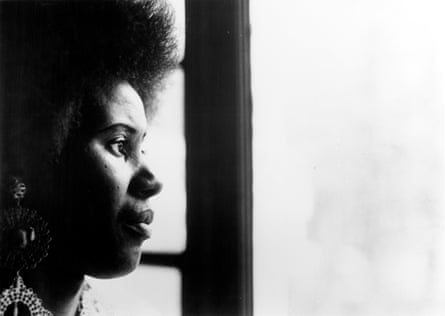
By the time the new generation of 21st-century UK jazz musicians were learning their craft, Coltrane’s music had a kind of underground ubiquity that fed back into the academy. Sheila Maurice-Gray, the founder of Afrobeat-jazz ensemble Kokoroko, thought it completely normal as a turn-of-the-millennium teenager in the Kinetika Bloco youth programme to be learning Blue Nile and Journey to Satchidananda – though she does also remember it as “very, very spiritual, and also there’s an accessibility that, as I heard it, is to do with leaning into her feminine energy; a kind of comfort you won’t find from other musicians of her generation”.
Even in her ashram, Coltrane was sending out waves through pop culture – through people such as her nephew and Niño who explicitly signed up to her cosmic mission, but also in rather more oblique ways. Asked for a comment on her influence, the ever gnomic David Byrne just says: “Influence on a younger generation? Check out the cover of the Luaka Bop record. Can you spot the very young Doja Cat?” Yes, the pop star did live in the Santa Monica mountains commune from ages eight to 12 – and while very ambivalent about the ascetic environment itself, has credited the minimalist, hymnal music Coltrane was then making with influencing her performance and persona.
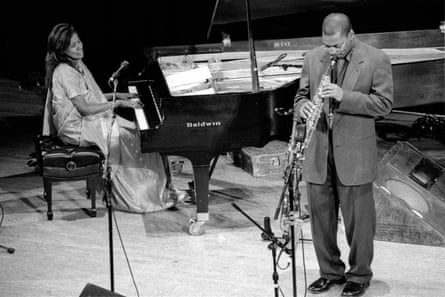
It’s not hard to see why a surge in interest in Alice Coltrane might be happening now in a time of chaos. Sonic Youth’s Thurston Moore says the expressions of “love overcoming greed through the power of art … have become more essential today more than ever, to a culture seeking spiritual truths while so many world leaders ravage our planet”. The DJ, writer and broadcaster Zakia Sewell sees in the music of Coltrane-indebted modern artists such as Khruangbin and Alabaster DePlume something that “speaks to people’s appetite in a time of crisis for stuff that goes beyond pop structures, but that isn’t just comforting but is soaring, expansive, sprawling”.
That sense of vast scope and radicalism is really the thing: the part that makes Coltrane’s music stick, after the dreamy atmospheres have lured you in. Even at its most meditative and minimalist, it is never washed out. Even her purest Hindu devotional chants still have deep, audible echoes of those Detroit churches, of the blues and, more distantly, of “being a badass on the scene” in smoke-filled bebop clubs and of wild free jazz improvisation.
Her new biography charts a life of struggle – to be heard and understood, to stand out even in the company of giants – as much as achievement and transcendence. But the ever-spreading ripples from her work have been as fascinating and varied as her life story, and are only getting more so. Or, as Steven Ellison sums up: “It’s been such an interesting and beautiful thing to see the new generation fall in love with Alice Coltrane.”
Cosmic Music, published by White Rabbit, is out now.