1 month ago
79
1 month ago
79
There was a mix of anticipation and trepidation in Penzance among the passengers waiting on to board Scillonian III.
Some were looking forward to an adventurous voyage on the ferry to the Isles of Scilly, which lie 30 miles off the Cornish coast; others were not quite so keen, knowing that when there is an Atlantic swell, the Scillionian can toss and turn, a tendency that has earned it the unflattering name the “vomit comet”.
This season is the final one for Scillonian III after almost 50 years linking the UK mainland with the archipelago.
“She’s been a brilliant ship,” said Scillonian III superfan Sholto Blackwell, 43, who has regularly sailed on the boat since he was taken to Scilly on holidays as a small boy. “She’s been a constant in my life. She almost feels like part of the family.”
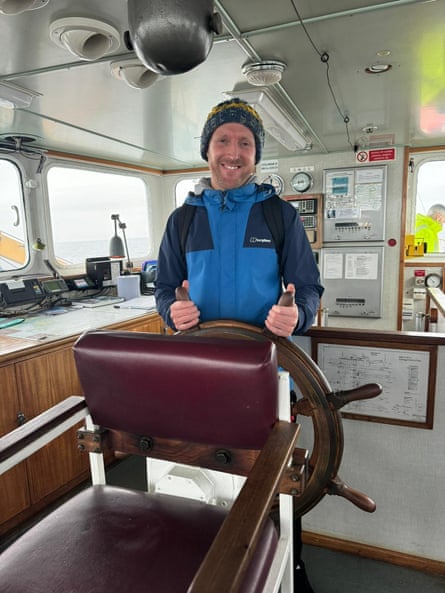
So, presumably, he does not get sea-sick? “My dad was a merchant navy seaman and so we sort of had the sea in our blood, but actually I do suffer in bad weather. The Scillonian does pitch and roll a bit.”
It does not put him off – the challenge of surviving the trip is part of the draw for many. “I’d rather be sea-sick on that vessel than not be on her at all. People look at me funny when I say that but she is my happy place. For me, being sick is all part of the package, really.”
Blackwell, a crane operator and lifting supervisor who lives near Bristol, is so besotted with the vessel that he set up the Scilly III Appreciation Group, which has more than 4,000 members. “There’s clearly a lot of people who feel as romantic about Scillonian III as I do.”
Among the voyagers this week were the Lassington Oak Morris Men from Gloucestershire, heading for Scilly to perform on the islands as part of their 50th anniversary celebrations. They danced on the Penzance quayside before boarding. One of their number, Vernon Webb, admitted he was feeling apprehensive. “I’m not a great sailor,” he said.
As well as being a favourite with visitors, the ship has many fans among Scilly residents, many of whom have a favourite seat. They know that when the going gets rough, one of the best places is the windowless lower saloon, where you can drift off to the sound of the engines.
Scillonian III was launched in May 1977 having been built at Appledore in north Devon. It has carried more than 5 million passengers, supporting tourism, the economy and the social fabric of the islands.
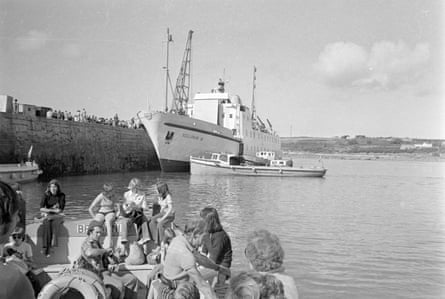
The 2026 season runs until November, and next March, Scillonian IV will take over. Currently being fitted out at a shipyard in Vietnam, it will carry more passengers, be swifter and feature “roll and pitch reduction systems” to counteract the impact of the swells.
The last voyages of Scilllonian III are bittersweet affairs for past and present crew members.
Former shipmaster Pete Crawford, who retired after 39 seasons onboard, cited the wildlife he has seen over the years as some of his best memories. “We’d see something every day. I’ve seen humpback whales breeching off Land’s End, a pod of orcas. Once a fishing boat called to let us know about a super pod of hundreds of dolphins in a feeding frenzy, so we went three miles off course to take the passengers to see that.”
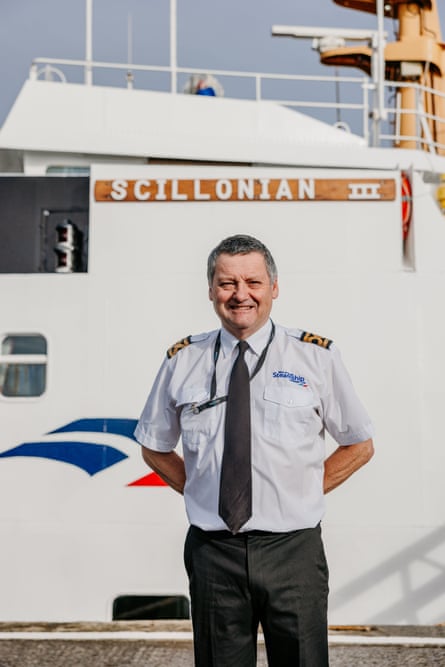
The current master, Dave Redgrave, who has been with the Isles of Scilly steamship group for 17 seasons, said they didn’t build ships like III now. “There’s lots of curves in it. Nowadays everything’s square. It’s a unique ship for a unique run. The passengers love it.”
He accepts the boat does roll. “The ship has a reputation and it can be a little bit bumpy.” He explained this was because the draft – the depth of the vessel below the waterline – was shallow. “That’ll make it bob around a bit.” But he said they had many days in the summer when the sea was flat and the trip was smooth.
Second engineer Steve George, who has worked on the ship for 39 years, working on everything from the engines to the ovens and toilets, said visitors loved to stop and chat to him about the vessel.
But even he can get a little sea sick. “When I first started, I was ill day after day after day and I used to think, is this for me? Over time you obviously, you do get used to it but even now occasionally I’ll feel a bit, not actually sick, but think: ‘I’ll be glad to get there today.’ When you get a lovely day there’s no better place and the islands are like a mini Caribbean – apart from the sea being a bit colder.”