3 months ago
154
3 months ago
154
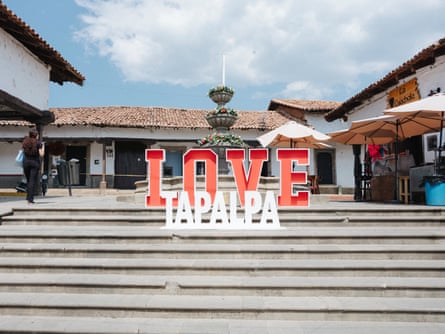
Two days before one of the world’s most powerful drug lords was killed while trying to flee a chalet in the hills outside Mexico’s second biggest city, the Tapalpa Country Club posted an advert on Instagram inviting lovers to visit a place where they could “inhale peace [and] exhale stress”.
“Date idea: Escape to Tapalpa,” read the message, advertising romantic private cabins, picnics with spectacular lake views and a golf course “to have fun together”.
The Mexican cartel boss known as “El Mencho” – who local people say was a regular visitor to this picturesque tourist hub of pine forests and cobbled streets in Jalisco state – appears to have liked the idea.
For it was here that the drug lord’s reign came to a dramatic end on Sunday morning after Mexican special forces – reportedly with the help of CIA intelligence and a US Predator drone – tracked him to a lodge in the gated community where he had been holed up with a girlfriend.
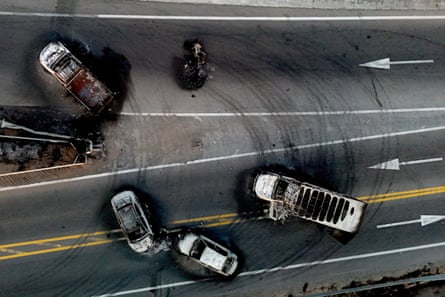
A restaurateur who works nearby recalled seeing four truck-loads of cartel fighters racing to the scene at about 8am on Sunday, after helicopter-borne army troops launched their surprise attack about an hour earlier.
“They were going into battle,” the food seller said, describing a ferocious five-hour shootout.
Videos posted on social media captured the ferocity of the conflict. “You could hear these booms. There was an explosion – I don’t know whether it was a car exploding or a bomb,” the restaurateur said.
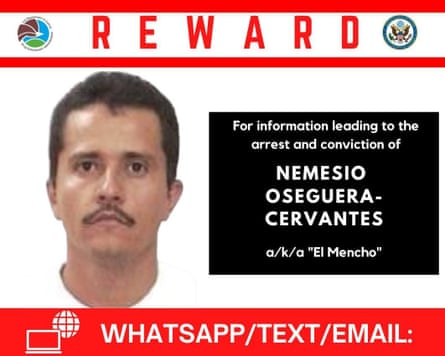
As El Mencho, whose real name was Nemesio Rubén Oseguera Cervantes, and two bodyguards fled into the woodland around his bucolic hideout, cartel members took to the streets to raise hell.
Two convenience stores at Tapalpa’s entrance were torched. El Mencho’s minions used excavators to carve metre-wide trenches out of the winding roads leading to their boss’s safe house. Felled trees, cars and lorries were doused in petrol and set alight.
“It was insane,” said one black-clad special forces police operative in Tapalpa, one of thousands sent to the region to control the chaos that rapidly spread across Mexico.
Cartel attacks were reported in at least 20 of the country’s 32 states. Jalisco’s capital, Guadalajara, and its top beach destination, Puerto Vallarta, were brought to a standstill, stranding tourists and leaving local people cowering at home. More than 60 people were killed.
But if the havoc was designed to distract security forces and help El Mencho escape, the strategy failed. On Sunday afternoon, as the gunfire faded, Mexico’s defence ministry announced that the 59-year-old leader of the Jalisco New Generation cartel (CJNG) had died in a helicopter on the way to hospital after being wounded in the firefight.
“We’ve … taken down one of the most sinister cartel kingpins of all,” Donald Trump boasted on Tuesday, claiming credit for the audacious Mexican military operation to capture their country’s most wanted man.
Four days after El Mencho’s killing, the Guardian’s reporters travelled by road to the shell-shocked narcoland tourist town where Mexico’s most feared drug boss made his last stand.
Postcards in now empty tourist shops celebrate the rural charms of a region that has also become a playground for narco bosses, whose drug labs and training camps are located in the surrounding sierras.
“Tapalpa is tranquillity,” reads one. But driving south from Guadalajara, through cartel-owned fields of agave, blueberries and avocado, the mood was tense and the landscape spoke to a day of terror and a brutal, years-long conflict fuelled by the US’s insatiable appetite for made-in-Mexico drugs such as methamphetamine and fentanyl.
In Techaluta de Montenegro, a quaint dragon fruit farming village at the foot of the mountain where El Mencho was killed, the supermarket had been firebombed, its carbonised facade contrasting with the cyan blue sky. Further ahead, a young man wearing a cap and blue jeans loitered at a deserted intersection monitoring the few motorists brave enough to make the ascent towards the scene of the narco boss’s death.
The 30-mile stretch up into Tapalpa was strewn with reminders of Sunday’s violence. A bullet-riddled police station. The charred remains of cars and trucks. The still smouldering carcass of a supermarket surrounded by red police tape carrying the word “Danger”.
A few miles past that redundant warning, more cartel lookouts appeared. First, in a white pickup truck which followed the unwanted visitors towards the centre of town. Then, a three-vehicle convoy led by a brawny masked motorcyclist wearing a dark grey tactical vest. Outside the deserted 17th-century St Anthony of Padua temple at Tapalpa’s historical heart, yet another narco scout appeared, this time surreptitiously photographing the outsiders. There was not a single member of the police or army to be seen.
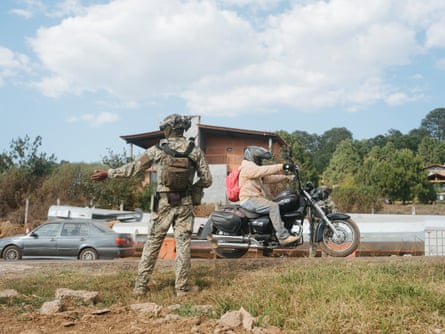
With cartel lookouts everywhere, local people spoke in hushed tones about what they called “el evento” – the event – and the downfall of a man respectfully known as El Señor Mencho (“Mr Mencho”).
One church official said two local Catholics were injured after being caught in the crossfire while out training for an annual pilgrimage.
A woman who introduced herself as a manager at the Tapalpa Country Club recalled receiving orders to abandon the upmarket property at about 7am on Sunday as the operation began. She did not say from which authority those orders came. Only on Tuesday morning were staff allowed to return.
In the intervening period, a group of Mexican journalists sneaked into the unguarded compound, discovering what they claimed was one of El Mencho’s abodes. Inside, they found a stash of medicine to manage the kidney disease El Mencho had long been reported to suffer and a handwritten summary of Psalm 91, a sacred text popular among Latin America drug traffickers whose lives hang constantly by a thread. “A thousand may fall dead beside you, ten thousand all around you, but you will not be harmed,” it read.
At La Loma, a nearby cluster of chalets, police located another of El Mencho’s sanctuaries, where his heavily armed security detail reputedly stayed when he was in town. In one room the stuffed heads of three animals – a zebra, a gazelle and a deer – were reportedly displayed on a wall. The approach road was scattered with bullet casings and partially blocked by two burned-out cars, perhaps those the restaurateur had seen speeding towards the area as traffickers tried to rescue their chief. The only soul to be seen at the entrance was a gardener watering his employer’s sun-scorched plants.
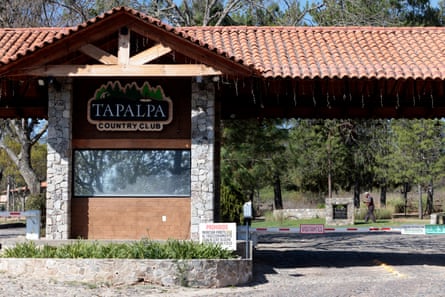
Incredibly, neither address – two of the most important crime scenes in recent Mexican history – was guarded by security forces.
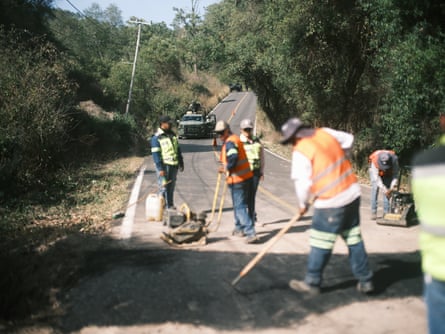
Government troops seemed to have other priorities on Wednesday afternoon, as they provided security to construction workers tasked with clearing and rebuilding the roads linking Tapalpa to the outside world.
On one back road, police special forces and army soldiers carrying assault rifles and machine guns had taken up position around a trench El Mencho’s underlings had dug to stop reinforcements arriving during Sunday’s attack.
As road builders poured sticky black asphalt into the fissure, the security forces clutched their weapons, well aware that despite El Mencho’s death, his Jalisco cartel continued to lay down the law here and across swaths of Mexico.
“If anyone thinks Mexican drug traffickers are going to stop operating because of what happened … I think they are delusional,” said John Feeley, a former top US diplomat in Mexico City who first heard El Mencho’s name about 15 years ago at the start of his ultra-violent rise.
While Trump has claimed credit for the criminal’s killing, Feeley was certain he would wash his hands of responsibility if – as some fear – the drug lord’s demise sparked a deadly inter- or intra-cartel war in Mexico. “The deaths will be in Michoacán, they’ll be in Jalisco, they will be in Guerrero,” he said, citing three of Mexico’s most notoriously violent states. “And [Trump] will simply say something along the lines of, ‘See, I told you that place is run by the narcotics traffickers’.”
As the troops prepared to retreat from Tapalpa before nightfall, a forest fire that local people said was sparked by Sunday’s gunbattle continued to consume the woodland where El Mencho’s life ended.
The restaurateur expressed hope the town’s newfound fame as the death place of Mexico’s most feared man would not put off tourists.
“We invite them to come, taking precautions of course,” he said, before adding: “Here in the centre of town, nothing happened at all.”