2 months ago
110
2 months ago
110
Starmer says he accepts 'with good grace' that he is not best person to lead Labour into next election
Starmer says he accepts the decision he has to go with good grace.
The question being asked now is not who was best placed to change the Labour party, to take us into power and to begin the vital work of improving lives for millions of people. Those questions have been answered.
The question my party is asking now is whether I am best placed to lead us into the next general election.
I have heard the answer of my parliamentary party to that question, and I accept that answer with good grace.
Every decision I’ve taken has been about putting the country I love first. That is why I will resign as leader of the Labour party.
I have spoken to His Majesty the King this morning to inform him of my decision.
Key events
Australian PM Anthony Albanese pays tribute to Starmer saying he can be 'proud' of his contribution to UK
Anthony Albanese, the Australian PM, has issued this statement about Keir Starmer’s resignation. He said:
I consider Keir Starmer a friend and I’m thinking of him on what must be a very tough day.
Serving in public life is a tremendous privilege but politics can also be a harsh business.
When the time comes for Keir to leave Downing Street, he can be proud of the contribution he has made to the country he loves and to the Labour party that he led back to government in 2024.
I’m grateful for the opportunities we had to work together to strengthen our Aukus defence and security partnership, support the brave people of Ukraine and keep children safe from the damage that social media can do.
I wish Keir, Victoria and their children well with everything the future holds.
Zack Polanski says Burnham's recent policy talk 'not encouraging', and that as PM he 'must be bold'

Peter Walker
Peter Walker is a senior Guardian political correspondent.
Zack Polanski, the leader of the Greens in England and Wales, has said that Starmer’s departure should be the moment for “a bold change of direction” for the nation.
He said:
We are still waiting to see which version of Andy Burnham might going to show up in Downing Street. While he has talked about a change of course, the early indications are not encouraging and suggest more of the same with better communication skills.
The time for half measures and sticking plasters is long gone - if he becomes the next PM, Burnham must be bold or he will be bust.
Jessica Elgot points out that, if Andy Burnham does become PM around 17 July (see 10.04am), Keir Starmer will attend the Nato summit – but Burnham would be in post for the UK-EU summit.
Two very big dates around this period:
- 7th July is Nato summit which Starmer looks likely to attend - and by which we need the Defence Investment Plan
- 22 July is the EU reset summit in Brussels. Will this be PM Andy Burnham?
Farage calls for general election

Ben Quinn
Ben Quinn is a Guardian political correspondent.
The Conservatives may not be arguing that having a new PM requires an election (see 7.52am) but Nigel Farage has called for an election. He claims that it is “ridiculous to pretend that Andy Burnham has any kind of meaningful mandate to lead the country.”
The Reform UK leader, who is himself licking his wounds after his party was beaten in last week’s Makerfield by-election, referred to that result in an “essay to Britain” in which he said that Burnham now presumed to be prime minister “based on less than 25,000 votes”.
“I’m not frightened of Andy Burnham or any of the other Labour Party stooges,” wrote Faragm who claimed that the “uniparty” of Labour and Conservatives were frightened of Reform. He added:
That’s why they band together at every byelection to attempt to block us from victory, why they tried to cancel the local elections and why they’ll try their very hardest to hold off on a general election for as long as possible.
Andy Burnham has good reason to be afraid of us. Reform is the only party that listens to the desires of working people and offers them solutions, rather than flattery and patronisation.
How Burnham could become PM around 17 July

Jessica Elgot
Jessica Elgot is the Guardian’s deputy political editor.
If there are no challengers then you can expect Andy Burnham to be prime minister on or around 17 July.
Keir Starmer said that Labour’s governing body - the national executive committee - will open nominations on 9 July and that the process will be concluded by the summer recess which is expected on 16 July.
Two members of NEC confirm to the Guardian that Burnham can be prime minister by the following day - 17 July - though it could be the following Monday when parliament is in recess.
If there is a contest, all bets are off - but Starmer said he expects that to conclude by September.
Here is video of Keir Starmer announcing his resignation.
What Starmer said about his achievements as PM
In his speech, just before he got to the passage where he announced his resignation, Keir Starmer talked about his achievements in government. Here is that passage.
And look at what we’ve achieved in just two years.
An economy that is stronger, going faster than our peers, wages rising faster than inflation in every single month since we came to power.
Investment secured, infrastructure being built, an end to austerity with the fastest fall in NHS waiting lists for 17 years, the biggest improvement in rights for workers and renters in a generation.
The biggest uplift in defence spending since the cold war.
Small boat crossings falling, asylum hotels closing, protecting young people from social media and half a million children being lifted out of poverty because of the choices that I made.
Our reputation in the world restored, with Britain once again standing up for decency, respect and the rule of law, securing trade deals, standing with Ukraine, standing up for our values and rebuilding our relationship with our allies in Europe.
Change promised by a Labour government. Change fought for by a Labour government. Change delivered by a Labour government.
Peter Walker
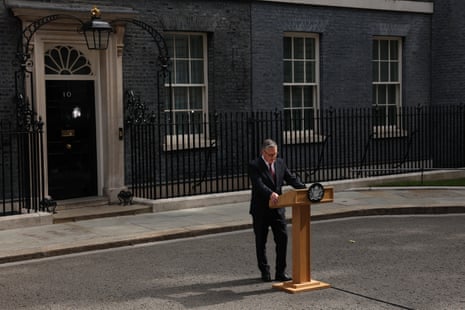
In the end it was rapid and efficient, but nonetheless emotional.
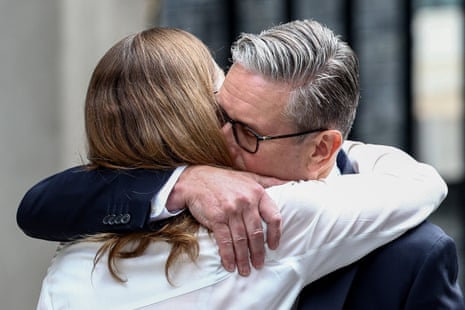
The particular part of Downing Street where I was standing meant I was watching Keir Starmer directly in from of me but I could also see his cabinet and advisers - and his wife, Victoria - behind him. Many, particularly Victoria, were very obviously emotional as the soon-to-depart PM spoke.
The earlier part of the speech, where Starmer set out his achievements in office, was almost drowned out by Ode to Joy blasting from the vast speaker owned by the professional protester Steve Bray just outside the speech.
But suddenly - perhaps a kindly passer-by pulled out a lead - it went quiet. Starmer set out his plans to leave and how, and became emotional himself as he thanked his colleagues, then also Victoria and his two teenage children.
Anyone who has spoken to Starmer in private knows how much he talks about his family, and with such clear pride. They will be a comfort in the most difficult moment of his political career.
Starmer ends speech saying he will leave 'biggest job in country' to spend more time on 'most important job', as dad and husband
The end of Keir Starmer’s speech was particularly moving, and he sounded close to tears at the end.
I will also give my successor my full and unequivocal support, knowing that they will inherit a Britain that is far stronger and fairer than the one I inherited two years ago, better prepared for the challenges ahead and better able to ensure the Labour party secures a second term in office.
I want to thank all of those friends and colleagues who have been at my side for these past six years or so for their incredible commitment, service and support.
I want to thank the brilliant No 10 staff and our country’s extraordinary civil service, who dedicate their lives to public service.
And when I leave the biggest job in the country, I shall spend more time on the most important job, being the best husband I can to my fantastic wife Vic, who has been a rock by my side through good times and bad, and being the best dad I can to my beautiful children who are my pride and my joy.
Thank you very much.
Starmer says new PM to take over mid July if Burnham unopposed, or by end of August if there's election
Starmer sets out the timetable for his departure.
I will ask the national executive committee of the Labour party to set out a timetable, with nominations opening on the 9th of July and completed by the summer recess.
In the case of a contest, this will ensure a new leader is in place before parliament returns in September.
I will remain in post as prime minister until the contest is complete, and I will do everything I can to ensure an orderly handover of power.
The Commons summer recess is due to start on 16 July and so, if Andy Burnham is unopposed (as seems increasingly likely – despite Wes Streeting previously saying he would definitely stand as a candidate), he will become PM in the middle of next month.
If there is a contest, the new PM will be in post by the end of August. The Commons returns after the summer recess on 1 September.
Starmer says he accepts 'with good grace' that he is not best person to lead Labour into next election
Starmer says he accepts the decision he has to go with good grace.
The question being asked now is not who was best placed to change the Labour party, to take us into power and to begin the vital work of improving lives for millions of people. Those questions have been answered.
The question my party is asking now is whether I am best placed to lead us into the next general election.
I have heard the answer of my parliamentary party to that question, and I accept that answer with good grace.
Every decision I’ve taken has been about putting the country I love first. That is why I will resign as leader of the Labour party.
I have spoken to His Majesty the King this morning to inform him of my decision.
Starmer confirms he is resigning
Starmer confirms he is resigning. He has spoken to the king, he says.
Starmer says he proved his critics wrong
Starmer says he proved his critics wrong.
We proved those people wrong because we changed our party, ripping out the poison of antisemitism, restoring trust on the economy, defence and national security, and becoming a party that once again stood proudly with, not against, our national flag.
The hard work of change was with a singular purpose, not power for power’s sake, but to change Britain for the better, to build a fairer country with dignity and respect, where everyone is seen, everyone is valued, wealth and opportunity for all, not just the privileged few.
Starmer says becoming PM two years ago proudest moment of his life
Starmer says walking up this street two years ago was the proudest moment of his life.
A new Labour government, the first in 14 years.
A page in our country’s history turned after years of disappointment and despair, the chance to change the lives of millions of people for the better.
That’s what I came into politics for.
The journey to that point was not easy.
Six years ago, I inherited a Labour party that was politically, financially and morally bankrupt.
I was told time and time again that my party was finished, that we were consigned to history, that a majority at the general election, let alone a landslide majority, was impossible.
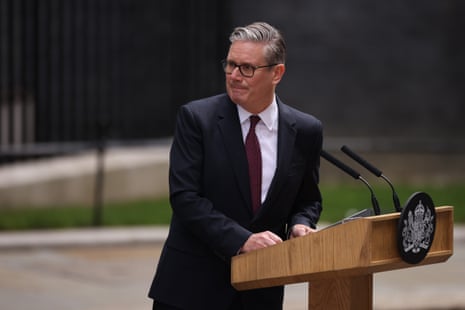
Keir Starmer is coming out.
There is loud applause from his staff and supporters.
He looks miserable.