3 months ago
125
3 months ago
125
Swathes of south-west England were left flooded and cut off as Storm Chandra brought heavy rain and strong winds, prompting calls for more resources to be invested in making the region more resilient in extreme weather.
The storm also caused deep snowfalls in northern Britain and led to travel disruption and the shutting of hundreds of schools across the UK.
The south-west of England, which had already been battered by storms Goretti and Ingrid earlier this month, bore the brunt. The Environment Agency (EA) said more than 30 properties had been flooded, mainly in Devon, Cornwall and Hampshire.
On Tuesday afternoon the EA issued a red flood warning – meaning danger to life – for the Upper Frome River in Dorchester, Dorset, advising that properties could be flooded.
Earlier, a second red warning had been in force in the Devon town of Ottery St Mary, with the River Otter rising to its highest level on record. EA officers had advised people in parts of the town under threat to move family, pets and cars, if safe to do so, and turn off gas, electricity and water.
Devon and Cornwall police urged people not to travel in Exeter and east and mid-Devon unless they urgently needed to. Devon and Somerset fire service rescued people from 25 vehicles stranded in flood water.
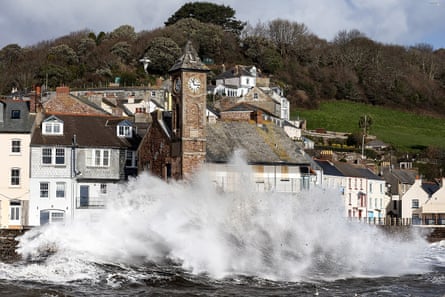
The leader of Devon county council, Julian Brazil, told the Guardian the floods demonstrated how vulnerable the region was. “We feel a bit cut off down here. The south-west feels let down.”
He said a good illustration was the rail network. Services between London and south-west England on Tuesday were cancelled, delayed or involved bus transfers because of flooding on the line between Taunton and Exeter.
“We feel we’re being left behind,” Brazil said. “We’ve seen billions pumped in [to rail services] up north, and that’s about just shaving a few minutes off the times getting to London. What we’d like is to actually be able to get to London on the train at all.”
His complaints echoed those of people in Cornwall this month, many of whom were left without power, water and internet after Storm Goretti.
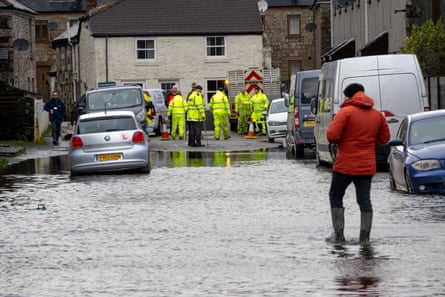
Richard Foord, the MP for Honiton and Sidmouth in Devon, said people were having a “horrendous” time and he predicted the number of properties flooded would increase.
The Devon Wildlife Trust expressed concern for the beavers that live in and around the River Otter. A spokesperson said: “Despite being semi-aquatic mammals, rapidly rising and rapidly moving water is a threat to them, especially young, less experienced animals. Floods will overwhelm their burrows and lodges, the sheer force of the water can be too much for them to swim against and submerged debris represents a threat.”
Residents of the Somerset Levels, a low-lying area very vulnerable to flooding, feared their homes could be at risk again. The Flooding on the Levels Action Group (Flag) claimed the authorities had not funded maintenance of the waterways sufficiently. It also expressed concern that earlier this month, as heavy rain fell, a pumping station that removes water from the area was not operating because of planned electrical works.
Flag’s spokesperson Bryony Sadler said there was concern homes could be flooded. “We’re tentatively starting to move stuff. I’ve rung neighbours this morning to tell them to move animals out,” she said.
Extreme rainfall is becoming more common and more intense in many parts of the world because of human-caused climate breakdown. This is because warmer air can hold more water vapour. Flooding is also affected by human factors such as the existence of flood defences and land use.
The Met Office said 105mm of rain fell on parts of Dartmoor in Devon in 12 hours. The strongest winds recorded were 75mph gusts at St Bees Head in Cumbria and 63mph at Machrihanish on the west coast of Scotland.
By late afternoon on Tuesday there were more than 100 flood warnings in England, meaning flooding was expected, and more than 200 alerts, meaning flooding was possible, with heavy rain falling on already saturated ground. There were six flood warnings and more than 20 alerts in Wales.
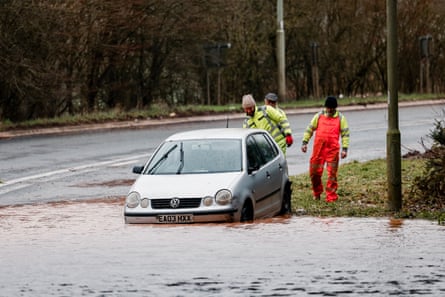
There was significant travel disruption because of rain, wind or snow in northern England and south Wales. In Scotland and Northern Ireland, some flights and ferries were cancelled.
In Devon, one man, Billy Vernon, described how he and his sons, 14 and 17, were trapped by flood water upstairs in a house close to the River Axe and he had to wade through waist-deep water to fetch supplies.
He said water began coming into the house at 4am on Tuesday. “It was frightening. My son came running in panicking saying that the house was filling up with water. All of the furniture is destroyed and the walls are going to have to be redone.”
The rail operator GWR said that after Storm Ingrid at the weekend a large sinkhole had now appeared in Devon and would need to be filled, leading to a closure of the line between Exeter St Davids and Newton Abbott overnight on Wednesday and into Thursday.