3 months ago
187
3 months ago
187
For Alec Priest, an instrument technician at Sullom Voe oil terminal on Shetland, the case for digging tunnels under the narrow stretches of ocean that separate his home from work is clear-cut.
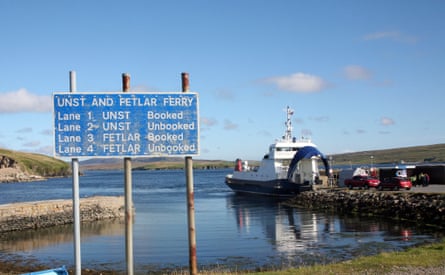
As things stand, two ageing ferries crossing tidal sounds notorious for their powerful currents break up his commute. For a casual tourist, that adds to the mystique. For time-pressed islanders, care workers and businesses, it adds delays, stress and costs.
Those two ferries over Bluemull and Yell Sound convert a 34-mile drive from Priest’s home at Baltasound on Unst, the most northerly of Shetland’s islands, to Sullom Voe on Shetland’s main island, into a 3.5 hour round trip. He works 12-hour shifts at the terminal.

“It’s a colossal waste of time,” he said. “During the winter, if you have any gales, there’s a good chance the ferries will stop. It does make you cautious.”
Cutting tunnels between Yell and Unst and Shetland’s Mainland would shrink that journey dramatically to perhaps 40 minutes each way. Instead, Priest stays in staff hostels at Sullom Voe, so is away from home for weeks at a time. “It’s a shame for my family, but it’s the only option,” he said.
Priest is part of a very energetic campaign by islanders on Yell and Unst to promote tunnels. In 2025 they commissioned and funded geological surveys – and retained advisers steeped in Scandinavian tunnel engineering – in a bid to prove their economic, social and financial value.
The social cost of not having the tunnels is significant, campaigners argue, because it drives depopulation and isolation. Priest’s sister left Yell for Shetland’s Mainland with her family to avoid the insecurity of relying on ferries. School rolls on Yell fluctuate as families arrive and leave again, he said.
They point to the Faroes, to the north of Shetland, where road tunnels connect numerous islands, including the world’s only underground roundabout – the brightly lit Eysturoyartunnilin. Shetlanders also look enviously at Norway, where islands have been linked to the mainland for decades.
Their campaign, backed by their Liberal Democrat MP, Alistair Carmichael, is credited with forcing tunnels and bridges firmly on to the political agenda. Scottish ministers have included fixed links in their strategic transport plan and gave Shetland £10m to investigate connectivity options ranging from ferry replacement, to flights to tunnelling.
A government spokesperson hinted that further commitments could emerge with the publication of an updated infrastructure strategy, alongside the publication of the Scottish budget in January.
“Inter-island connectivity, including funding, has been a focus of discussion at the Orkney and Shetland ferry replacement task forces since early 2023, and we will continue to work in partnership with local authorities,” they said.
Officials in the Western Isles are also pressing their case to complete what they describe as a continuous “spinal link” connecting their sinuous chain of islands, with bridges or tunnels to connect south Harris with north Uist, and south Uist with Barra.
As the crow flies, Leverburgh in south Harris is about five miles from north Uist; getting there by ferry takes up to 80 minutes as it weaves for nine nautical miles (10 statute miles) between a dozen tiny islands to Berneray.
But there are disputes about the merits of cutting tunnels or building longer bridges. Orkney is focusing on replacing its ageing ferry fleet, battling with Scottish ministers reluctant to pay for them given Orkney’s ferries are council-owned and council-run.
Torcuil Crichton, the Labour MP for Na h-Eileanan an Iar (Western Isles) argues that tunnels or new bridges in his constituency are a costly “fantasy solution” that would take too long to deliver. The islands need new ferries now, and far more money invested in social and health services.
“The quickest way to connect the islands is to fund some ferries,” he said. “It’s political energy being expended on a long-term solution when we face a connectivity emergency now.”
Carmichael believes the concept will be immensely appealing; the islands in Shetland connected to Mainland by causeways have no problems with depopulation, he said. “I have always said the most difficult tunnel to be built would be the first one. Once you’ve proven the concept, you won’t have to make the case [for others]. Communities will be banging on your door.”
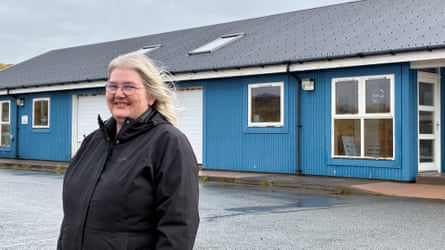
Alice Mathewson, the development manager for North Yell Development council, whose home is on Unst, said tunnels would greatly increase the islands’ resilience. Ferry crews fall sick and ferries break down. She and Priest estimate the two tunnels could cost between £115m and £135m to build; replacing Shetland’s ferries would cost £100m on top of their £7m a year in subsidies.
Tunnels can carry and protect vital internet and electricity connections – its subsea phone lines have been accidentally cut several times recently – and ensure Shetland’s salmon farms can get their produce to market. Islanders would be happy to pay tolls to fund the cost of tunnels and embrace public-private financing, she said.
“The ferry service has served our islands very well but that’s a 20th-century form of transport,” she said. “In the 21st century the answer is: dig a hole. Scotland has to drag itself into the 21st century.”