1 month ago
82
1 month ago
82
Literary fiction
Fiction
Audition
Katie Kitamura
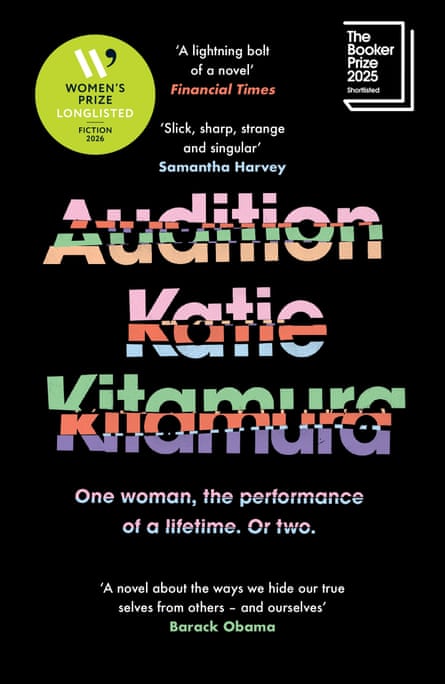
The opening pages of Katie Kitamura’s fifth novel establish a nervy, fraught physicality. The narrator is meeting a man at a restaurant. She is anxious, hyper-vigilant.
Waiting at the table is a young man, Xavier, self-assured and faintly discomfiting. The meeting is edgy and awkward, rendered in a tapestry of small gestures. Initially, we wonder if we are being subjected to the prose equivalent of bad acting: a surfeit of fussy movement, signifying nothing – an impression heightened by the stumbling gait of the narrator’s run-on sentences.
But admirers of Kitamura’s previous novel, Intimacies, will recall the taut discipline of that book’s prose, and trust that, here, the language has been loosened by design. Sure enough, when the churn of movement and syntax is disrupted – appropriately, by the smallest of gestures – a deeper existential dread emerges. Xavier sits back, exhales. The narrator, with a sense of shock, recognises the movement as her own, “lifted from my films, my stage performances, and copied without shame. A piece of me, on the body of a stranger.” Xavier has studied her, she believes, then performed her back to herself.
Audition is a novel of mirrored halves, angled towards an absent centre. In the first, Xavier tells the narrator that he believes himself to be her abandoned son – something she makes clear is impossible. In the second, he is her son, or, at least, he is willingly performing that role. In the first half, the narrator recalls with sadness her affairs, after a miscarriage. In the second, it is her husband who has strayed. It’s not so much a question of which is real; this is a novel about the suspension of disbelief necessary for life to be tolerable at all.
Acutely aware of the very real trauma that attends the loosening of personhood, Audition nonetheless thrills at the freedoms made possible through collapse. The result is a literary performance of true uncanniness: one that, in a very real sense, takes on life. Sam Byers
£8.99 (RRP £9.99) – Purchase at the Guardian bookshop
Fiction
Seascraper
Benjamin Wood
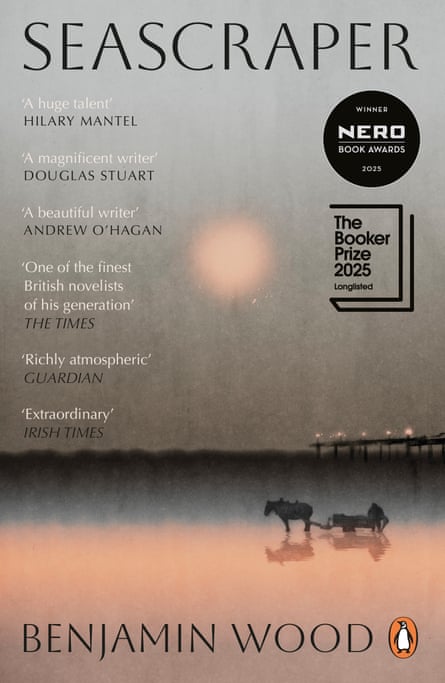
You don’t think you need a novella about a folk-singing shrimp fisher living with his mother on a fictional stretch of isolated coast until you read Benjamin Wood’s Booker-longlisted fifth novel, Seascraper. Wood conjures wonders from this unlikely material in a tale so richly atmospheric you can almost taste the tang of brine and inhale the sea fog.
Seascraper follows the daily trials of Tom Flett, a “shanker” who scrapes the sand for its yield at low tide with his trusty horse and wagon, risking his life in a job that is simultaneously boring and dangerous. Tom is clearly in the Hardyesque tradition of unworldly young men who tend the land or work with their hands (Gabriel Oak, Jude Fawley), and it’s this that alerts us to his vulnerability to charmers and chancers.

When the latest suitor turns out to be a slick American film director named Edgar Acheson, Tom sees his chance of escape. Edgar is scouting locations for a movie adaptation and immediately looks to recruit Tom as his local guide, “a guy who knows the beach, the tides”.
What makes Wood’s writing such a pleasure is his attentiveness to the prosaic details of everyday life. Whether it’s harnessing a horse, cooking a fry-up or tuning a guitar, he transforms the quotidian into the poetic, making the exactitude of each task sing on the page. The book is full of visceral and evocative descriptions of the natural world, “the festering scent of bladderwrack … a strange, spasmodic crunch each time the wheels pass over razor shells and gnarls of driftwood … undulating sand that gives beneath the wheels as readily as butter”. He’s equally adept at creating warm and believable characters whose deep humanity makes you want to spend time in their company. Jude Cook
£8.99 (RRP £9.99) – Purchase at the Guardian bookshop
Fiction
Rejection
Tony Tulathimutte
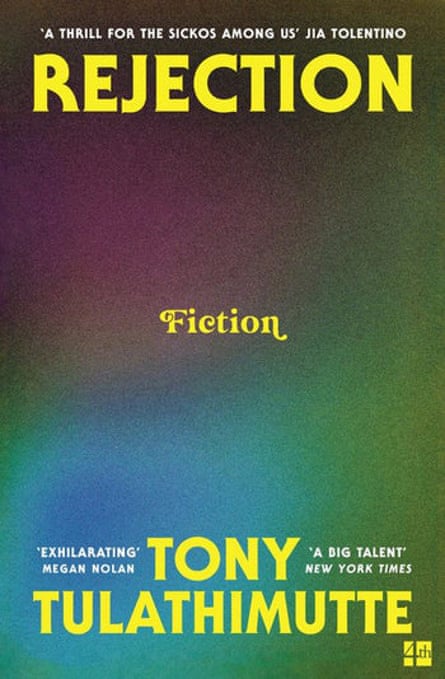
In 2019, the Brooklyn-based literary magazine n+1 published a short story that went viral. Titled The Feminist, it follows the life of a man who turns from a bell hooks-reading Supporter of Women into a bitter moderator in an online forum about how feminism is a cancer. Rejection has hardened him over the years.
Now, half a decade later, The Feminist and six other short stories have been gathered in an interlinked collection. The Feminist now feels like a prescient prequel to our current moment, while Rejection’s other stories take aim at wider subjects, following a range of characters: a woman who self-destructs after being romantically rejected; a man who comes out as gay, but really it’s his sadism he’s reckoning with; a disaffected Twitter addict who refuses all attempts to define them according to race, gender, and sexuality: they want to live beyond identity, that tiresome predominant organising category of our era.
What makes the stories so readable – what made The Feminist such a hit – is Tulathimutte’s magnetic prose, at once entertaining and acute. In fact, Rejection feels like being inside the internet. At times it mimics the language of twentysomething online spaces (of a disappointing man: “we hate him now yes? typical venus in sag”). More broadly, the stories capture the spirit of our doomscrolling age: the paranoia, the dread, the defensiveness and resentment that has curdled into political death spirals everywhere. Rebecca Liu
£8.49 (RRP £9.99) – Purchase at the Guardian bookshop
Fiction
Helm
Sarah Hall
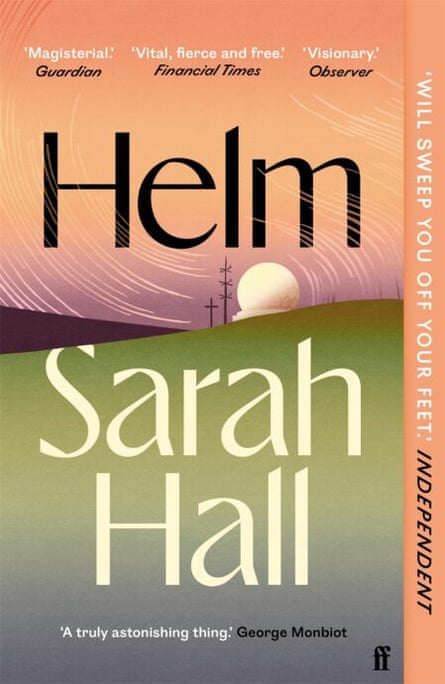
In Hall’s new novel, weather and climate are not just potent settings but the main event. The central character in Helm is the Helm, Britain’s only named wind.
This wind, which is local to Cumbria, occurs when air sweeping down Cross Fell, above the Eden valley, creates both a crest and a low bar of cloud. “Tricky to explain/visualise”, admits Helm. “For now, imagine a skater launching off a quarter pipe two thousand feet high, then somersaulting. Again. And again and again.” As the book begins, Helm witnesses its own arrival. An ice age, sun flares, ash cloud; and, relatively insignificant in the context of such deep time, the evolution of humanity. Because there are many people in the novel, too, which is structured by braiding their stories with Helm’s.
Hall’s ambition may be bounded by one valley, but it reaches through thousands of years. Her subjects range from a neolithic tribe to a medieval exorcist; from an isolated 18th-century wife to a quixotic Victorian meteorologist; from a wind-touched, lonely mid-20th-century child to a present-day academic counting plastic particles in the air. From stone tools to the Industrial Revolution to the advent of AI, each era has its own existential encounters with Helm: as deity or devil, as a psychological or a scientific mystery.
A project of this scope, which requires a range of research and imagination that could have produced several historical novels, not to mention an entire other volume of meteorological expertise, holds so much in suspension around its whirling, windy core that it could easily blow apart. But, despite the occasional threat or lull, Helm doesn’t. Partly, I would argue, this is because of Hall’s development as a consummate short story writer. Her novels are never less than hugely accomplished, but the narrative demands of the longer form, especially in more conventional earlier work, can sometimes dissipate the blaze of which she is capable. Hall is freed by the constraints of the short story – like the female sculptor in her last novel, Burntcoat, she burns away everything extraneous – and her work only gains in concentrated, suggestive power. Each strand of Helm has this concentration; the characters and voices could stand alone, but they flow together into something deep and rich, held together by the Eden valley, and its Helm. Aida Edemariam
£8.49 (RRP £9.99) – Purchase at the Guardian bookshop
Fiction
The Pretender
Jo Harkin
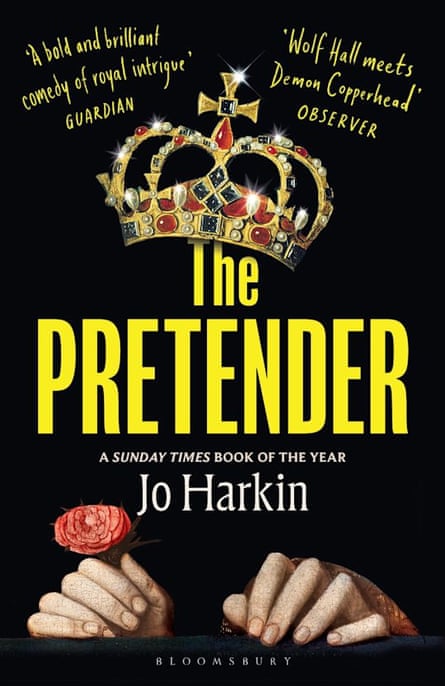
One day in 1484, strange men arrive at the Oxfordshire farm where 10-year-old John Collan lives. They’ve come to carry him away to a new life, for he is not, after all, the farmer’s son; in fact, he’s Edward Plantagenet, Earl of Warwick, spirited away in infancy to keep him safe ahead of the day he might return to claim the throne of England. That day is now in sight. He can’t call himself John any more, but he can’t yet be announced as Edward, Earl of Warwick. In the meantime he’ll be given a third name: Lambert Simnel.
Over the course of this fantastically accomplished novel, the many-named boy will travel from Oxford to Burgundy then Ireland, and at last into the paranoid and double-crossing heart of Henry VII’s court. The tail end of the Wars of the Roses – with Richard III’s crown snatched from the mud of Bosworth by Henry Tudor – is a foment of plot and counter-plot, and our hero spends his adolescence being passed around scheming factions who go so far as to hold a coronation for him. What a painful life this is for a boy “so grateful for any amount of love” as he falls in and out of favour, uncertain of his own parentage, gaining and losing relatives as their interest turns to other plots and other pretenders. Imogen Hermes Gowar
£8.49 (RRP £9.99) – Purchase at the Guardian bookshop
Fiction
Eden’s Shore
Oisín Fagan
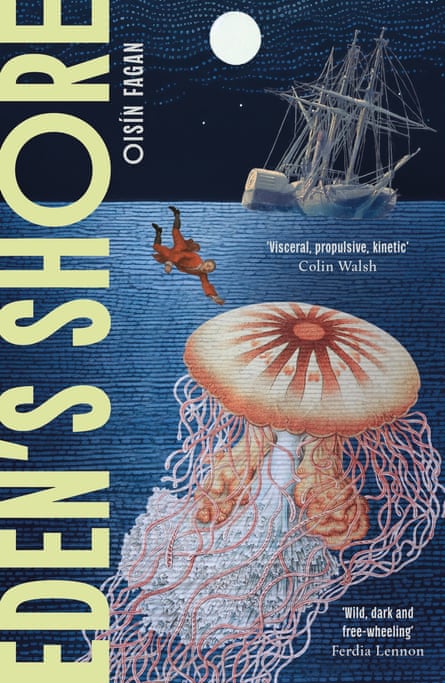
In that dimple of European history between the French Revolution and the coronation of Queen Victoria, there lived a not inconsiderable number of men whose foremost ambition was to set sail for the Americas, and there, in their own parcels of conveniently cheap and plentiful wilderness, found utopian communes where society could be forged anew in accordance with the principles of enlightenment. It certainly didn’t hurt that these endeavours would enable – even necessitate – quite a lot of shagging. Samuel Taylor Coleridge and his mates, Roberts Southey and Lovell, laid plans, between blasts of nitrous oxide and versification, for the foundation of a commune on the banks of Pennsylvania’s Susquehanna River, chosen for its “excessive beauty and its security from hostile Indians”. Lack of funds quickly became an issue, and soon our intrepid Romantics had compromised on location, proposing to found their “Pantisocracy” in rural Wales instead of the New World. Perhaps unsurprisingly, the plan never came off.
Angel Kelly, the hapless protagonist – or perhaps initiator would be a better word – of Oisín Fagan’s second novel, Eden’s Shore, is one of these Coleridgian dreamers. His story ends up functioning almost as a prologue to the novel. This sprawling epic of the late 18th-century Americas examines questions of complicity, violence, the limits of philosophy, and what place love could have – what redemption it might begin to offer – in a world governed by the extractive logics of colonialism. If that sounds like an enormous drag, I assure you, this novel is unexpectedly hilarious and very beautiful. As well as deftly controlling and differentiating a vividly realised ensemble of dreamers, drinkers and mercurial freebooters, Fagan achieves a sultry, skirling prose that captures with equal precision both the beauty of the tropics and the spiritual and physical mutilations practised in their shade-bound midst. AK Blakemore
£9.89 (RRP £10.99) – Purchase at the Guardian bookshop
Fiction
Open, Heaven
Seán Hewitt
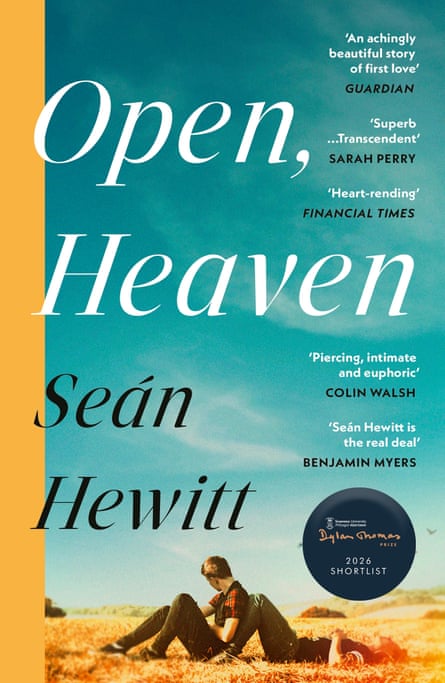
Hewitt’s debut novel Open, Heaven takes its title from William Blake’s poem Milton, which speaks of wandering through “realms of terror and mild moony lustre, in soft sexual delusions of varied beauty” – a line that quite nicely describes the reader’s experience of this book.
Our narrator James, a librarian who loved but never desired his husband, is a man arrested in time past. Directed by doctors to rest after the “bewildered weeks” that follow his divorce, he returns endlessly to thoughts of his youth, “hoping to find the answer to something left unfinished”. He searches online for properties in the village of Thornmere, where he was once a solitary teen who loved – with disastrous single-minded loyalty – a boy called Luke. He discovers a farmhouse for sale which is achingly familiar; so he is prompted to return to Thornmere in person, having never really departed it in spirit, and we are plunged into the body of the novel.
I was arrested by the presentation of a version of Englishness which is perhaps best arrived at by some remove. Hewitt was born in Warrington, but lives and teaches in Dublin; his mother is Irish. There is consequently a sensibility at work here which is intricately familiar with and fond of a particular kind of Englishness, which in clumsier hands might appear trite. It roots the novel both geographically, and within the canon of English literature: Hewitt is never imitative of Hardy or Lawrence or Gerard Manley Hopkins, but allows the novel to speak into their echoes. Sarah Perry
£8.49 (RRP £9.99) – Purchase at the Guardian bookshop
Fiction
The Book of Records
Madeleine Thien
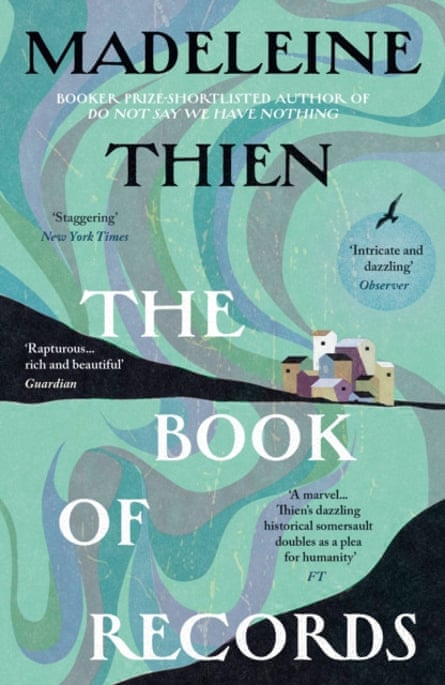
In Madeleine Thien’s rapturous fourth novel, The Book of Records, “the Sea” is the name given to a gargantuan migrant compound, sprawled on the shoreline a decade or two in the future. Lina and her ailing father, Wui Shin, occupy an apartment on the labyrinthine 12th floor, from where they can watch the refugee boats pull in and depart. The pair have fled the flooded Pearl River Delta, leaving behind Lina’s mother, brother and aunt but carrying three volumes from an epic biographical series entitled The Great Lives of Voyagers. These tattered instalments cover the respective histories of the German-Jewish philosopher Hannah Arendt, the Chinese poet Du Fu and the Portuguese-Jewish scholar Baruch Spinoza.

Lina will go on to spend many years in the Sea, but as the book begins, the girl has no sooner settled into her apartment than the doors slide open to reveal her neighbours. The refugees gather around the new arrival like Dorothy’s companions in The Wizard of Oz. They breezily introduce themselves as Jupiter, Bento and Blucher, but they are also the avatars of Du Fu, Spinoza and Arendt. It is through their stories that we learn how Spinoza was labelled a heretic in 17th-century Amsterdam and Arendt went to ground in Nazi-occupied France. “You do know a lot about Du Fu,” Lina tells Jupiter at one point. “What am I,” Jupiter replies, “other than the things I know?”
The Book of Records is a rich and beautiful novel. It’s serious but playful; a study of limbo and stasis that nonetheless speaks of great movement and change. If this turbulent, mercurial tale has an anchor, it is its belief that “in order to extend life and preserve civilisation, we are obliged to rescue one another”. Thien explains in the acknowledgments that she has lifted this quote from The Book of Mountains and Rivers, a 2012 essay collection by the Chinese writer Yu Qiuyu. She hands it on from Arendt to Blucher to Lina in the Sea, as though it’s a baton or a lifeline that connects all the world’s great voyagers. Xan Brooks
£8.49 (RRP £9.99) – Purchase at the Guardian bookshop
Thriller
Thriller
Clown Town
Mick Herron
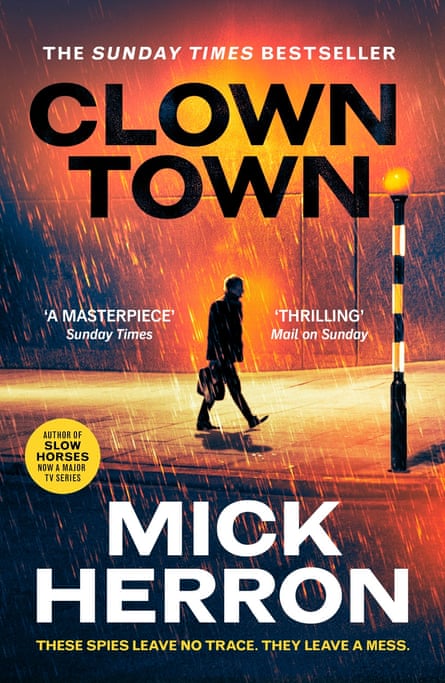
Herron’s plot takes off from real-world events: the Stakeknife scandal – in which it turned out that MI5 had been protecting a murderously vicious IRA enforcer as an intelligence asset – appears here in the story of Pitchfork, whose signature “nutting” technique of killing during the Troubles was running over people’s heads.
Pitchfork’s story was covered up – until it wasn’t. His old handlers have come out of the woodwork and, to mix metaphors, the sky soon grows dark with chickens coming home to roost. Herron’s hero River Cartwright (whose late grandfather’s archive, we discover, contained crucial material about Pitchfork) starts pulling on a thread. The Service’s First Desk, the machiavellian Diana Taverner, launches another of her fiendish schemes and is soon once again sparring with the Slow Horses’ profane ringmaster Jackson Lamb.
Over the last decade this series of novels about a community of cashiered spies has made the transition from “well-kept secret” to “household name”. Herron is now an authentic megastar of the genre, and since the Apple TV+ series Slow Horses every reader (and I expect the author) will have recalibrated their mental image of Jackson Lamb from Timothy Spall to Gary Oldman (early novels likened Lamb to Spall “gone to seed”). But the books are still the main event – because it’s Herron’s line-by-line writing that really makes them stand out.
These books are a strange and addictive hybrid. The bones of any Slough House novel are those of a classic spy story: there will be bad actors, buried secrets, hidden agendas, opaque and shifting stratagems and, sooner or later, gunplay or chases or kidnappings or eruptions of semi-competent violence. But the self-seriousness of most spy fiction is not present. The surface fizz is more like a sitcom: the back-and-forth of witty insults and off-colour jokes, sight gags and character work – Herron’s oddball cast chafing against each other while they sit in their shabby office opposite the Barbican, suffering through their make-work day jobs. Sam Leith
£9.89 (RRP £10.99) – Purchase at the Guardian bookshop
Environment
Environment
How to Save the Amazon
Dom Phillips
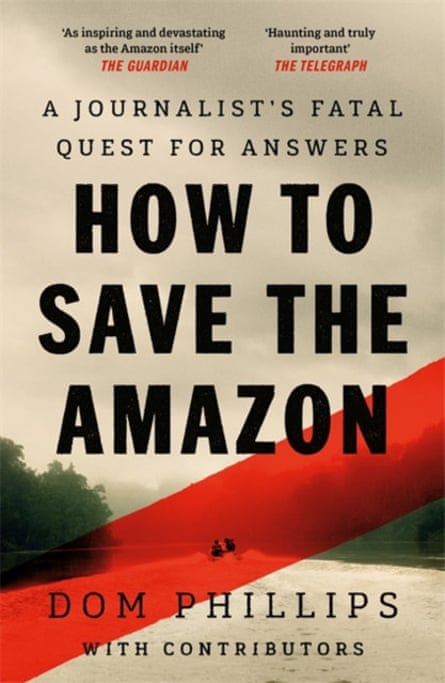
On page 165 of How to Save the Amazon, a black-and-white photo interrupts the text. Two wooden crucifixes stand in a freshly hacked clearing, lashed to tall, thin stumps. One of them bears the name Bruno Pereira. The other, Dominic Phillips, the author. The image splits the book in two. Before it, the pages are filled with Phillips’s vivid prose. After it, his friends and former colleagues have gathered and attempted to complete his work as best they can.
Erected on the bank of the Itaquaí river, in a remote part of the Brazilian Amazon, the crosses mark the spot at which – early on the morning of 5 June 2022 – Pereira and Phillips were murdered. The two men had been travelling downriver in a small motorboat when they were attacked. Pereira, a Brazilian forest protector and Indigenous specialist, was shot first: three times, including in the back. Phillips, a Guardian reporter, was shot once in the chest, at close range.
“No reader should be in any doubt that these pages have been stained by blood,” write Phillips’s successors. “The killers blasted a gaping wound in this book that is far too great for any infusion of solidarity to heal.” Over the final half-dozen chapters, fellow journalists struggle with Phillips’s impossible handwriting, retrace his footsteps and reveal tantalising flashes of what could have been. The result is a book both brilliant and broken, one that is ultimately as inspiring and devastating as the Amazon itself. Charlie Gilmour
£9.89 (RRP £10.99) – Purchase at the Guardian bookshop
Biography
Biography
Electric Spark
Frances Wilson

In life, Muriel Spark was by turns an editor, critic, biographer, playwright, Jewish Gentile, Catholic convert, divorcee, abandoning mother, spy. As Frances Wilson observes in this canny biography, she looks in every photograph as if she is played by a different actor, so drastic are the changes in her face and style. From precocious Edinburgh schoolgirl to unhappy Rhodesian wife, spirited London bohemian to poised Roman socialite, Spark made an art of unsettling transformations. She was the queen of narrative control, not least the narrative of her own life.
It’s Wilson’s belief that Spark was playing a cat and mouse game with the future, packing her novels with clues and cryptic mementoes from her own past. Rather than the conventional cradle to grave, Wilson’s focus here is on the first 39 years of Spark’s life, culminating in the publication of her debut novel, The Comforters, in 1957: “the years of turbulence, when everything was piled on”. This doesn’t mean that later masterpieces like A Far Cry from Kensington or Loitering With Intent are ignored, but rather mined for evidence of their real-life antecedents. Time slips and shuttles, fittingly for a writer who was such a master of prolepsis, those devastating little glimpses into the future that make novels like The Driver’s Seat and The Girls of Slender Means so uncanny. Olivia Laing
£9.34 (RRP £10.99) – Purchase at the Guardian bookshop
Memoir
Memoir
The Language of War
Oleksandr Mykhed
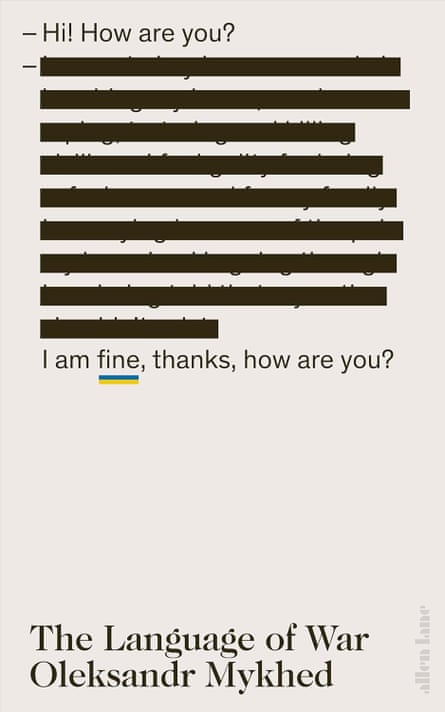
Oleksandr Mykhed and his wife Olena lost their home when the Russians invaded Ukraine. Before February 2022 he had never held a gun in his hands. But a week before the invasion, fearing the worst, he trained with a Kalashnikov assault rifle. And after helping to make a bomb shelter out of a university library in Chernivtsi, he enlisted in the armed forces of Ukraine.
His book, much of it written during his 100 days in the barracks, is less a record of armed service than a reflection on the impact of war – how it has changed him and others, too, not least children. It’s a ferociously angry book, borne of “rage, love for homeland, revenge”.
Traumas appear in his conversations with fellow Ukrainians, one of them his mother, a literature professor who was forced to flee with her husband from Bucha after the invasion and whose way of coping with the shock of evacuation was to keep her coat on at all times, as if it was a shell or cocoon. His parents’ plight enrages Mykhed: “War is living through history that you would not wish on anyone.” But his epilogue does offer a measure of hope. “My faith in the power of literature is being restored by the Russian occupiers’ fear of our books and culture,” he says, and he imagines himself, “on the day of our victory”, on a wide road between fields, “an amazing landscape before me. Another week or two will pass, and the season will change, hiding the scars of war.” Even then, he’ll still need to let out a long scream: “I want to forget it all. I want to never forget.” Blake Morrison
£11.69 (RRP £12.99) – Purchase at the Guardian bookshop
Memoir
Maybe I’m Amazed
John Harris
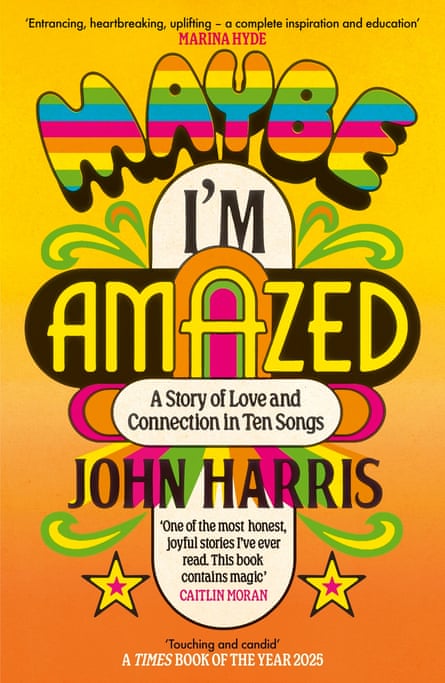
Maybe I’m Amazed opens with John Harris’s 15-year-old son, James, ecstatically absorbed in a live performance by Paul McCartney, “so held in the moment that he is almost in an altered state”. Harris then loops back to before James’s birth, and tells the story of his son’s arrival, his preschool diagnosis of autism, and how his differences manifest as he grows up. James loves music – the Beatles chief among a rich buffet of bands and tracks he listens to, over and over – and so Harris divides the book into 10 chapters named after songs, each with a particular resonance.
Harris writes about music with wit, clarity and a welcome lack of pretension. One chapter takes its cue from Funkadelic’s “weird … incongruous” track Fish, Chips and Sweat – about a carnal encounter that takes as its backdrop “the least sexy meal imaginable”. Another from Nick Drake’s Northern Sky, a song whose lyrics evoke “a sudden euphoria that leaves you silent, and still”. Harris even bravely attempts a rehabilitation of Baker Street, “a masterclass in the arts of arrangement and production”, so hackneyed from familiarity we might miss the complicated stories implied by its “sparse, carefully chosen words”.
Threaded throughout this are he and his wife Ginny’s struggles and anxieties around parenthood, and James’s emerging strengths and challenges. Like all parents, Harris’s journey involves plenty of learning on the job.
He writes powerfully about “almost Victorian levels of cruelty” inflicted on autistic people in care, and how, through his and James’s shared love of music, his initial doomy grief gives way to a constellation of admiration, fear, humour, awe and, of course, love. Tim Clare
£11.69 (RRP £12.99) – Purchase at the Guardian bookshop