2 months ago
89
2 months ago
89
The Mamas and the Papas – Mansions (1968)
I grew up listening to the Mamas and the Papas’ hits but had never heard their albums before this year. I had no idea anything as creepy as Mansions lurked within their sunny oeuvre. Its sound is ominous, its mood one of stoned paranoia, its subject rich hippies sequestered in the titular luxury homes, haunted by the sensation that the flower-power dream is going wrong.
The weirdest thing about it is its eerie prescience. A year after its release, a group of people not too dissimilar to those depicted in the song found out just how wrong the 60s counterculture could go. The spectre of the Manson murders hangs chillingly over the track, compounded by the fact that, on their eponymous 1966 album, the Mamas and the Papas recorded Strange Young Girls, about precisely the kind of lost souls that Charles Manson would ultimately convince to do the devil’s work. A minor but thoroughly unsettling slice of buried pop history. Alexis Petridis
Katy B – Katy on a Mission (2011)
There’s a well-known cognitive bias where, after you become aware of something new, you start seeing it everywhere. It’s known as the Baader-Meinhof phenomenon, but from this year, I’ll think of it as the Katy B effect, after Katy on a Mission became the unexpected soundtrack of my summer. Having spent my teens and early 20s in New Zealand, I’d never heard it before; I first clocked it at Glastonbury, when two friends and I stumbled on Katy B’s set at the Shangri-La stage at 4am. “Stumbled” is the word: I didn’t learn its title until three weeks later, at a house party with the same friends. Handed control of Spotify, they agreed: Katy on a Mission. Two weeks later, I caught it again at Brighton Pride, the womp-womp bursting from the tent.
Discovering this pop-dubstep classic has made me feel connected to a moment in British culture I missed, while coming across it in the wild 15 years later has felt like a second wind for my own youth. As much as I loved 2010s pop at the time, I now find much of it too saccharine to readily revisit. Katy on a Mission shares the era’s exuberance but tempers it with foreboding that now seems prescient. Since summer, I’ve had it on high rotation, making up for lost time. Elle Hunt
Roberto De Simone and Nuova Compagnia di Canto Popolare – La Gatta Cenerentola (1976)
When Barcelona electro-punk duo Dame Area worked in the tiny club Màgia Roja, a hub for the city’s 2010s experimental scene attended by the likes of Arca and Björk, nights often closed with the dark, pounding Secondo Coro Delle Lavandaie. Sounding like an acoustic version of some industrial dance banger, it’s actually a piece from Neapolitan artist Roberto De Simone’s 1976 folk opera La Gatta Cenerentola, in which several washerwomen discuss a sex dream. Dame Area showed me that track years ago, calling it a major influence, and it’s so good I barely gave the rest of the musical a chance. When De Simone died this year, I finally listened to the whole 1976 recording, and kicked myself for not doing so sooner. This eccentric gem celebrates his city’s folklore – based on Giambattista Basile’s 1630s version of Cinderella – and musical traditions, from the Renaissance villanella to the wild folk dance of the tarantella. Alastair Shuttleworth
Opal – You Ready (2012)
I was at a party when the DJ played an unfamiliar song from a familiar voice, which instantly sent my hips swinging as though I already knew every beat. I scrambled for the Shazam app and found that it was I Said It by Opal, a name I recognised from the lyrics of Mr Vegas’s dancehall classic Hot Fuk: “A Opal, Hottaball and Vegas!” I soon had the song on repeat, in love with its incredible lyrics – “Nookie well tight / It nuh quicksand” – then discovered it was from a six-track EP from 2012, You Ready. That record served me the track Physically Fit, set to the English nursery rhyme One, Two, Buckle My Shoe, which has become the soundtrack to my lifting sessions in the gym.
What amazed me is how singularly inventive, playful and sexy this tight EP is and how little known it seems to be despite Opal’s voice being familiar to anyone who knows anything about dancehall; you can’t even find the lyrics or much reference to these songs online. It was released on the label Zojak, also home to Vybz Kartel’s global hits Fever and Summertime: I’ll be trawling through its catalogue for more vulgar, frisky, addictive hits. Jason Okundaye
Ulver – The Norwegian National Opera (2011)
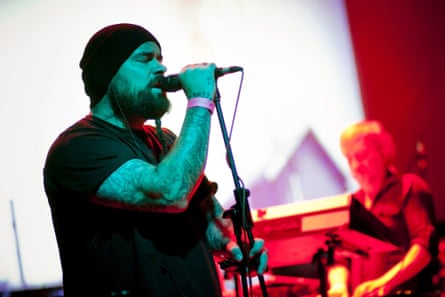
Ulver are the kind of fearless creatives more people should idolise. They started as part of Norway’s black metal scene before escaping not just the borders of that genre, but plenty more as well. Between albums, soundtracks and EPs, they’ve put out more than a dozen studio recordings, and they’ve run the gamut from contemporary classical to post-rock and synth-pop. All of it’s great. So, I was borderline giddy after I stepped into a secondhand shop and stumbled on a tattered copy of this CD/DVD of the band performing at their country’s opera house that I’d never heard of. When I put it on, I discovered that it wasn’t just some oddity, but Ulver in excelsis. It brought their avant garde spirit to new dimensions, using enigmatic video projections as well as interpretive performances from British artist Ian Johnstone. Whether the band were exploring the vaudevillian verve of In the Red or the spoken word of Plates 16–17, it all felt immersive and mystifying. Matt Mills
Bob Dylan
The stats don’t lie: my most-played artist this year is one Bobby Zimmerman, spurred by my slightly embarrassing Damascene conversion at the hands of A Complete Unknown in January. (In second? America’s next great bard, Addison Rae.) It stuck: on a long drive, Blonde on Blonde or Blood on the Tracks will inevitably find their ways on to the stereo.
Last month, I went to see him live for the first time, figuring that his advanced 84 years might limit future chances. I’d heard so much about Dylan’s contemporary shows being formless dirges in which you might, four minutes into a song, suddenly get a recognisable snippet of It Ain’t Me Babe – albeit potentially in the style of Irving Berlin’s Puttin’ on the Ritz, as a perplexed Bon Iver told me he got at a show in Wisconsin earlier this year. I was prepared for that to be the whole night, and to enjoy the latter-day Dylan experience for what it was: who am I to argue, showing my face this late in the day?
But that night in Leeds, he played pristine versions of It’s All Over Now, Baby Blue and Desolation Row. Witnessing such classic 60-year-old songs feels like the gig equivalent of looking at the Mona Lisa or The Scream – getting to share these unbelievable moments of kismet with timeless, foundational art. (Equally captivating was watching this stubborn legend, who largely performed with his back turned, do human things like scrunch his hair and scratch his nose.) Maybe my favourite bit, though, was the spooked, still rendition of Key West (Philosopher Pirate) from 2020’s Rough and Rowdy Ways. I wish that alone had lasted an hour. Never mind the best old music I discovered in 2025: I sense this is a process that will see me through at least the next decade. Laura Snapes
La Bionda – One for You, One for Me (1978)
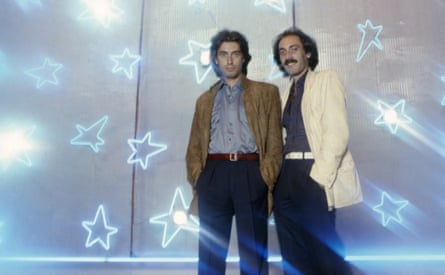
I saw Brady Corbet’s The Brutalist four times in 2025. It’s a masterpiece, as is composer Daniel Blumberg’s Oscar-winning score – a sublime kaleidoscope of noise lurching between grandiosity and slipperiness. I listened to it a lot this year, but not as much as I listened to One for You, One for Me by Italian disco duo La Bionda, which plays over the credits.
Extremely stupid but extremely catchy, with the squelchiest synth I’ve ever heard, it slaps in the simplest way a song can slap. Every time I left the cinema I was compelled to listen to it over and over, an addictive rush rendering critical thought impossible. The film ends with its complex narrative knowingly forced into a neat conclusion, wryly reflected in its switch from Blumberg’s tricksy score to novelty pop. Perhaps my smooth-brain response was conceptually engineered as part of this tone shift, but I can’t be mad when the song is this good. Claire Biddles
Badly Drawn Boy – Once Around the Block (2000)
It’s no secret that I’m drawn to slightly naff provincial guitar music from the early 2000s (I’ve written glowing reviews of Keane and Hard-Fi at recent editions of Glastonbury), but this year I surprised myself by becoming totally enamoured with Once Around the Block by Badly Drawn Boy after hearing it played in a park in Serbia. Many will associate the track with singer-songwriter landfill, or the About a Boy soundtrack, which BDB composed and performed, but as someone who missed it the first time round, I find it extremely charming: the jaunty but melancholy melody, Damon Gough’s pained cadence, the airy backing vocals. It’s so twee and understated, you could imagine it being sung by the Marine Girls or some Sarah Records band, if you ignored the very real connotations of flannel shirts, beanies and open mic nights. I’m not bothered about the rest of Badly Drawn Boy’s music, but this song has had me in a chokehold. Safi Bugel
Labi Siffre – Crying Laughing Loving Lying (1972)
Despite not having a functioning record player for about two decades, my dad still has boxes of LPs gathering dust in his attic. Earlier this year while I was helping him make space so the ceilings wouldn’t cave in, I came across Labi Siffre’s 1972 album Crying Laughing Loving Lying and, intrigued by the live-laugh-love–style title, decided to take it home with me.
Siffre had always been a name I associated with the mighty civil rights anthem (Something Inside) So Strong and had otherwise dismissed as some kind of one-hit wonder. Listening to Crying Laughing Loving Lying, I realised how embarrassingly wrong I was. Armed with an acoustic guitar and his yearning falsetto, Siffre’s 40-minute record led me through the emotions of its title, from crying to the sweet entreaties of My Song, to laughing at the coy lyrical twist of the title track, loving the rollicking rhythm on Cannock Chase – and lying since that I had always known about his masterful songwriting skill. It’s a record that has been on repeat for the rest of the year and has cemented Siffre as a national treasure in my mind. Ammar Kalia
Oppenheimer Analysis – Don’t Be Seen With Me (1982)
It’s rare that a cover version outstrips the original song, and even rarer that the cover and original are equally good. But the latter happened this year when cosmic techno producer Avalon Emerson did her superb version of Don’t Be Seen With Me by early 80s synthpop duo Oppenheimer Analysis. Using plenty of echo on her vocals alongside propulsive drum programming, her take is psychedelic and relentless, like the lights of a tunnel seen through a passenger window. I could scarcely believe the original, which I’d never heard before, would be a match for it.
But it is, while being thoroughly different. It shares the same vocal melody and synth motif, but a heavy, bone-dry snare tolls like a portent throughout, and the production’s stiffer, more uptight bearing is a better match for the lyrics. It’s the tale of a person who, on realising that determinedly keeping people at arm’s length is no way to live, feels their old self disintegrate at the arrival of a charismatic newcomer. “Fresh from the cradle, you’re a passion lethal / Innocent smiles don’t mask the evil to a fool like me.” Is this person trying to exploit our narrator? Or is it all paranoid self-loathing from someone terrified of love and society? It’s a great bit of dancefloor storytelling, whatever form it takes. BBT
Dua Lipa – Be the One (2017) / The Ting Tings – Be the One (2008)
When I recently joined my 11th band, they gave me a list of 32 original songs to practise plus a few well-known covers they throw in at smaller gigs. On the list was Be the One … which I took to mean Dua Lipa’s hit from 2017. Playing along with it gave me an epiphany. This glorious electro-pop banger had somehow passed me by, although I wasn’t sure how it would transpose to my band’s indie-folk-pop setup. “What Dua Lipa song?” they asked me, looking rather befuddled, at rehearsals. It turned out that they’d wanted me to learn the Ting Tings’ Be the One, a 2008 indie-pop hit which had also passed me by but which I’ve now discovered is a little gem. So far, it’s going down really well at gigs, but if the world ever cries out for an acoustic/guitar indie-folk-pop reinvention of Dua’s electro-pop colossus, I’m ready. Dave Simpson
Dido – Life for Rent (2003)

Everyone knows Dido. It’s not quite fair to say I “discovered” Dido this year. In fact, the first time I heard White Flag, I was roughly five years old and it happened, memorably, as I was tasting Heinz’s new green and purple ketchup. But I listened to her second album on a whim this year after listening to the new Snuggle album and marvelled at what a good Dido approximation their song Woman Lake is. As it turns out, Woman Lake only has the light perfume of Dido. The woman herself contains much more than featherweight power ballads: there’s the harried Balearic grooves of Sand in My Shoes; Mary’s in India, a song about – I believe – stealing your best friend’s man while she’s on holiday; and Paris, a dejected and atonal ballad that’s not too far removed from PJ Harvey at her starkest. I was mainlining Life for Rent for a few weeks, but I had to stop – a friend told me I was beginning to romanticise everyday life too much. Shaad D’Souza