2 months ago
112
2 months ago
112
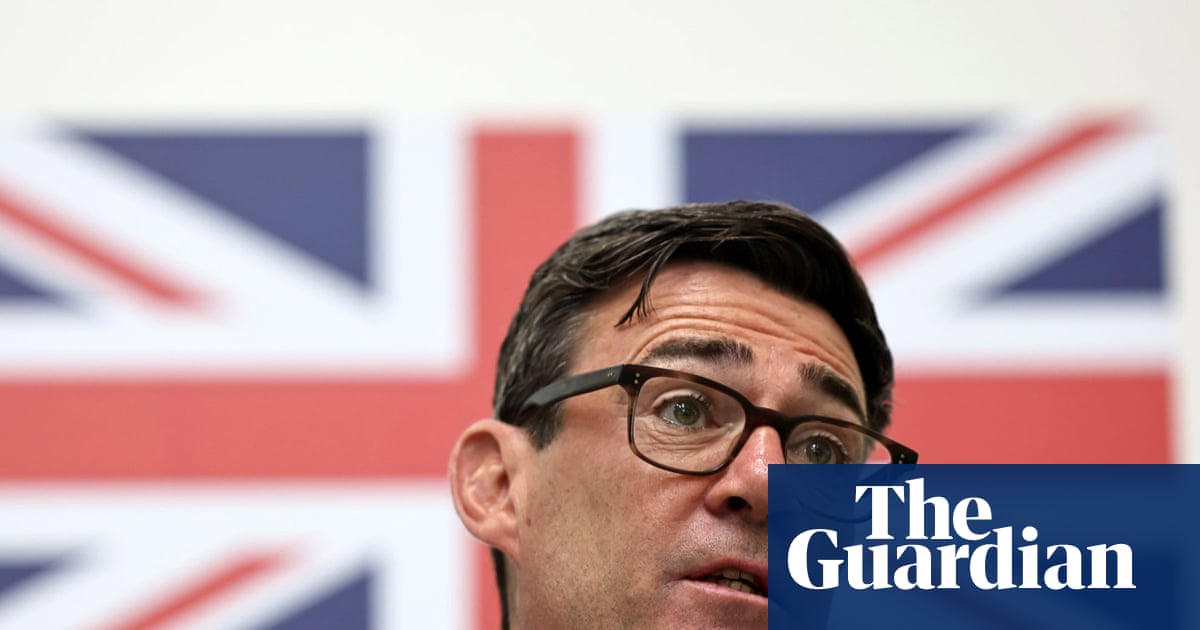
Andy Burnham is finally Labour leader. After trying – and failing – twice to be elected by party members, he took the top job on Friday without a contest. Sir Keir Starmer remains prime minister until Monday, when he will tender his resignation to King Charles, who will invite Mr Burnham to form a government. Then the future that Mr Burnham has long imagined will cease to be a promise and become a test.
Much will be written about the man. But why does Mr Burnham believe what he believes? One clue lies in the Guardian’s letters page in 1991. Fresh from graduating in English at Cambridge, the 21-year-old Mr Burnham defended an “uncouth and uncultured” Philip Larkin from critics who dismissed him as “too parochial”. Larkin – a bigoted curmudgeon – is difficult to admire, but his poems are not.
Nearly 35 years later, Mr Burnham finds himself on the same ground: bringing to national politics a northern, provincial sensibility that metropolitan commentators have often underestimated. Consciously or not, the young Larkin admirer has spent his political life making the same case as the poet in another register: that ordinary lives and ordinary places deserve serious attention.

There’s a well-worn maxim that politicians campaign in poetry and govern in prose. Mr Burnham has often reversed it – and knowingly so. He has said that William Shakespeare taught him to build political speeches through cadence and emotional force, while the poet Tony Harrison showed him that mastering words could be a route out of powerlessness. During the pandemic, this skill helped him, as Manchester mayor, turn a funding dispute with Boris Johnson’s government into a moral argument about who should bear the cost.
Mr Burnham’s politics become more intelligible when read through his literary influences: Larkin made the everyday important; Harrison supplied the language of class and voice; Shakespeare provided the eloquence. His task now is to turn that poetic inheritance into the prose of national government.
That means answering harder questions: who owns what, who taxes whom, who borrows, who spends and who decides. What remains largely unwritten and unsaid is which institutions, powers and fiscal choices would replace the Thatcherite settlement that Mr Burnham condemns. By having a coronation rather than a contest for the Labour leadership, Mr Burnham has been allowed to forestall that reckoning. That may be a mistake.
Those tests will come soon enough. Friday was a good day for Labour – and for the country. In Mr Burnham the nation will have an experienced politician with a gift for language, well versed in using rhetoric to change people’s minds. He has a coherent diagnosis of what ails Britain. His argument that private control of essential infrastructure makes inflation harder to manage points to either public ownership or tighter regulation. Where Mr Burnham lands will crystallise his politics in the public’s mind.
At Harrison’s memorial earlier this year, Mr Burnham described the importance of the poem V to him as a teenager and connected literature with his own sense of politics. Harrison saw Britain trapped by the “versuses” of life – the class, economic and ethnic differences that split the nation – and dared to imagine it “united”. Mr Burnham says that vision shaped him. His government will now be judged on whether it can make that single word mean more than a poet’s hope.
Do you have an opinion on the issues raised in this article? If you would like to submit a response of up to 300 words by email to be considered for publication in our letters section, please click here.