4 hours ago
9
4 hours ago
9
Exhibition of the week
The Bayeux tapestry
Blood and thunder, friendship and betrayal, marginal monsters and raw sex – all human life and more is depicted in this medieval artistic masterpiece that tells an epic national story with unrivalled punch and power.
British Museum, London, from 10 September until 11 July 2027
Also showing
Emma Reyes
A look back at this Colombian painter who brought the subaltern cultures of the Americas into the mainstream of modern art.
White Cube Mason’s Yard, London, until 3 October
Jimmy Wright
There’s an alluring tint of Van Gogh’s Sunflowers to this artist’s recent works.
Thomas Dane Gallery, London, until 1 October
Catherine Murphy
Tough no-nonsense realism is taken to the point of surrealism in Murphy’s paintings.
Sadie Coles HQ, London, until 7 November
Entangled and Woven
If the Bayeux tapestry makes you wonder how textile art is faring, here’s a show threading that theme from India and Korea to Manchester.
Whitworth, Manchester, until 3 January 2027
Image of the week
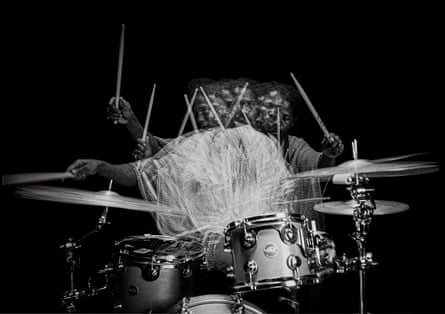
Photography began as a hobby for Temi Adegbayibi after he started photographing his cousin’s band Ezra Collective. But perseverance, confidence, skill and talent has seen the 26-year-old’s work – which captures the movement, intimacy and joy of performing, particularly in his images of Black musicians – exhibited at the Royal Albert Hall. The photograph above shows Adegbayibi “trying to capture the energy of a drum solo”. Read more here
What we learned
An Egyptian queen’s 673-diamond necklace was stolen in a smash-and-grab raid
Jackson Pollock’s Blue Poles sparked one of Australia’s most enduring culture wars
Wilem Frischmann, one of architecture’s most daring engineers, has died aged 95
The theft of Renaissance art by Messina from a Sicilian museum baffled investigators
Woo Jin Joo uses London junk to bring a spirit of playfulness to the art world
The graffiti artist Helch, who has died, left an indelible mark on high-rise Britain
Masterpiece of the week
The Story of David and Goliath by Francesco Pesellino, c 1445-55
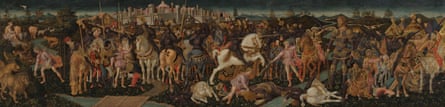
This Renaissance painting of conflict was created more than 400 years after the Bayeux tapestry. But for all its greater sophistication and especially its command of the new science of perspective, you can’t really say it is a clearer or more emotionally powerful visual narrative. If anything, Pesellino’s painting is harder to make sense of. Because the Bayeux tapestry tells its tale in a completely linear way, unfolding stage by stage, with no layers of action, it is wonderfully easy to follow. Here, the story’s progress is chaotically clogged with crowd scenes and landscapes in depth. So even though the figures are much more muscled and their faces better drawn, some raw simplicity is lost. At another level, nothing has changed: this is still a medieval artwork from an epoch when horses and battles, castles and armour were the most glamorous themes in art.
National Gallery, London
Sign up to the Art Weekly newsletter
If you don’t already receive our regular roundup of art and design news via email, please sign up here.
Get in Touch
If you have any questions or comments about any of our newsletters please email [email protected]