2 hours ago
9
2 hours ago
9
Mysterious disappearances have been taking place lately in Rutland, an East Midlands pocket between Leicestershire, Lincolnshire and Northamptonshire that is often considered to be England’s smallest county. Usually, there are road signs when driving into a new county welcoming you over the border. But in recent months, these have been going missing. After 10 signs vanished, the council decided to remove the remaining 17. Now there are no official “Rutland” signs at all.
The area’s MP, the Conservative Alicia Kearns, is “not sure” what the motivation behind the thefts is. But they are certainly a fitting metaphor for Rutland’s disappearing status: its council is due to merge with Leicestershire county council in spring 2028.
The changes are part of the government’s plans to create 15 new councils across England, replacing smaller district and county councils with larger, single unitary authorities that would run services. The government says it is aiming to cut duplication in the older two-tier system and allow the new larger councils to focus on government priorities such as housebuilding. The new authorities will have a population of about 500,000 people; Rutland’s estimated population is just over 41,000. For the people of Rutland, this marks nothing short of “having our identity stripped from us”, according to a statement on Kearns’s website. It’s sparked a campaign to Save Rutland. A petition presented to parliament earlier in the year was signed in person by 7,141 people.
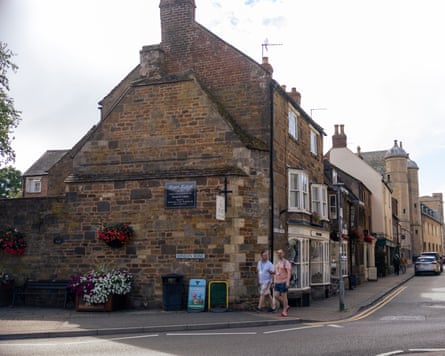
In an age of Change.org petitions circulated on social media, it feels oddly quaint to hear of a paper and pen petition. But that is Rutland in a nutshell, I realise shortly after stepping off the train in its county town of Oakham: oddly quaint. At Oakham Castle, there are more than 200 horseshoes on display , a result of the “horseshoe toll” that any visiting member of the royal family or peer of the realm must, to this day, pay (the most recent horseshoe payment was made in 2024 when the Duke and Duchess of Edinburgh visited). As I spend the day travelling around the county (conveniently, no journey takes more than 15 minutes by car), everyone I meet is quick to extol its community spirit, its safety, its beauty – something I can see for myself as I pass clusters of thatched cottages surrounded by fields of sheep, and cutesy town centres where fences are lined with bunting.
“The joke goes: ‘Rutland is England 50 years ago,’” says Kearns when we meet at the county’s most famous landmark, the UK’s largest reservoir by surface area, Rutland Water, home to the Rutland Osprey Project. She tells me about the county’s farming community, its tradition of Friday shoots that supply the local pubs with game, its pride in local businesses. So resistant are Rutlanders to some aspects of modernity, “we were the last county to have a McDonald’s built”, she says. Even when it did finally arrive, in 2020, the decision “was really controversial”.
Kearns grew up in Cambridgeshire (although her mother’s family are from Rutland), moving to the county only after she was elected MP for Rutland and Stamford in 2019. But she has clearly fallen in love with the place she now calls home, and is passionate about protecting Rutland’s identity as a small, quirky, historic county. “Oakham Castle is the oldest English court building still in continuous use,” is just one of the Rutland facts she reels off in the car as we drive around. The county is also home to the National Leg Wrestling Championships and the World Nurdling Championship, she tells me, which involves players throwing pennies into a hole drilled into a wooden seat (“the winner’s called the best tosser”). A 10-metre-long “sea dragon” fossil was found in the county in 2022. “What else? The first person to translate the Qur’an from Arabic into Latin came from Ketton,” which is another village in Rutland.
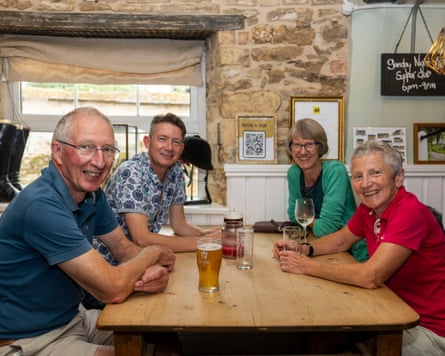
To add to its quintessentially British charm, Rutland is full of excellent pubs. I visit one, the George & Dragon, in a village called Seaton. It’s everything you want a village pub to be, a small, stone-built country inn with mismatched chairs and wooden beams across the ceiling, buzzing with customers even at 5pm. I meet Ralph Offer, the owner, who, conversely, isn’t your stereotypical pub landlord – he is just 30 years old, having taken a loan out to buy the pub when he was 21. Clearly someone with a laser eye for business, he explains that the chance to visit the smallest county in England is Rutland’s “biggest selling point”, and helps to bring people to his pub, which also has rooms.
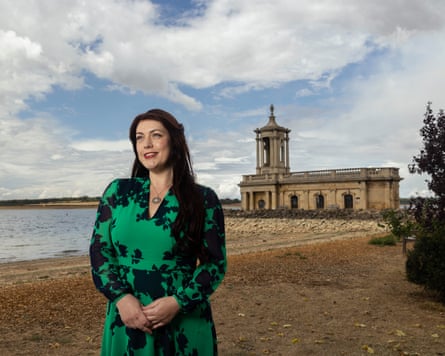
But though its size is what is usually first mentioned about Rutland (the county was the subject of the Eric Idle sketch show, Rutland Weekend Television, in the 70s, which centred on the fictional station being “Britain’s smallest TV network”), the question of whether Rutland actually is (or will remain) the smallest county is complicated. First, it depends what your definition of a “county” is. As the Historic Counties Institute points out, the towns, villages and landscapes that have historically made counties and their identities do not always match the shifting administrative boundaries of local government. There are 39 historic counties in England – of which Rutland is the smallest at 382 sq km (147 sq miles) – and this will not change after any local government changes. In fact, Rutland was absorbed into Leicestershire as a local district once before, in 1974, before regaining its independent status in 1997, after a government survey found that about 80% of respondents had a strong sense of belonging to Rutland.
Separately, there are the ceremonial counties, 48 areas that each have a lord lieutenant – a representative of the monarch in an unpaid role, who performs ceremonial duties and promotes charities. On that list, Rutland is not the smallest – it comes fourth, after the ceremonial counties of the City of London, which is 2.90 sq km (1.12 sq miles), Bristol, which is 110 sq km (42 sq miles) and the Isle of Wight, which is 380 sq km (146.7 sq miles). This ceremonial status is what the Save Rutland campaign is fighting to keep, and what is not protected by legislation. Because Rutland is the only existing ceremonial county that is due to be wholly absorbed into a new local government area, it is uniquely affected in this way.
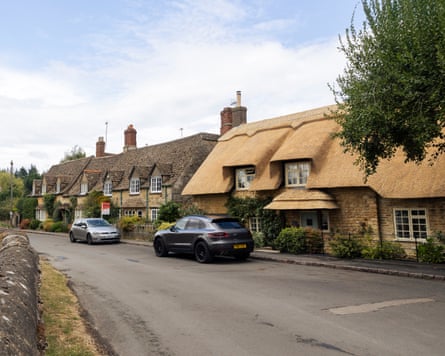
But what difference will losing its ceremonial status make to the people of Rutland? According to Joshua Malone, the director of public affairs at the Historic Counties Institute, the main issue is “the visibility and official recognition of Rutland” that may diminish after merging with Leicestershire county council. “Its name may become less prominent in civic life, signage, public information and administration.” If it is no longer a ceremonial county, Rutland would cease to be considered a “lieutenancy area”, which means it would lose its official representatives of the sovereign: the lord lieutenant and the high sheriff. The need to change the legislation wouldn’t be necessary at all if the Historic Counties Institute had its way: “Our longstanding policy is that lieutenancy areas across Britain should be realigned with the historic, geographic counties, so that these important civic institutions reinforce rather than obscure established county identities,” Malone tells me. “Rutland is a particularly good illustration of why that matters: if its lieutenancy were based permanently on Rutland itself, rather than being connected to changing local-government geography, the present uncertainty could not arise again during a future reorganisation.”
Kearns has twice attempted to get Rutland’s ceremonial county status enshrined in legislation, but her amendments were rejected by the government. That said, she does not believe the government has “gone out to try to screw us over” – she believes ministers “genuinely didn’t realise” that the changes to local government would affect Rutland’s ceremonial status, “because we are the only county in the country in that position”. A spokesperson from the Ministry of Housing, Communities and Local Government told the Guardian that it would “protect Rutland’s strong sense of community and heritage and ensure its unique identity endures through any reorganisation, including protecting its ceremonial status”.
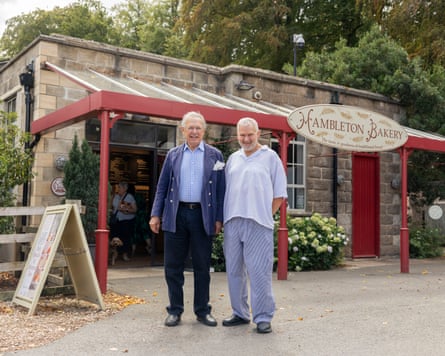
After a short drive through some more chocolate-box villages with Kearns, we arrive at the original branch of Hambleton Bakery, a Midlands chain begun by the Rutland duo Tim Hart and Julian Carter, which the MP is keen to show off. And once I’ve sampled one of its sandwiches, which could easily give any trendy London bakery with queues around the block a run for its money, I’m dangerously close to becoming a diehard member of the Save Rutland campaign. Rutland is pretty great, I think, with my mouth full of cloud-like bread – perhaps this bakery alone deserves ceremonial status?
Rutland is “a nice place to stay”, says Ramsay Ross, the leader of Rutland county council’s Labour group and the councillor for Oakham North West. “But there’s also poverty here, most evident in the constituency that I am in, and precious little has been done about it because we’re seen as being a wealthy county.” The council merger “will allow us to access more economic development funds”, he says – and will hopefully mean that more affordable housing can be built. Ross’s belief that more affordable housing should be prioritised was what motivated him to stand for councillor in the first place. “One of the things that we suffer from is that we have got proportionately the highest number of five-plus-bedroom homes as an authority in England,” he says. So when trying to meet the target of housing being more affordable, “you’re starting from a very high base”.
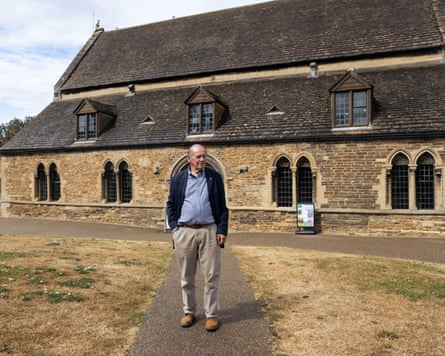
Ross has little time for the Save Rutland campaign – in fact, he laughs when I bring it up. “I can’t see ceremonial status as the be-all and end-all,” he says. “The lord lieutenant and the high sheriff do provide support to local charitable bodies. There’s no question about that … But it’s not something that I would die in a ditch over.”
David Coop, a customer I speak to later on at the George & Dragon, agrees. “I honestly think it’s pretty pointless,” the 55-year-old managing director says. He decided against signing the petition, because he wasn’t entirely sure what “saving the ceremonial status of the county” means. Rutlanders will “still have a sense of pride” in where they live regardless, he says.
His friend, Colin Lowther, 75, a retired academic, disagrees. He was “happy to support” the petition, because “people have historical roots here”, he says – such as the local blogger Charlie Pallett, 31, who helped to start the Save Rutland campaign after being inspired by her late grandmother, who protested against Rutland’s merger with Leicestershire the first time around. “Now she’s no longer with us I feel as if she’s shouting down at me, saying: ‘You’d better fight for it, because we lost it once before, so we don’t want to lose it again.’ I feel like that’s really important.”
What is clear from almost everyone I speak to, whether they support the Save Rutland campaign or not, is their pride and their sense of community-mindedness. However, a more cynical read of the Save Rutland campaign would be that the statistically richer Rutlanders don’t want to become absorbed into the poorer county of Leicestershire. “If you look at the people who are most concerned about the issue of ceremonial status, it has been Conservative supporters,” Ross says.
But whether or not there’s an element of snobbery or nimbyness to the argument in favour of ceremonial county status, there’s also something very touching about meeting people who love where they live. And, as Coop reminds me as we sit in the pub at the end of my day in Rutland, a sense of local identity does not come from “what somebody else decides, what it’s called or how big it is” – or even whether there are road signs announcing it. “It’s what you make it.”