3 months ago
188
3 months ago
188
In a week’s time, a new era will begin in Formula One as a major shift in regulations brings with it an air of unpredictability when the Australian Grand Prix gets under way in Melbourne.
The cars have been made smaller and lighter with the intent of making them more nimble, better to drive and to facilitate improved racing. The wheelbase has been reduced by 20cm to 340cm and the width by 10cm to 190cm. Across changes in the chassis and to the engine, the overall weight has been reduced by 30kg. Drivers such as Lewis Hamilton have declared themselves generally pleased with the improved handling characteristics of the more sprightly rides, which will operate with approximately 40% less drag, but they will not enjoy the same downforce or the same pace as last year’s models and are expected to open the season around one to two seconds a lap off last year’s times.
New hybrid engines and a slew of design and technological changes have also brought a whole new lexicon that needs to be mastered from active aero to super-clipping. Read on for a full technical guide to F1’s key 2026 changes.
New hybrid engines
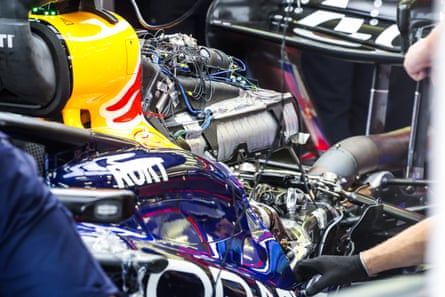
Perhaps the single biggest change in the new regulations is the adoption of new hybrid engines, which now deliver a nearly equal split in power from the internal combustion engine and electrical energy.
The 1.6-litre V6 turbocharged internal combustion engine (ICE), now powered by fully sustainable fuel, will deliver approximately 400KW or 536bhp and will be combined with the motor generator unit – kinetic (MGU-K), capable of producing 350KW or 469bhp, an expansion of almost 300% on last year’s electrical energy delivery.
Notably the MGU-H (motor generator unit – heat) has now been removed. This was employed to harness energy when off throttle to then reemploy it to ensure the turbo was spooled up and prevent turbo-lag – the delay in response of power from the engine as the turbo comes up to speed to deliver the boost.
Turbo lag is an issue drivers and teams will now have to deal with, notably at the start of a race and in exit of corners. Both are being addressed. The FIA has trialled a new start procedure in which a five-second hold on the grid is applied to allow the cars to apply the revs to spool up the turbos. Equally drivers are already experimenting with cornering in lower gears to keep the revs high for the turbo and to better harvest energy. Ferrari have opted to use a smaller turbo on their engine and are enjoying quick starts and great pace on corner exit.
Active aereodynamics
To reduce drag and allow for the potential effects of the electrical energy being drained by the end of a straight and causing cars to have to slow, both the front and rear wings will be able to open on a straight and then close through corners. (Or in the case of one innovative Ferrari experiment flip the entire rear wing upside down). Similar to the previous drag reduction system (DRS) on the rear wing that has now been removed, it will be available to all drivers at all times. The wings will open in designated “straight mode” zones and return to the default “corner mode” for everywhere else on the circuit.
Overtake mode
The DRS has been removed after 15 years and replaced by the driver-actuated overtake mode. As with DRS it can be deployed when within one second of the car in front at the designated detection point. On activation it allows the driver to deploy additional electrical energy to maintain a higher velocity to assist in overtaking. It can be used in one fell swoop or in small increments across a lap up to a defined limit of energy.
However, the energy employed will still have to be recovered after use, offering the opportunity for a car that has been passed to come back at a rival as they attempt to harvest energy. The world champion, Lando Norris, has suggested that it could lead to unusual overtaking opportunities and to the potential “yo-yo-ing” of positions across a lap.
Boost mode
Allows for the driver-deployed management of the power delivery from the electrical system that was previously largely managed and run by software and engine mapping. Use of additional energy at the driver’s discretion can be deployed in attack or defence at any point across a lap, allowing the use of the maximum 350KW available. However, with the amount of energy available capped, it too must then be recovered.
Recharge mode
With the employment of electrical energy now a vital part of the armoury, maintaining it to maximum effect across a lap will be a fundamental demand on drivers. Alongside the energy recovered from braking, techniques will include that of lift and coast, previously deployed in fuel saving and by maintaining high revs through corners in a lower gear and most notably “super-clipping”. This is the process by which the hybrid begins recharging the battery when the car is at full throttle at the end of straights, causing a loss of power and speed.
Much of this has already faced considerable criticism from drivers, not least in that even on a qualifying lap there may be some level of having to manage rather than all-out attack. If this materially affects the racing, F1 and the FIA can be expected to intervene to adjust the rules.
Flat floors
The ground-effect era of 2022 to 2025 comes to an end as “flat” floors return. The ground-effect was intended to produce high downforce from the low pressure flow of air through the floor aerodynamics, known as venturi tunnels. It did deliver huge downforce but was unpopular in how it made the cars handle and did not provide the hoped-for ability for cars to follow one another closely. Instead of the floor, the rear diffuser has once more become key but there will be a downforce reduction of approximately 15-30% in 2026. This is another factor to which drivers will have to become accustomed but which, as with overall speed, the teams can be expected to begin to overcome in no short order as they develop the new cars.
Tyres
The wheels remain at 18 inches but the tyres have been made narrower, at the front by 25mm and at the rear by 30mm. Doing so will reduce drag and cut weight but also decreases the size of the contact patch between the tyre and the track, reducing the mechanical grip to which drivers had previously been accustomed. There will also be adaptation and understanding required as to how these new size tyres function in terms of degradation on different circuits, temperatures, conditions and across a race distance.
Fully sustainable fuel
Another new challenge and a very technical one for the fuel manufacturers. All fuels must be certified as 100% sustainable by the FIA. This can be from a synthetic fuel made using sustainably sourced hydrogen gas and carbon monoxide, or a biofuel. The latter must use sources from “non-food” biomass or waste products to make no impact on the food chain. A potential battleground in the years ahead with great import for the manufacturer that could return a little extra bang per buck from their juice.
How will driving change?
The increased capacity and role of the electrical energy and its deployment and recharging will now play a fundamental part in racing. Efficiency in usage and management of the electrical components will be a major target for engineers as they develop the cars and this could well become a key differentiator with the Red Bull already having demonstrated an ability to recover quicker and thus deploy longer than its rivals.
Similarly drivers who can adapt quickest to these new demands, adjust to the new style required and best use the new options open to them will steal a march. Grasping and exploiting what will be complex new methodologies, including both in-the-moment tactical, as well as strategic, decision making, constitutes a formidable challenge. Many, including the four-time champion Max Verstappen, have already expressed discontent that energy management across a lap is antithetical to the idea of racing and has led F1’s chief executive, Stefano Domenicali, to call for calm as the sport adapts.