3 months ago
164
3 months ago
164
The best known member of the band Hot Chocolate was their frontman Errol Brown, but in the engine room, co-writing their hit songs and playing bass, was Tony Wilson.
Wilson, who has died aged 89, set up Hot Chocolate with Brown in London in 1968, and had writing credits with Brown on You Sexy Thing, Love is Life, Brother Louie and Emma, all Top 10 UK singles in the early 1970s. With and without Brown, he also wrote various tracks for their first three albums.
The pair had met in the late 60s as young men, having both arrived in the UK from the Caribbean several years before – Wilson from Trinidad and Brown from Jamaica. Brown was still new to the songwriting game but Wilson, older by seven years and far more experienced, encouraged the younger man to develop his talent.
Their subsequent collaborations produced a string of soulful pop tunes that made Hot Chocolate into one of the most successful British singles bands of the 70s, beginning with Love is Life in 1970 and peaking with You Sexy Thing in 1975, which made it to No 2 and became a marker of their enduring popularity by featuring in the Top 10 across three different decades.
Initially sharing singing as well as songwriting duties, Wilson eventually became disenchanted with the fact that Brown was pushed to the foreground, and he quit the band in 1975 to pursue a solo career in the US.
One of the four children of Gladys (nee Hernandez), a french polisher, and her husband, Wilfred Wilson, Tony was born in Port of Spain, Trinidad, and attended two of the city’s secondary schools – Tranquillity Boys and Belmont Modern, where he showed more interest in sport than music.
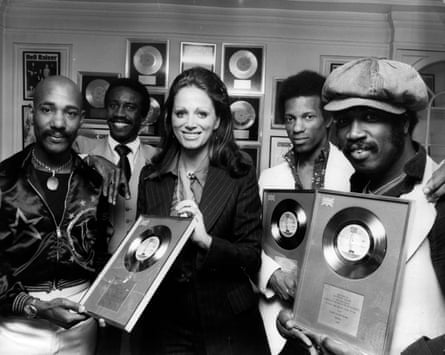
Nevertheless he became a fan of American soul, and after moving to the UK in 1961 at the age of 25 became involved in the London music scene, releasing two solo singles, Yes I Do (1964) and What Did I Do? (1967), the first in the prevailing English pop style and the second with a more soulful R&B vibe. Not long after the release of that second record, he bumped into Brown in West Hampstead, north-west London, where they had been living opposite each other.
Hot Chocolate came into being after the pair began to work on a version of John Lennon’s Give Peace a Chance. According to Wilson, he and Brown went to the Apple offices in London with a demo of the song – and to their surprise ended up playing it in person to Lennon and Yoko Ono, who were impressed.
When Lennon discovered they had no name for their new project, a receptionist, Mavis Smith, came up with Hot Chocolate Band, and the song was released on Apple. Although the record deservedly sank without trace, the first two parts of the name stuck, and Wilson and Brown went on to recruit Patrick Olive on percussion, Franklyn De Allie on guitar and Jim King on drums, before signing to Mickie Most’s RAK label.
Some of the first Wilson/Brown compositions were used by Most for his other artists, notably Bet Yer Life I Do for Herman’s Hermits, Heaven Is Here for Julie Felix and Think About Your Children for Mary Hopkin, all in 1970. But the same year Hot Chocolate also released their debut single, Love is Life, which made it to No 6 on the UK charts.
I Believe in Love got to No 8 in 1971, while Brother Louie – about the trials of an interracial love affair and featuring a memorable Wilson bass line at its heart – peaked at No 7 in 1973, becoming a US No 1 when the Stories created their own version of it shortly afterwards.
Emma, a dark tale, reached No 3 in 1974, while You Sexy Thing would almost certainly have gone higher than No 2 the following year if it had not been blocked by Queen’s Bohemian Rhapsody, one of the biggest selling singles of all time. Making it to No 3 in the US, it re-emerged as a Top 10 hit in the UK with a remix in 1987 and then as a re-release in 1997 after it featured in the film The Full Monty.
Wilson had taken singing duties on some of Hot Chocolate’s early releases, but by the time of You Sexy Thing their record label had consciously begun to project Brown as the band leader. “Everybody thought that Tony had the better voice, and he was certainly better at hitting the notes and had a better range,” conceded Brown. “However, Mickie Most felt that I should become the lead singer because I had the more commercial voice.” The resulting tension between Wilson and Brown fractured their songwriting partnership, leading to Wilson’s departure in 1975.
Flush with royalties from the band, Wilson embarked on a solo career with two soul/disco albums, I Like Your Style (1976) and Catch One (1979), neither of which had any commercial success. Both LPs, along with a clutch of singles, were released on the American label Bearsville Records, based in the picturesque town of Bearsville in New York state, to where Wilson relocated.
While there he also wrote Everyone Can Rock and Roll for Bill Haley, which became the featured track on the rocker’s 1979 album of the same name, his last ever. In 1980 Wilson came up with the raunchy, soca-tinged single Use My Body for the Trinidadian singer Mavis John, which proved popular in the Caribbean and found a new lease of life many years later when it was featured in two American TV series, High Maintenance and High Fidelity.
A third and final solo album, Walking the Highwire, came out in 1988, but by then, having moved back to Trinidad, Wilson was mostly focusing on nurturing and recording musical talent from the island of his birth.
He is survived by his partner, Dalia, three children, Joanne, Robert and Danny, and four grandchildren, Jake, Mia, Hope and Ellie-May.