3 months ago
164
3 months ago
164
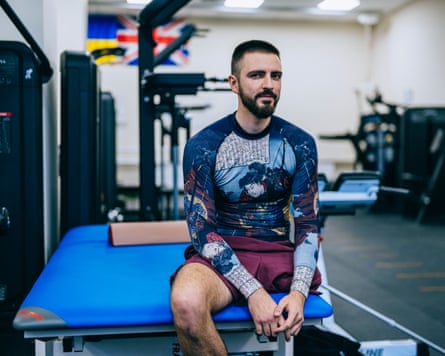
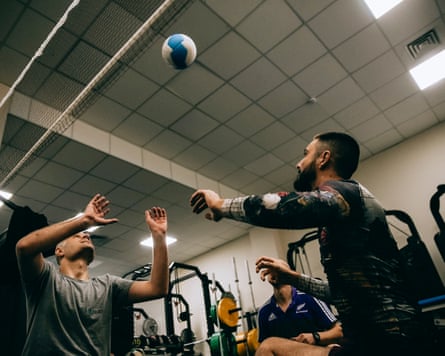
At a specialist treatment centre in Ukraine, as other amputees play volleyball nearby, Vladislav shows a video on his phone of how he lost his left leg. He found the footage – of a drone closing in rapidly on a buggy, Vladislav standing exposed at its rear – on a Russian military social media channel.
The 31-year-old, an arbitration lawyer before Russia launched its full-scale invasion in 2022, makes a double whistling noise to describe the drone’s ominous progress. “That’s me,” he says, pointing at the video, filmed from a fibre optic drone, chasing him down with terrifying ease as the vehicle slows for a corner. Then the screen goes blank.
Vladislav was driving between positions somewhere near Lyman, in the north-east of Ukraine, on 21 August when his life changed for ever. An explosion “bam on the left ear” threw him and the driver to the ground. Still conscious, he could see the injury to his left leg was obviously very serious. But this was not his immediate priority.
“To be honest, I checked my crotch, if everything’s in the right place,” he says, grinning. The check was affirmative and so in that moment, the stricken soldier says, he reasoned life was worth still living. “Only after that, I turned my tourniquet.” That choked off the blood supply to his left leg, giving himself a chance of survival.
The respite was short. Once rescued, Vladislav was soon losing consciousness. “I don’t know if it’s real or a common trope, but pictured in my memory I saw a white tunnel with a light at the end.” But it was not the end. “My comrade fell on me with his elbow on my wounded leg and I opened my eyes with every curse I knew.”
Dozens of seriously wounded Ukrainians such as Vladislav, who have had or need to have amputations, come to this specialist treatment centre every month. No one will say exactly how many are being treated here, but across Ukraine crude estimates suggest the total number of amputees runs well into the tens of thousands.
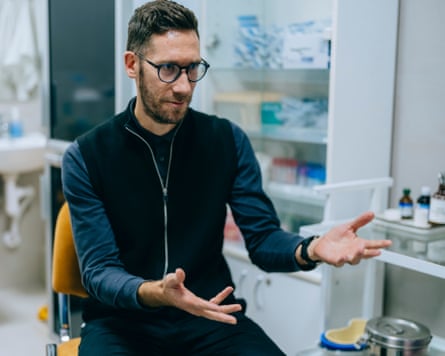
Providing help, support and advice to Ukrainian staff at the centre are a small number of British military personnel – doctors, physiotherapists and occupational therapists from the UK’s defence medical services, part of Project Renovator. The Guardian observed some of their work during a day visit, including sessions where British practitioners discussed their use of temporary prosthetics with Ukrainian counterparts.
“The numbers here are truly humbling,” says Mike, a British rehab consultant and an army lieutenant colonel, who is part of the UK team helping out. Mike worked in Afghanistan, where the British military was present until 2014, and says professionals like himself can contribute “an understanding of complex amputee rehabilitation” and “can help move their patients on to new legs quicker”.
He is keen to emphasise that the British presence works both ways, in that there are opportunities for him and his colleagues to learn. Thanks to a combination of innovative surgery, electrical stimulation and rehab, the Ukrainians “are managing to fix nerve injuries faster than I’ve previously seen”, he says.
Britain has only minimally acknowledged a wider military presence in Ukraine, beyond its staffing at the embassy in Kyiv. Security measures around the medical crew remain tight, with only Mike able to be identified.
“I’m proud that the UK is stepping up to ensure wounded Ukrainian soldiers get the best possible treatment,” said John Healey, the defence secretary, praising their work. He said their goal was to work alongside Ukrainian teams “to deliver care and rehabilitation”, an effort that will have to continue long after the war finally ends.
There are a wide range of classes, and family and friends are able to visit unless the staff believe it would be unhelpful to an individual’s recovery. Part of the approach is to have “psychologically aware clinicians”, according to Mike, who can identify when patients run into mental problems. But a key part, as the volleyball shows, is being part of a group so the wounded can motivate each other.
Vladislav’s case is one of the simpler. He hopes to have a final prosthetic leg ready soon and to be discharged earlythis year. He says his mental state is strong, though at some point after two or four weeks, when he was on his own, he admits, “I cried a lot”. It was “like a divorce” until he eventually thought: “Let it be.”
What helped, the former lawyer says, was having his family nearby, including baby son Adam. However, he says: “I did not tell my wife about my injury for around a month and a half because she was pregnant.” Two weeks after Adam’s birth he told her what had happened, though by then she had “suspected something”, he admits.
Oleksandr, 48, is a former fitness teacher and swimming instructor who had both his legs amputated below the knee after an artillery shell landed close to him on 18 October 2024. After he arrived at the treatment centre, a succession of further surgeries proved necessary. One was to stabilise his wound, which had become infected; later, a metal brace was attached to the bone so the prosthetics would fit.
It has been a long, gruelling treatment, including a month in intensive care, and at one point Oleksandr wells up in tears at the thought of it. “In the beginning it was hard for me just to sit in the wheelchair. I was sweating immediately,” he says. But gradually, going to the gym with rehabilitation experts helped, and at some point as his exercising gradually improved, “I knew then I would get through,” he says.
There is a brightness and purpose in his eyes now but the future is uncertain. He wants to leave this year, when his legs are ready. “I hope I will be able to get back to my job as a fitness trainer,” he says. “But I just don’t know. I just need to understand what my abilities will be on the prostheses, how long I can walk. When I will learn walking, I will understand what my abilities are.”