2 months ago
92
2 months ago
92
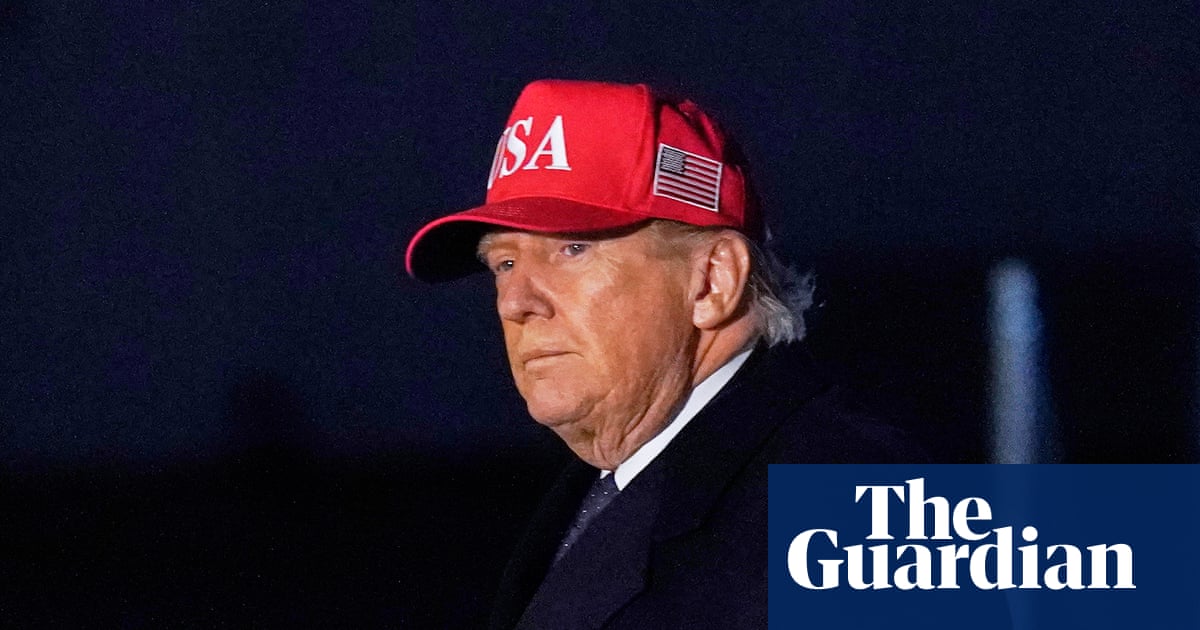
When Donald Trump has something to say, he takes to Truth Social.
Trump has used the platform to announce policies on everything from the economy to travel bans, making declarations that are key for Americans seeking information about his government.
Perhaps just as importantly, Americans could be missing out on understanding Trump’s mental state and his performance in office. On at least one occasion Trump has appeared to be confused about whether or not certain AI videos are real on Truth Social. In early December, the president posted 158 times on the platform in three hours, raising questions not just about his increasingly unusual behavior, but also how he is spending his time.
But few Americans will have witnessed this erratic, and revealing, behavior directly because just 3% of people in the US use Truth Social.
The relatively tiny number of people using Truth Social, revealed in a Pew Research Center study published in late November, could effectively cut people off from direct communication from their president. It may also shield Trump, 79, from some questions over his mental state.
Trump’s restriction to Truth Social, a company which he owns and whose value has contributed to his soaring net worth, means only 3% of US adults have witnessed Trump’s increasingly incoherent rants, frequent sharing of racist posts, and generally odd behavior.
On 1 December, he shared a post that referred to Somali Americans as “inbred savages” who are seeking to “impose their Sharia bullshit”. That the president was apparently endorsing racism towards immigrants in this way went largely unnoticed by the media – thankfully for the sake of people who want to know what’s on Trump’s mind, he repeated some of the same framing in public days later.
In an example that brings into question the president’s competence, at 5.44pm on Saturday, Trump announced on Truth Social that “the suspect” in the Brown university shooting “is in custody”.
No doubt the post came as a relief to the small number of people who saw it, but unfortunately it wasn’t true. Nineteen minutes later Trump was forced to correct his post. “The suspect is NOT in custody,” he wrote.
The rants and inaccuracies are mixed in with what is just odd behavior. Trump reposts random videos without comment, including a 10 second clip which features a dance track over a photo of three men in military clothing, and throws up photos of himself with no context provided.
In late September, Trump, the oldest person ever to be inaugurated as president, appeared confused about what policies he had or had not announced, and also about which videos are real and which are AI-generated. He reposted to Truth Social an AI-generated fake video which promoted “med bed hospitals”, a video which showed an AI version of himself speaking.
Setting aside that the idea of “med beds” is a rightwing conspiracy theory – one version of the theory posits that the government and/or a group of wealthy Americans have access to medical bed-like devices that can cure almost every illness, but are withholding the technology – Trump’s post prompted a number of questions.
Did Trump believe that the video really showed him announcing med bed hospitals? Did the president think he gave a speech about “med beds” at the White House? Did he believe that his government is about to send “med bed cards” to every US citizen?
We will probably never know the answer, and Trump deleted the post, but this was at least an example of his Truth Social confusion breaking through to a wider audience: much of the media picked up on his confusion.
Emmitt Riley III, associate professor of politics at the University of the South and the president of the National Conference of Black Political Scientists, said some of Trump’s output is “amplified by mainstream media, and recirculated across various other platforms”.
And some things have been big enough to break through: Trump’s rant about Rob Reiner, published on Truth Social a day after the film-maker died, was widely reported. It may be that even using a sparsely populated social platform cannot hide the behavior of an erratic, seemingly exhausted president from the American public.
“Americans have a front-row seat to the decline of Trump, right? So we’re now seeing videos and pictures of him falling asleep during cabinet meetings, dozing off doing important international summits,” Riley said.
“He spent a lot of time on the campaign trail criticizing the former president’s cognitive decline, and yet we’re watching his age catch up with him in real time.”
As the Republican party, which is indelibly tied to Trump and his whims, gears up for crucial midterm elections, the question is whether Trump’s supporters will choose to believe what they are seeing, or opt to bury their heads in the sand.