2 months ago
92
2 months ago
92
The UK’s rollout of electric car chargers slackened markedly in 2025 amid investor concerns over a slower-than-expected switch to cleaner battery vehicles.
There were 87,200 chargers installed in the UK at the end of November, an increase of 13,500 compared with the end of 2024, according to data from Zapmap, which tracks charger installations.
That represented the smallest number of new chargers installed in the UK since 2022, and put the industry on track for growth of less than 20%, down from 37% the year before. It would be the slowest annual growth in the decade since installations started to take off.
The number of electric cars sold is still growing rapidly, accounting for 23% of British sales in the first 11 months of 2025 – up from 19% at the same point last year. However, growth has not been as quick as previously expected. Some manufacturers have slowed their switch from petrol to electric, while some investors in charging infrastructure have also slowed down.
Carmakers persuaded the UK government to weaken electric car sales targets despite warnings from the charging industry that lower sales would imperil investment.
Colin Walker, the head of transport at the Energy and Climate Intelligence Unit, a thinktank, said the slowdown in charger installations this year was “no surprise” given the “rather mixed messages on EVs” from the UK government, including a new pay-per-mile tax on electric cars from 2028, announced at last month’s budget.
“Its weakening of the zero emission vehicle mandate could incentivise the sale of plug-in hybrids rather than EVs,” he said. “And while it won’t change the fact that EVs will remain considerably cheaper to run, the 3p per mile tax on EVs risks undermining consumer confidence. All of this could slow EV sales considerably, which, in turn, could undermine business confidence and slow investment in the public charging infrastructure this country needs.”
There were 48,100 slow chargers at the end of November, an increase of 15% over the year. The number of ultra-rapid chargers, which tend to be used for quick top-ups on longer journeys, rose 39% to about 9,800.
Electric vehicle charging speeds
Show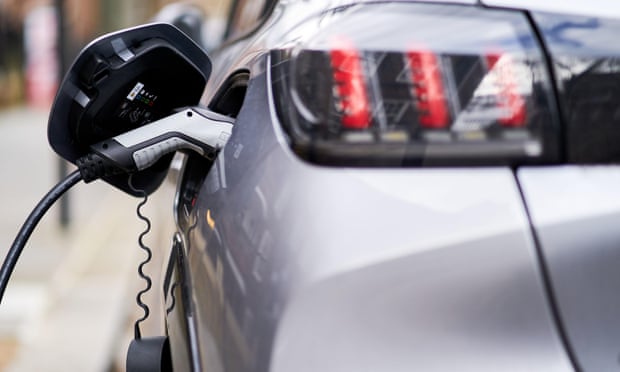
Not all chargers are created equal
More and more people are buying electric cars, and are having to grapple with charging for the first time. However, not all chargers are created equal, and the profusion of units can cause confusion.
Charging speeds are measured by power output in kilowatts (kW), while battery capacity is measured in kilowatt hours (kWh). For example, a Nissan Leaf has 39kWh of battery capacity, while a Tesla Model Y has 60kWh.
Recharge times vary depending on battery size: divide the battery size by the power to get a very rough idea of how many hours it will take to charge. (E.g., a 60kWh battery at a 22kW charger would take about three hours.) The quicker the charge, the more it tends to cost.
Slow: up to 8kW
Common at homes, on-street chargers and places cars hang around like car parks or hotels. Suitable for charging overnight. Plugging in with a UK three-pin plug to the mains at home will deliver about 2.3kW – although it is not recommended.
Fast: 8kW to 49kW
Found at urban sites like supermarkets, shopping centres or car parks. Capable of charging a smaller battery in a few hours.
Rapid: 50kW to 150kW
Typically found close to big roads for journey charging, but also increasingly found in locations such as supermarkets or gyms with short dwell times. 50kW could give 80% charge in less than an hour.
Ultra-rapid: 150kW and above
Most chargers being installed at motorway services or dedicated charging hubs are now at least 150kW. Many newer cars can now handle 150kW, and several can charge at speeds of over 300kW, adding hundreds of miles of range in around 10 minutes.
Photograph: John Walton/PA Wire
Vicky Read, the chief executive of ChargeUK, a lobby group for the charging industry, said that there had been fewer installations than the industry wanted of slow chargers, which tend to be used to charge more cheaply overnight.
“Across the market charge point operators have been facing rapidly rising costs, which has impacted the pace of the rollout in some more commercially challenging locations, while grid connections continue to hold back installations,” she said.
Some analysts believe that the UK’s charger rollout is on track. The supply of public charging across Great Britain remains ahead of demand by 1.5 years, according to analysis in September by Cenex, a non-profit research body. However, rapid chargers by motorways for longer journeys are much more developed: existing charge points could cope with demand for the next six years without any more added, Cenex said.
Read said delayed local electric vehicle infrastructure (Levi) funding for councils would start arriving in bulk in 2026 and 2027, helping installations to accelerate again.
She said: “To ensure we stay on track as we make this transition, we need to have the government’s support to reduce the cost burden – which is affecting driver prices as well as pace of rollout – and to remove the bottlenecks like connecting to the grid.”
Despite the UK’s progress in charger installations, the regional variations remain large. Northern Ireland, the poorest region in the UK, has only 39 public chargers for each 100,000 people, compared with 301 for London, according to Zapmap data last updated in October. Northern Ireland, the East Midlands and north-east England were the slowest regions for charger installations per person in the year to October.
Melanie Shufflebotham, the Zapmap chief operating officer, said there was still “strong growth in ultra-rapid charging”.
“Charge point operators face challenges as the tender and commercial contract process for the Levi fund have taken longer than anticipated, and in parallel, there are also concerns in terms of accessing grid connections in a timely fashion,” she added.