3 months ago
143
3 months ago
143
Muscovites have been turning to walkie-talkies and pagers amid unexplained disruptions to internet services in the capital, as the Kremlin appears to ramp up control over online activity in Russia.
Users in central Moscow, as well as in St Petersburg, first reported difficulties accessing mobile internet about a week ago. Many said they were unable to load websites or apps, while some lost service altogether, leaving them unable to make phone calls.
The Kremlin said this week that the outages were being introduced to “ensure security” and would remain in place “as long as additional measures are necessary”, without providing further details about the reasons behind the restrictions.
For months, users across Russia have complained about widespread mobile internet shutdowns, though the disruptions have drawn far less scrutiny than those now affecting Moscow’s inner centre, the country’s political and economic hub.
The outages were a “massive headache”, said Dmitry, a 31-year-old consultant in Moscow. “I’m having trouble ordering a taxi, sending work emails, or even just messaging my family.”
Human rights activists said the shutdown could be linked to Moscow testing a new so-called “whitelist” system, under which only a limited number of government-approved websites and essential online services would remain accessible to Russians.
Officials in Moscow previously said the “whitelist” of available websites would include “all resources needed for life”, including marketplaces, delivery services and online pharmacies. But observers say the system would dramatically censor Russians’ access to the wider web.
Internet shutdowns have become increasingly common in Russia since the full-scale invasion of Ukraine. In 2025, the country ranked first globally for the number of internet disruptions, according to estimates by the research group Top10VPN.
Russian officials have previously claimed internet shutdowns were an effort to thwart Ukrainian drone attacks, though experts say such measures are unlikely to be effective.
The latest disruptions have hit courier services, taxi apps and retail businesses particularly hard. Russia’s business daily Kommersant estimated that losses from the internet shutdown in Moscow could reach about 1bn roubles (£9.4m) a day.
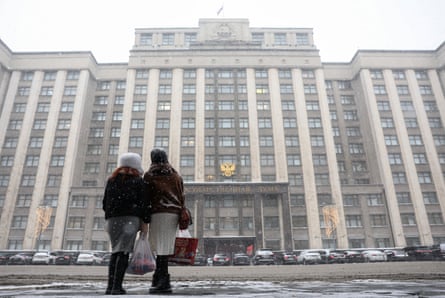
The outages have also reached Russia’s parliament, the State Duma, where lawmakers on Thursday complained that mobile networks and wifi were not working inside the building, leaving the deputies effectively cut off from the outside world and unable to access the internet.
Faced with the disruptions, many have turned to older forms of communication. Russians have begun buying more walkie-talkies and pagers, according to data from the e-commerce platform Wildberries & Russ cited by Russian media.
Sales of walkie-talkies have risen by 27%, while pagers used to communicate with clients and staff have increased by 73%. Demand for paper maps of Moscow has nearly tripled.
The shutdown comes amid a renewed crackdown on Russia’s online space. Authorities have already blocked WhatsApp, Facebook and YouTube, and there are growing rumours that the widely used messaging app Telegram could face restrictions as early as next month.
A Russian lawmaker said on Thursday that the country’s security services could gain the ability to limit VPN traffic within the next six months, potentially cutting off one of the last ways many Russians can access blocked websites.
At the same time, officials have been pushing Russians to join a state-backed “super-app” called Max, modelled on China’s WeChat, which is widely believed to be controlled by Russia’s security services.