3 months ago
122
3 months ago
122
High-stakes talks between the US and Iran over the future of Tehran’s nuclear programme ended on Thursday without a deal, as the White House weighs a military operation that would mark its largest intervention in the Middle East in decades.
The Iranian foreign minister, Abbas Araghchi, claimed that “good progress” had been made at the talks and Omani mediators predicted negotiations would reconvene at a technical level next week in Vienna.
But there was no immediate evidence to support suggestions that the two sides had drawn closer on the fundamental issues of Iran’s right to enrich uranium and the future of its highly enriched uranium stocks.
Nonetheless both Iranian and Omani mediators sought to cast the talks in a hopeful light, likely seeking to avert a US threat to launch strikes from its fleet of aircraft and warships that have massed in the region.
Araghchi, described the talks as “one of our most intense and longest rounds of negotiations”. He confirmed that further contacts would take place in less than a week.
The indirect talks in Geneva were held in two sessions, with reports that the US team led by Donald Trump’s special envoy to the Middle East, Steve Witkoff, had been disappointed by the proposals put forward by Iran.
The brevity of the second session of talks also appeared ominous, observers said.
Iranian officials rounded on reports in US media that suggested Tehran would be required to end enrichment and allow its stockpile of highly enriched uranium to leave Iran.
At one point, to the frustration of Tehran’s team, Witkoff had to break off his talks with Araghchi, to drive across the Swiss city to meet Ukrainian negotiators.
The Omani mediators rejected talk of a breakdown, claiming new and creative ideas were being exchanged with an unprecedented openness in what was being billed as a third decisive round of indirect consultations.
The US is demanding permanent Iranian guarantees on uranium enrichment and inspection mechanisms that will satisfy Washington that Tehran will never be able to build a nuclear weapon, a goal it has always denied.
The US secretary of state, Marco Rubio, has also said Iran’s refusal to discuss its ballistic missile programme is a problem, prompting Iran’s foreign ministry spokesperson, Esmaeil Baghaei, to complain about inconsistencies in the US negotiating demands.
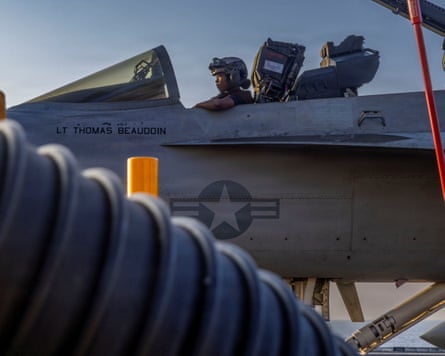
The talks are being held against the backdrop of Trump’s unprecedented buildup of US assets in the region, including two aircraft carrier strike groups, attack aircraft, plane-refuelling equipment and submarines equipped with Tomahawk missiles.
At heart of the talks is whether the US will try to debar Tehran from all uranium enrichment except at a minimal level, such as for medical purposes at the Tehran research reactor – a five-megawatt unit dating back to 1967 and supplied by the US for the production of medical isotopes.
The right to enrich uranium domestically has long been seen as an absolute symbol of Iranian national sovereignty, and was conceded by the US in the 2015 nuclear deal.
Some of the dispute about enrichment can be deferred since Trump claimed that Iran’s three main nuclear facilities at Fordow, Natanz and Isfahan had been obliterated by US bunker busting bombs last June, making it technically impossible to enrich uranium in high quantities for the foreseeable future.
Tehran refused to allow the UN’s nuclear watchdog, the International Atomic Energy Agency (IAEA) to inspect the scale of the damage to the sites since the US attack.
Rubio said on Wednesday: “They’re not enriching right now, but they’re trying to get to the point where they ultimately can.”
A US demand that the three facilities be permanently dismantled would conflict with Iran’s proposal that low-level enrichment should be permitted at under UN supervision, possibly after three to five years. The US did not previously object to such a plan.
A further impasse lies in the fate of Iran’s stockpile of uranium enriched to 60% purity, close to nuclear weapons grade. The IAEA says Tehran has yet to identify the whereabouts of a stockpile of 400kg –enough to build five to six bombs similar in power to that which destroyed Nagasaki in 1945. The IAEA also estimated in May last year that Iran had 8,000kg of uranium enriched to 20% or below.
The highly enriched stockpile could be down-blended in Iran, as Tehran proposes, or exported to Russia or the US. It would be a major Iranian concession for its entire 8,000kg stockpile to be sent to the US, even if it led to a swathe of US and UN economic sanctions being lifted.
One Iranian official in Geneva insisted: “The principles of zero enrichment for ever, dismantling of nuclear facilities and transferring uranium stocks to the US is completely rejected.”
Trump now has the military assets in place to strike Iran either as part of an extended assault designed to enforce regime change, or to execute a more targeted strike designed to force Tehran into a more flexible negotiating position. Trump’s coercive negotiating deadlines have always been flexible, but his military commanders will not want to keep such a large and expensive concentration of forces on a leash for much longer.
Trump is under domestic pressure to show that he has not taken the US down a negotiating blind alley, with Democrats demanding a vote in Congress on what they are describing as his war of choice. An Associated Press poll this week found that 56% of Americans did not trust Trump to make the right decision to use military force outside the US.
The director general of the IAEA, Rafael Grossi, has moved centre stage in the talks since his imprimatur is needed to convince Washington that Iran’s guarantees on future low-level enrichment can be technically verified.
Tehran is also insisting it will not negotiate on non-nuclear issues. It has ruled out making its ballistic missile programme or its support for “resistance groups” across the Middle East part of the discussions. It describes its ballistic missiles, some with a range of 1,300 miles (2,000km), as purely defensive.
Rubio said on Wednesday that the ballistic missile programme would have to be addressed at some point, an admission that the subject may not be on the immediate agenda, but could not be disbarred from later talks.
He said: “Iran refuses to discuss the range of its missiles with us or anyone else, and this is a big problem for us. Iran has missiles that increase their range every year, and this could be a threat to the United States because the range of the missiles may reach American soil.” Its short-range missiles could also hit US bases in the region, he noted.