3 months ago
155
3 months ago
155
All his life, like his parents before him, Giorgos Konstantinos has learned to live next to RAF Akrotiri on Cyprus.
He has dealt with the roar of planes, the comings and going of military vehicles and the war games. But never has Konstantinos, the village’s vice-mayor, witnessed anything quite like the events of the past two days.
“We live here, we’ve got used to all the exercises, we’ve got used to all the planes, but what we never imagined is this,” the retired lawyer said on Tuesday, standing in front of the main gate to the facility. “Who would have thought of a drone flying through our skies, exploding on the other side of that fence and forcing all of us to leave?”
In a moment, he said, the dangers of living next to a British base, when conflict was raging not so very far away, had suddenly become very real. In the early hours of Monday, sirens had begun to sound after the unmanned one-way attack drone crashed into RAF Akrotiri’s runway.
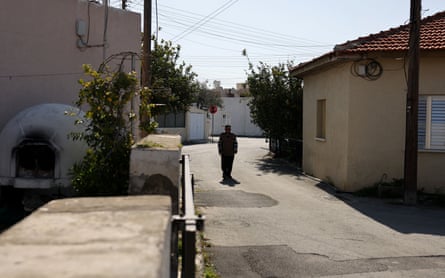
The next day, the village of low-level villas and houses was all but deserted; police cars parked in front of its church, its streets eerily empty, its school under lock and key – testament to a government-ordered evacuation overseen by civil defence forces.
“There are over 1,000 of us in our community, but today not more than 30 have remained,” said Konstantinos. “They’ve all gone, either to hotels, the nearby monastery or relatives in Limassol. People don’t feel safe when there’s so much uncertainty. Even the British can’t answer the question everyone here is asking: why, when there are so many air defence systems on that base, was the drone not detected earlier?”
It is a question more and more Cypriots are asking.
The EU’s easternmost member state is barely a 20-minute flight from Lebanon, from where the Shia militia group Hezbollah is believed by Cypriot officials to have launched the Shahed-type drone and two others intercepted later on Monday morning.
“I have a job on the bases, like many of us in Akrotiri,” said Michalis Georgiou, one of the few local people who, by Tuesday, had returned to the village. “What happened on Sunday was terrifying. I was asleep, then I heard the sirens, then suddenly my parents and I were packing and fleeing. I’m not at all sure I am going to stay. The same thing could happen again, right?”
The RAF base is all that Georgiou, 25, has ever known. He is the first to say that its presence on soil retained by Britain after the island nation became independent in 1960 is “very strange”.
Part of an expanse in the south of the eastern Mediterranean island, the British-controlled territory sprawls across 99 sq miles. A landscape dotted by rugged fields and antennas – the most visible sign of the facility’s use as a listening post and spy station – surrounds the base’s barbed-wire perimeter.
In the distance, across a bay, lies Limassol, the coastal town known as “Moscow on the Med” because of its popularity among Russians.
Late on Tuesday, as the sun set, hundreds amassed on Limassol’s seafront to protest against the US-Israeli offensive against Iran and demand the withdrawal of military fixtures seen increasingly as a danger for Cyprus.
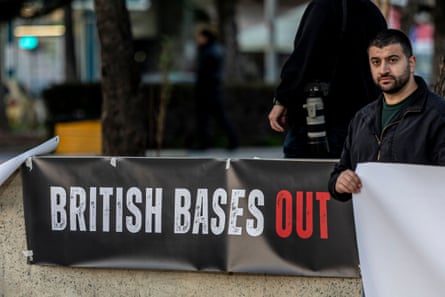
“Ours is a small country that must remain neutral,” said Tasos Kosteas, who heads the Pancyprian Peace Council, which organised the demonstration. “The bases are clearly a danger to Cyprus, because it is the bases that Iran is targeting. Our basic message tonight is that the interests of the US and Israel are not the same as ours. The big powers only care about Cyprus because of its geostrategic importance, they don’t care about its people.”
This week’s strike is the first against a British military installation on the island since 1986 and, in the minds of some Cypriot officials, is linked to the decision of the UK prime minister, Keir Starmer, to allow the facilities to be used in a defensive capacity by the US – even if the UK maintains the attack happened before that policy was announced.
On Monday, Nicosia took the rare step of openly chastising London for its perceived failure to clarify the base’s role. In an address, Nikos Christodoulides, the president of Cyprus, said the country had no intention of participating in any military operation.
Concerns the island could be dragged into a widening regional war – at a time when it is also heading the EU presidency – are evident in the military hardware also heading to its shores. This week, France followed Greece in deploying military support to the country in the form of state-of-the-art frigates, F-16 fighter jets and anti-missile and anti-drone systems.
The move came as it was announced that Akrotiri, and several other areas, would remain under evacuation for several more days.
“We think there should be a permanent shelter here,” said Konstantinos. “A refuge point where we would feel safe. It’s not a demand that we’ve had before, but now I think everyone would agree it’s become a priority.”