3 months ago
187
3 months ago
187
When I visited Christine’s bungalow in Trowell, Nottinghamshire, and asked if I should take my shoes off, she joked: “I wouldn’t worry, I’ll be getting a new carpet soon enough when it floods again.” She’s got another good one about the time she, a 70-year-old great-grandmother, had to climb through her conservatory window because her front and back doors had been sealed shut by flood barriers. “If you don’t laugh, you’ll cry,” she says. And there is a lot to cry about: mainly the fact that her home is unsellable due to multiple floods.
In 2020, the brook that backs on to Christine’s home burst its banks and water poured into her house, as well as the homes of her neighbours Jackie, 67, and Rhona, 76. As we sit around a table drinking tea, they tell me about having to rip out their floorboards, skirting boards, kitchen cupboards and entire bathrooms. Doors had to be taken off their hinges and thrown into skips. Fridges, washing machines, furniture, all joined the pile.
Fortunately, their insurers paid for their houses to be refurbished and for furniture to be replaced. Property Flood Resilience assessments were carried out by the Environment Agency (EA), the government body responsible for flood management. As not enough houses were affected, the optimum but most expensive solution – to install embankments and walls to stop water from topping the brook – was not implemented. (For context, the EA has faced an overall cut in its funding of 50% during the past decade.)
Instead, the cheaper alternative of flood-proofing individual houses was offered. Christine, Jackie and Rhona had a mix of flood doors and barriers installed, and were provided with pumps to remove any water that did make it into their properties. In 2023, having been delayed by Covid, the work was finally completed. Eight months later, their houses flooded again.
It turns out the assessments had missed the fact that their homes were built on platforms and the water was coming up through the ground and into them. The barriers provided only stopped surface water from getting into their properties.
While they were telling me this, heavy rain began to thud on the conservatory roof. Christine looked concerned. “It makes you panic,” she says. In bad weather, the women remain vigilant for the next flood warning. When there is one, they log on to the relevant government website and stay up during the night, fully dressed, messaging one another in their group chat and checking the levels provided by a gauge fixed to the brook.
Jackie has an exact plan of how to stack her furniture so that some of it can be saved, and plastic raisers to place under what furniture can’t be stacked. Then there are the flood barriers to be erected in her garage and outside her back door. I lifted one up, and it felt as heavy as a barbell. This is no way for a pensioner to live, but as far as the EA is concerned, it has done its job for Christine, Jackie and Rhona. The work carried out has made them “flood-resilient” rather than flood-proof. Flooding is to be expected, and damage minimised.
Residents believe that the flooding began after the building of multiple nearby housing developments, with one more leisure development to come. Extra discharge and surface runoff now drain into the brook. According to the lead local flood authority, once all the developments in the area are complete, runoff into the brook will be about 44% more compared with the pre-development baseline. The particular shape of this brook means that when it is overwhelmed with too much water, too quickly, it creates a second river – straight into people’s homes.
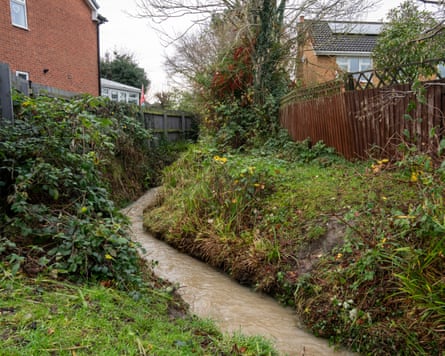
Planning rules should prevent any new building developments from increasing flood risks, but there is a small, but not inconsequential, loophole that is preventing this. Developments are assessed one at a time and often done in phases. Taken on its own, a project may be viable, but when the impact of multiple developments is added up, this can have disastrous consequences for communities. Every time we build we not only add more runoff, but we also build on the very land that acts as a natural flood protection: tarmac and concrete don’t soak up water, whereas soil does.
Repeated risk of flooding is making Christine, Jackie and Rhona’s properties unsellable. Like all homeowners, they are required to inform buyers of any flooding in the previous five years, and unsurprisingly this has affected the sales of their homes. Jackie would like to move in order to be closer to her soon to be born grandchild, but looking at sales of similar properties in her area, she may have to drop the price significantly and use her pension money to help her move. Her experience tracks with larger trends: a study from Bayes Business School suggests that homes at risk of flooding are sold for between 8% and 32% lower than average compared with non-affected properties.
Even when sellers are able to find buyers, some lenders, such as Nationwide, may no longer provide mortgages. The government has stepped in to cover the flood-risk element of home insurance until 2039 so that customers do not see a spike in premiums. However, the end date for this scheme and the fact that it doesn’t cover houses built after 2009 means that mortgage lenders do not want to fund homes that will lose value and be sold at a loss if repossession occurs when a mortgage is defaulted.
This is a dynamic that may become worse as flood risk encroaches on more of the UK’s housing stock. Labour’s “build, baby, build” housing policy means more homes are being built on green belt land, meaning less natural flood defences, more runoff and increased flood risk for existing homes. Even worse, Guardian analysis has predicted that more than 100,000 of these new homes could be built on the highest-risk flood zones in England. At the same time, extreme weather is increasing because of climate breakdown and the Environment Agency data says 6.3m properties, residential homes and businesses are in areas at risk of flooding, rising to 8m by 2050.
All this points to a potential risk for the financial sector. As long as the government is covering flood risk, the Bank of England sees little threat to financial stability from flooding, but after the current scheme ends the outlook may look very different as negative equity and mortgage defaults lead to banks having reduced collateral and capital.
Of course, all of this may be needless worry if the government remains an insurer of last resort. But that is dependent on what politicians decide in 2039. Meanwhile, Christine, Jackie and Rhona will spend their days at the mercy of the weather forecast.
-
Kirsty Major is a deputy Opinion editor for the Guardian