3 hours ago
5
3 hours ago
5
My dad and I believe in many of the same things: cheesecake; the Geelong football club; my mum. And that we should immediately be experts at anything. First try. No practice. No revision.
He taught me this in kindergarten. Every day he pushed me to be brilliant. We played spelling games in the car and did maths workbooks for fun. Before I started school I had “published” a library of my own books, complete with copyright information. I had become – and I’m assuming this is true of most Guardian writers – a precocious kid who irritated everyone around her by being boisterously, aggressively right about everything all of the time. Just like my dad. (Obviously I’ve grown a lot since then.)
So when he asked, at age 77, if I would edit the novel he’d been working on, I responded with what I’ll generously call abject terror. I knew, from teaching hundreds of later-life would-be writers, that there would be feedback. Good Lord, would there. And I also knew, from a lifetime of being explicitly told, that we always got things right the first time. No exceptions.
I wanted to say no. I wanted to tell him, Dad, our relationship is too precious to me. “I’m not sure I have time,” I said, because I am the worst daughter on Earth. But, after my life had flashed before my eyes, I took a beat. The truth is: his outrageous self-belief is well founded. Most people are worse than him at most things. My dad doesn’t ask for help from just anyone. And yet, he had asked for mine.
He didn’t just believe in cake and footy and my mum. He believed in me.
So I did a 180. I ran directly towards the lion’s den. “Sure,” I said, impaling myself on the sword of my dad’s validation, “I would love to edit your novel.”
He sent me the manuscript and I sent him some ground rules: everything was open to suggestion; he wasn’t allowed to yell at me; critiquing his work wasn’t the same as critiquing who he is as a person (writers know this is a lie). He agreed. I opened his document with fear in all four chambers of my heart, and started reading.
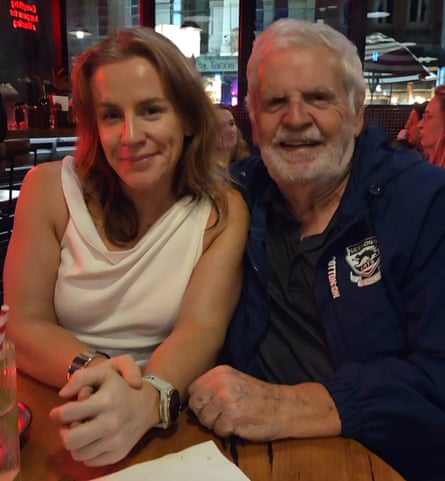
I had a lot of feedback. He had written a gorgeous story about young men and football and friendship, but like most new writers, his dialogue clanged. His characters’ actions didn’t ring true. He told too much and showed too little. Nervously, I added comments. At first they were like, “Hi Dad, I love you so much!!!!!! I would maybe consider removing this word ONLY IF YOU WANT TO! Shall we get a coffee?” I sent him a chapter at a time, waiting for him to call and tell me I was out of the will and also a live shark was on its way to kill me.
But he didn’t. Mum sent secret photos of him bent over his laptop, writing and rewriting.
Around page 260, I noticed something. Inside this story about vulnerable young men was a vulnerable older man. As his characters trained and competed to be better than before, so did he. With his 80th birthday in the near distance, my dad was asking me to teach him something new, and I realised he wasn’t perfect at everything first go; he was perfect at persevering. When I was little and frustrated at not being the best, he didn’t show me I didn’t have to try. He wasn’t teaching me I could get things right first time but that I should never stop believing I might.
The tables turned. “This doesn’t make sense,” I wrote. “She would never do this.” I began to lean on what I knew about him. “You know how the wind comes through Norwood Oval and it brings the pie smell? Show me that.” I had a shorthand for everything. A common anecdote. A memory we shared. Family folklore, in-jokes, people we’ve known. “WHY is this character behaving like Simon from the fruit shop???” Sometimes I just called him and made him explain himself, rationalise his choices, workshop a problem until it was solved.
Dad made revisions. The harder I challenged, the better he wrote. Each chapter he returned was an improvement on the last, with people and scenes and conversations busting out of the pages. Not on his first go, or even second go, but on his ninth and tenth goes. “Thank you,” he said, over and over. “This is so helpful.”
The more honest I was, the more he appreciated it. He did not yell at me. He did not think I loved him less.
When Dad published his book this year, we did a podcast about father-daughter editing. He spoke about how much it meant to him that I said yes. I ordered my copy the minute it went live, and when it arrived, I shelved it alongside my own books. Our little library – not of getting it right first time, but of learning to believe you might.