3 months ago
178
3 months ago
178
First comes the hummus: studded with chickpeas, anointed with a little reservoir of olive oil, greedily smeared up with hunks of pitta bread and messy fingers. Then the tabbouleh, then some homemade falafels, and then the lentil soup, and already the senses are overloaded, plates and bowls spilling off the edge of the table. But there shall be no reprieve, for the mains are coming.
Maqluba for the meat-eaters – traditional Palestinian upside-down chicken and rice, decorated with lightly browned cauliflower florets, topped with razor-fine almonds. Stuffed aubergine and courgette for the veggies. Before you ask: yes, there will be dessert, and it’s baklava and homemade chocolate. Home time, and slowly you winch yourself upright, stagger sideways towards the door and vow never to do something so gluttonous and decadent ever again.
But then Faten and Mahmoud have been running their supper club at Cafe Metro for six months now, and so far repeat business has not been a problem. The space is small and intimate; tickets sell out weeks in advance; the proceeds pay for aid for the hungry and homeless of Gaza. And like so many successful ideas, it happened basically by accident: a one-off fundraiser that quickly graduated into a kind of cultural event, a fixture of the north London social scene, a source of comfort and community in troubling times, resistance in its tastiest and most delicately spiced form.
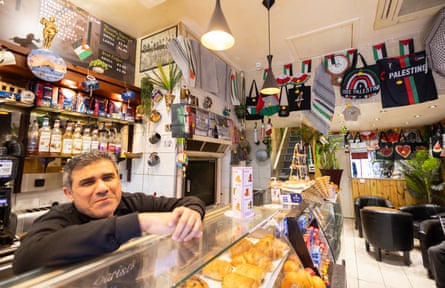
Faten moved to London in 2014. Her family once lived in the city of Beit Hanoun in Gaza, and now lives out a precarious and hunted existence in one of Gaza’s many temporary refugee camps. But as she stands at her stove cooking the recipes her mother taught her, she feels a little closer to the land she left behind; the big, loud family meals rich with aroma and gossip, where everyone seems to be talking at once. “We love to show people our culture,” she says. Amid the chaotic bustle of north London, food is one of her links back, a marker of the Palestinian identity that Israel’s bombs and snipers are so intent on erasing.
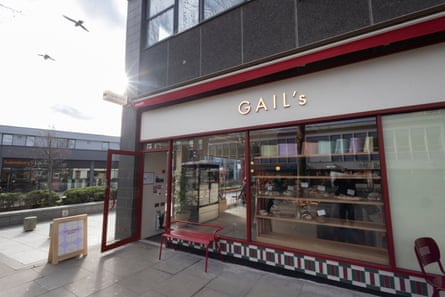
The cafe itself has existed since the 1980s, proudly blazons its Palestinian heritage, and has long attracted a small but loyal clientele. In recent years, however, a number of predators have appeared on its doorstep. Costa Coffee arrived a decade ago. Starbucks and Greggs followed soon after. Then, a few weeks ago, on the site of the former corner shop two doors down, came a new branch of the upmarket bakery, Gail’s.
Gail’s has long been feted as a purveyor of luxury baked goods and is an unmistakable barometer of local affluence. In recent years, however, as the brand has expanded to almost 200 shops across the UK, its presence has become increasingly contested. Critics accuse it of accelerating gentrification and squeezing out smaller outlets. Campaigners point out that its parent company, Bain Capital, invests heavily in military technology, including Israeli security companies. And so even though Gail’s describes itself as “a British business with no specific connections to any country or government outside the UK”, its very presence 20 metres away from a small independent Palestinian cafe feels quietly symbolic, an act of heavy-handed high-street aggression.
The night before it was due to open, Gail’s was daubed with red paint. Less than a week later, all its windows were smashed in. Slogans reading “reject corporate Zionism” and “fuck Bain Capital” were written on its walls. To date, no arrests have been made. A spokesperson for the Board of Deputies of British Jews has described it as “part of a wider trend to try to drive Jews out of wider civil society” (Gail’s was founded by an Israeli baker in the 1990s). The local branch of the Palestine Solidarity Campaign made it clear it had no involvement. It should scarcely require saying that Mahmoud, a mild-mannered man in his 60s, had nothing to do with it. “We compete with them legally,” he says. Mahmoud believes rivals seek to dominate the local trade, “but our cappuccino is £2.95 and theirs is £4.50. That’s how we compete.”
And so somehow these two north London cafes, from two entirely separate worlds, with what we have to assume are two almost entirely separate clienteles, have found themselves on the frontline of a war. A deeply asymmetric war, defined by gross imbalances in power and resources and platforms, but a war nonetheless, and one that simultaneously feels more distant and more local than ever.
Cafe Metro has also found itself targeted in the last couple of years. Pro-Israel activists regularly descend on it to slap stickers on its windows reading “Stop killing people” and “One of these days you’ll thank us”. Islington council enforcement officers have reportedly entered the shop and ordered it (unsuccessfully) to take down its Palestinian flags. In the current oppressive climate, even to exist as a Palestinian in western society is to be the target of aggression and suspicion, to be tainted as a murderer and an antisemite, even if your ambitions stretch little further than cooking food and serving coffee.
Does any of this move the dial in the occupied territories even one iota? Almost certainly not. But perhaps this is simply the nature of an increasingly disenfranchised age. Palestinian activism has arguably never been less capable of exerting a meaningful influence on global events, and so is increasingly defined by small acts of petty symbolism. A smashed window. A provocative sticker. You can’t lay a glove on the US-Israeli military-industrial complex, and you can’t get your local council to boycott Israeli goods, and you couldn’t stand with Palestine Action and the protest march on Sunday has been banned by the Metropolitan police. So some people then direct their ire at the bakery with distant links to Israeli security funding.
Food – the access to it, the denial of it, the culture and tradition it represents – has become a recurrent theme of this forever war, one with multiple resonances. And so Faten and Mahmoud will carry on hosting their supper clubs, feeding the people of north London, existing in a world where their very existence is threatened.
The falafel, the lentil soup, the upside-down chicken: these are blunt and frankly inadequate tools of defiance. But when they’re among the few things you have left, you may as well use them.
-
Jonathan Liew is a Guardian columnist