3 months ago
130
3 months ago
130
I wore makeup for the first time just after I turned 12: a tube of green mascara from a pound shop in my home town in south Wales. This was not a chic emerald or a flattering forest green. It was a frosted, mucous-tinted green – a colour that looked like the aftermath of a minor chemical incident involving Shrek. There was a reason it cost only a pound.
I slicked it on with no real understanding of beauty, but a clear instinct that I loved how it altered my face. The outside world was less enthused. People hated it. Teachers told me to take it off; I’d then reapply it in the toilets. Girls in my year looked at me with genuine repulsion. It wasn’t pretty, or cute – so nobody understood why I would want to look like that.
But I loved the way it transformed my face. I loved how polarising it was. I loved that it made people slightly uncomfortable. That was the first time I realised beauty didn’t have to be about looking “pretty” – it could be unfiltered self-expression. The beauty industry is inclined to claim that certain products are “life-changing” – but occasionally that isn’t hyperbole. That mascara was the start of a trajectory.
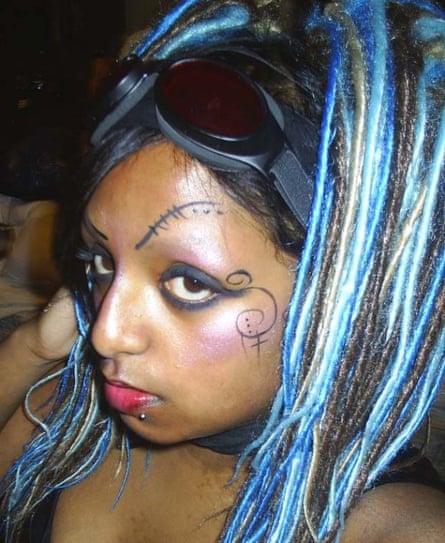
Beauty was always political for me. Growing up, there wasn’t a foundation for my skin tone, just a spectrum that spanned from “porcelain” to “tan”. I became a reluctant chemist, mixing various pigments together to try to make a colour that worked. It would have been easier to wear something too light and accept the ashy cast, but refusing to disappear into colours not made for me felt like a small, stubborn act of protest.
Summers were spent bleaching my hair and dyeing it pink. I customised my clothes with band lyrics and patches. I wasn’t rebelling for the sake of it; I was pushing back against having to tick so many boxes that didn’t feel right. I didn’t slot neatly into my Indian culture, where I felt I had to behave properly and not step out of line. I was acutely aware that I didn’t fit the Indian beauty standard, either – the one that prized fairness and glossy Bollywood femininity. And I certainly didn’t see myself reflected in the 90s and early 00s beauty ideal: size zero, pin-straight hair, washboard-flat stomach.
Beauty became the most visible way to articulate that refusal. At university, armed with freedom and a student loan, my experimentation intensified. I shaved off my eyebrows, entering my full‑pelt goth phase. I remember standing in Debenhams when a small child tugged at her mother’s sleeve and asked loudly: “Mummy, why does that lady have weird eyebrows?” I laughed as the mother looked mortified. And my aesthetic exploration went beyond hair and makeup. I got my first tattoo at 18; I had my septum pierced at a time when it was highly confronting and elicited comments about looking “masculine” or “ugly”. Those reactions were telling. The subtext was always the same: why would you choose to make yourself less conventionally attractive? I never thought about it very deeply, but I now realise it was because I wasn’t interested in being palatable.
And yet, like many women, I’ve also known what it is to fold under pressure. When I moved to London to work on fashion magazines, I soon realised there was a uniform. The aesthetic was studied nonchalance: expensive fabrics in muted tones, hair that looked as though you’d done nothing to it (which, of course, meant you’d done quite a lot). Standing out was frowned upon. When I look at photos from that period, I barely recognise myself. I can see that, at times, I was subconsciously assimilating. But I can also see that I was being worn down by a culture that thrived on pretty privilege, intimidation and a low hum of fear masquerading as perfectionism.
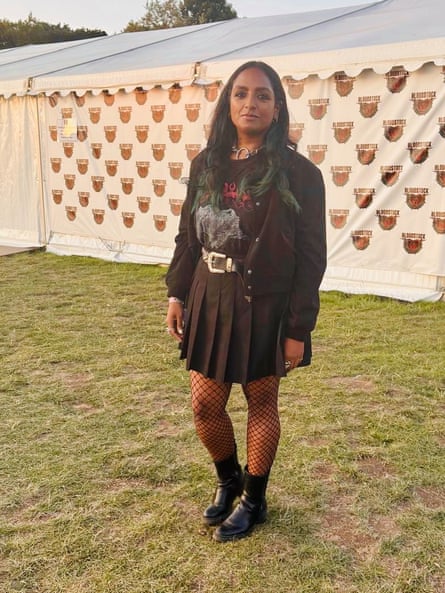
But every time I’ve drifted too far from myself, something in me has itched. For years, I rejected my south Asian heritage because I associated it with constraints around appearance and behaviour. But I’ve come back to it on my own terms, with black saris paired with latex tops, visible tattoos and black lipstick.
Beauty, for me, has always been an external expression of an internal truth. I’m softly spoken, so rarely the loudest in the room, but bold eyeliner, a wild hairpiece, a polarising scent or a set of sharp, embellished nails will do some of the talking for me. Over time, it’s also become a litmus test. If you recoil at my bleached brows, or red eyeshadow, then we are unlikely to agree on much else. And that’s useful information.
Fashion and beauty are frequently dismissed as frivolous, but they are cultural mirrors, reflecting our social, economic and political climates. To deviate from the dominant aesthetic – to wear glittery makeup at 60, blue blusher at 40, to let your hair go grey at 30, to take up visual space when you’ve been told to shrink and conform – is radical. Looking back, I chose that awful green mascara simply because I liked it. That should be the only reason any of us alter our appearance.
Now, when I feel myself slipping into the anxiety of ageing, or the urge to smooth the edges to be more acceptable, I do the opposite. I reach for the boldest thing in my makeup bag. It’s a small, private act of resistance; a reminder that I don’t have to contort myself into whatever shape is deemed desirable.