2 months ago
39
2 months ago
39
In the decade after Brexit, the relationship between Britain and France has been defined by rows over fishing rights, Channel crossings and trade. Boris Johnson even mocked Emmanuel Macron, telling his French counterpart to “donnez-moi un break”.
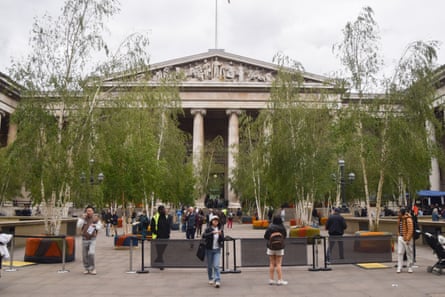
This week, that fractious chapter gave way to one of the most significant acts of cultural diplomacy between the two countries in decades. Almost 1,000 years after it was created, the Bayeux tapestry arrived at the British Museum, transported from France under cover of darkness, the culmination of years of painstaking negotiations between London and Paris.
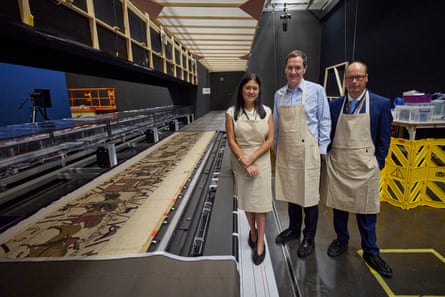
A small group of guests, including the culture secretary, Lisa Nandy, and the British Museum chair, George Osborne, were given a first glimpse on Tuesday of the historic embroidery as preparations continued for its public unveiling in September.
“You get a sense of the sheer vastness of the tapestry when you walk into that room,” Nandy said. “When President Macron visited the British Museum last year and we signed the official document, that’s when it all felt real to me.”
Precautionary rules had to be followed before anyone was allowed near the tapestry. Phones and pens were banned. We were asked to put on aprons and wear protective covers over our shoes.
“We look like a bunch of cheesemongers,” Osborne observed.
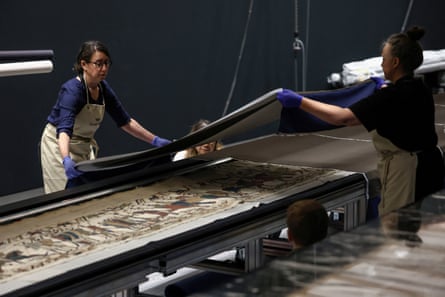
Only one section of the 70-metre tapestry was on display, with the rest covered by a black sheet in a long, glass case stretching into the distance.
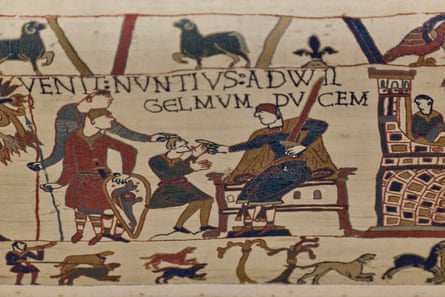
But that one fragment was enough to make the room fall quiet. It was laid out in the open, close enough to see the individual stitches, the faded colours and the tiny details woven into the fabric. The conservators nearby watched every movement with anxiety.
Michael Lewis, the British Museum’s lead curator for the exhibition, guided Nandy and Osborne through the scenes, which include an image of William the Conqueror, sword raised, receiving a message about Harold.
“So someone’s sitting on the throne, and someone wants to take it from him,” Osborne said. “All in the past!”
“I’ve been stitched up here,” Nandy joked.
“What would historians say about William now?” Osborne asked Lewis. “Did he have a legitimate claim to the throne?”
“Not at all,” Lewis replied.
“You’re trying to ignite an ancient battle,” Nandy said, attempting to suppress her laughter.
“I just thought we could tell Macron,” Osborne replied.
The loan, first proposed by Theresa May and Macron in 2018, required years of talks over everything from the conditions of transport to the precise temperature and lighting needed to protect an object that has never before left France.
“There couldn’t be any risk whatsoever of damage,” Nandy said. “A lot of the diplomacy in the discussions was about the minutiae and the painstaking detail: what sort of case it would be in, how it would be transported, what temperature, what lighting.”
The tapestry’s arrival was a carefully choreographed operation. The group were shown the enormous bespoke box in which it travelled, folded concertina-style inside its protective casing.
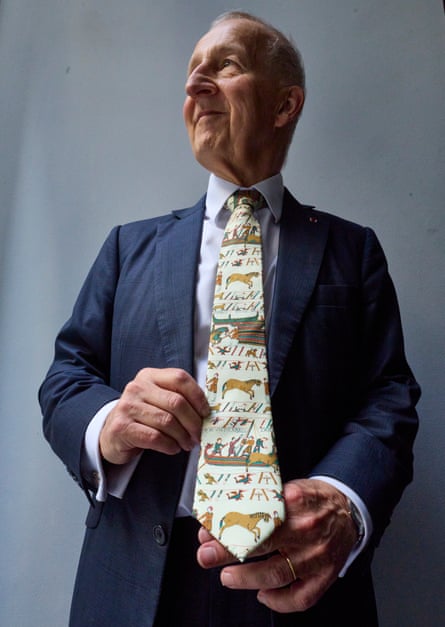
The UK’s special envoy for the tapestry, Peter Ricketts, arrived wearing a Bayeux tapestry tie. He was joined by his French counterpart, Philippe Bélaval, and it began to feel like a party.
For Nandy, the loan is evidence of a wider attempt to rebuild Britain’s cultural relationships after Brexit. “After the original agreement, talks stalled, not just because of the pandemic, but because there was a very needlessly antagonistic relationship for many years between the UK and France,” she said. “This does, in a lot of ways, feel like closing the loop on that chapter.”
Nandy first encountered the tapestry as a 12-year-old on a school trip to Bayeux. “I remember feeling quite sick from drinking a lot of hot chocolate,” she recalled. “But it was amazing to see.”
Now, she hopes the exhibition will give a new generation the same opportunity. Schoolchildren from across the UK will be invited to visit the tapestry in an effort to ensure it remains more than a relic of medieval history.
“There are quite a few people in the UK for whom the Bayeux tapestry is one of the most famous artefacts in the world,” Nandy said. “But there are also quite a few people, particularly young people, who don’t know anything about it.”
Nandy said the government had sought to make cultural exchange a more deliberate part of its foreign policy. “One of the things that we’ve been doing with a lot of our partner organisations, including the British Museum, is being much more proactive about helping them to navigate some of the complexities involved,” she said.
She pointed to China as an example where cultural links remain valuable but require caution. “The people-to-people connections are vital,” she said. “But there are obviously challenges around free speech, censorship, human rights and security.”
The British Museum has also been at the centre of debates about how cultural institutions navigate political pressures.
Nandy said institutions should not retreat from those difficult debates. “I think they relish it. Art has always been a way of challenging the status quo,” she said. “It’s always been a way of helping us to rethink our past and reinterpret the future.”
Nandy said decisions around future loans remained a matter for institutions, but the government could help create the conditions for dialogue. “To reach out with the hand of friendship,” she said, “whether it’s the Elgin marbles or Benin bronzes or any of the more controversial acquisitions.”
During the final photographs, conservators reminded visitors not to lean too close over the embroidery.
“Put your hands on it,” someone joked.
“Quelle horreur,” came a whispered response. The miniature Anglo-French exchange felt almost reassuringly familiar.