3 months ago
95
3 months ago
95
When the Paiter Suruí community expelled the last invaders of their land in 1981, they faced a divisive decision. Should they keep the coffee plantations left by the colonisers? Some destroyed them because of the death and violence contact with the non-Indigenous world had caused. Others felt sorry for the trees and couldn’t kill them.
More than 40 years later, those estates that survived are being nurtured, supporting families and the environment. “Today, we use coffee as a way to preserve the forest,” says Celeste Paytxayeb Suruí, a famous Indigenous barista and coffee producer in Brazil. The award-winning fine coffee she prepares is called “Amazonian robusta”, and is produced in the Brazilian state of Rondônia in the western Amazon.
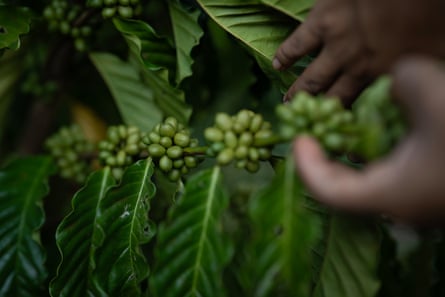
Nearly 140 Suruí families work in small coffee plantations on the Sete de Setembro Indigenous land. Abundant rain and constant hot temperatures has helped robusta coffee flourish there, with the climate resembling that of its native Congo basin.
For a long time, robusta has had a reputation as a lower-grade, bitter coffee, often used in cheap blends alongside its “tastier” cousin, arabica. But researchers have been working to change that and prove that robusta, too, can be a finer brew.
Improving robusta’s quality is not only a matter of taste, but of climate adaptation. Because robusta thrives in higher temperatures than arabica, it will probably be critical to meet global demand. Robusta production has already increased from 28% of total coffee produced in the early 1990s to 44% in 2023.
What is the Coffee crisis series?
ShowAs the climate crisis deepens, Latin America’s coffee producers – from the steep hillsides of Central America to the forests of Brazil and the Andean slopes of Colombia – are facing an existential threat.
While global markets still project an image of abundance, small farmers across the region are struggling with rising costs, unpredictable weather and a shrinking workforce, forcing many to question whether coffee farming remains viable.
The climate crisis poses an escalating threat by driving up temperatures in key growing regions. A recent Climate Central analysis found that the world’s five largest producers – Brazil, Vietnam, Colombia, Ethiopia and Indonesia – now face an average of 57 additional days of damaging heat each year.
The problem is evident across much of Latin America, a region that includes leading producers such as Brazil, Colombia, Mexico, Honduras, Guatemala and Peru, and accounts for more than half of global output. According to Climate Central, Brazil, the largest producer, now endures 70 more hot days a year.
“High temperatures place coffee plants under stress, reducing much of their productive potential. This is affecting coffee plantations around the world, as most are located within the same latitudes,” says Celso Vegro, an agronomist and researcher at São Paulo’s state agriculture agency.
According to Vegro, global coffee production has fallen short of expectations since 2021. Countries have been unable to keep pace with growing demand, leading to the depletion of global stocks, which has driven prices higher. “This year, Brazil’s harvest is expected to be large and to replenish supplies. But it will be only a temporary reprieve, as the same climate conditions persist,” he says.
In a new series, Coffee crisis, the Guardian spoke with producers from four Latin American countries to explore the challenges they face.
A recent report by Climate Central found that the climate crisis is affecting all the leading coffee producers, including Brazil, the world’s largest, which now experiences 70 more hot days a year.
Though robusta is better adapted to higher temperatures, it is not completely immune from the climate crisis. It, too, is susceptible to rising temperatures, and depends on rainfall. When drought hit Rondônia in 2024, production in Celeste’s small coffee plantation inside the Suruí territory fell 40%. That year, coffee prices soared worldwide due to the extreme drought in Brazil and also in Vietnam, the world’s second largest producer.
Demand for coffee continues to rise, yet research shows that the global land suitable for growing coffee will decline by at least 50% by 2050 for arabica and robusta.
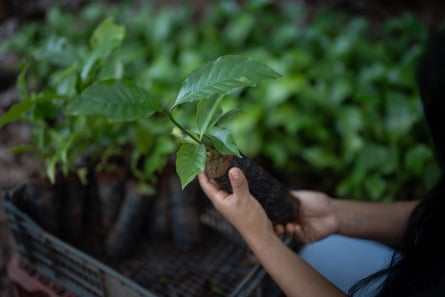
So, experts and farmers worldwide are increasing efforts to innovate, breeding more resilient plants to adapt to extreme temperatures, drought and rainfall, and to resist more pests that thrive in warmer weather.
Over two decades, researchers at Embrapa, Brazil’s federal agricultural research corporation, have increased robusta’s productivity roughly fivefold.
Amazonian robusta originated from natural crossings of conilon and robusta coffee trees.
Now Embrapa is testing 64 new crossings, selecting trees for higher temperature and drought tolerance, as well as better flavour.
Another critical aspect of improving robusta is harvest and post-harvest care. “If you harvest ripe beans, and wash and dry them appropriately, the quality increases exponentially,” says Enrique Alves, an Embrapa agronomist and researcher who moved to Rondônia 15 years ago and shares best practices with farmers.
The work has paid off for 10,000 coffee farms in the “Forests of Rondônia” region, most of them small family farms cultivating an average of 3.3 hectares (8 acres) of coffee. About 10% of the farmers produce fine robusta, Alves estimates.
Research shows that coffee plants benefit from being near forests as they provide high humidity and stable temperatures. Plants also benefit from the forest’s pollinators and its natural enemies of pests.
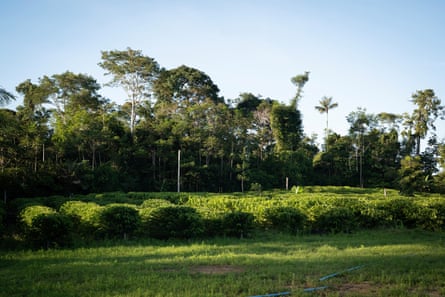
But in the 1970s, the federal government encouraged migrants from other parts of Brazil to clearcut forests, mainly for cattle ranching. Today, 45% of the Forests of Rondônia region is pasture, and coffee plantations occupy less than 1% of the land.
The Suruí, however, have been reforesting their territory since 2004, when they completed a 50-year environmental management plan.
Elsewhere in Rondônia, near the city of Cacoal, one family has been setting a sustainable example for years. On their 12-hectare farm, the 14-member Bento family produce their high-quality robusta from plant to cup. They have their own roaster and serve coffee to tourists visiting the farm. “We don’t charge for the visit; we want them to come here and see how we do it; then they will choose our coffee,” says Deigson Bento.
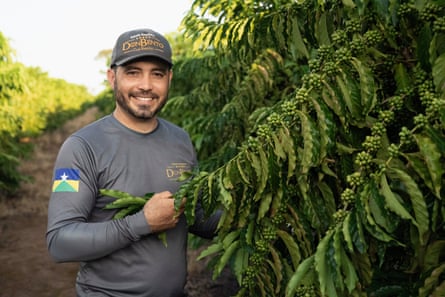
The family has won the state’s coffee sustainability awards numerous times by implementing measures such as water-saving irrigation, adding 1,500 trees to protect water sources, and raising bees to support the pollination of robusta. They also rotate coffee with corn, beans and other crops to improve soil health.
“You can have a 5,000-reais [£720] monthly income for a family on only two hectares of coffee,” says Bento. “We’ve advised over 500 people. People are eager to improve. Rondônia’s coffee was an ugly duckling, and now it’s a swan.”
There are those, however, who worry that higher coffee prices could lead to the replacement of small, sustainable family farms by large plantations which will disregard efforts to sustain the forests.
“Robusta coffee is great, but you need a strategy, or else it can generate deforestation, because monoculture causes that. It works with the Suruí because they have a plan for the territory’s environmental management,” says Neidinha Suruí, coordinator at Ethno-environmental Defence Association Kanindé, which helped create the plan.
She says reforestation and forest protection shouldn’t fall solely on Indigenous people, and that the government should provide more subsidies to farmers who protect the environment. She also urges consumers to choose wisely when they buy.
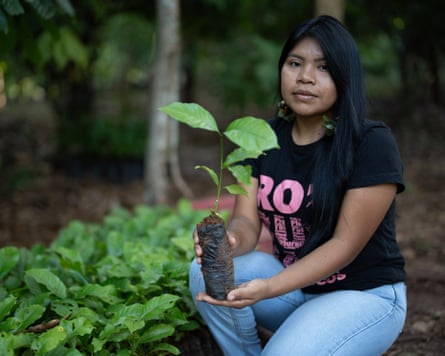
Paytxayeb Suruí, who has represented a line of Indigenous-produced coffee through a commercial brand since 2024, says: “When we talk about the Amazon, people think about the forest, but don’t think about the people who are inside the forest. They need to be valued as well as their work and their stories.”
Some, such as the renowned scientist Carlos Nobre, call for a culture shift to develop a market for forest products such as Brazil nuts, açaí, cocoa, cupuaçu and buriti.
“When the Portuguese arrived here in Brazil, they completely ignored Indigenous knowledge,” Nobre says. Although Brazil is home to about 20% of the world’s biodiversity, he calculates that “non-timber forest products” represent only 0.4% of Brazil’s GDP.
Brazil is not the only coffee-producing country looking for ways to ensure a roubust future for coffee producers. The nonprofit World Coffee Research (WCR) launched a robusta network last November, including six countries: Vietnam, Ghana, India, Indonesia, Rwanda and Uganda.
“Testing coffee trees across many countries and climates helps us see how they perform under a wide range of conditions – just like the variability farmers will face as the climate changes,” says Tania Humphrey, WCR’s director of research and development.
If one part of the researchers’ work has been to improve robusta’s adaptability and quality, the other is to change the market’s perception of its taste. For that, they created a new reference: a tasting wheel for the botanical varieties within the canephora coffee species, robusta and conilon.
“Coffee tasters were trying to fit canephora into a protocol created for arabica,” says Fabiana Mesquita de Carvalho, a neuroscientist at State University of Campinas. “Canephora is like red wine, and arabica is like white wine. Not all notes of red wine will be positive for white wine and vice versa.”
If, however, robusta is to have a future, many more people need to recognise and protect the forests, says Paytxayeb Suruí.
“If only the Indigenous people do their part, things won’t change. We need collective action to make a difference. The forest is the mother not only of Indigenous people, but of everyone.”