3 months ago
191
3 months ago
191
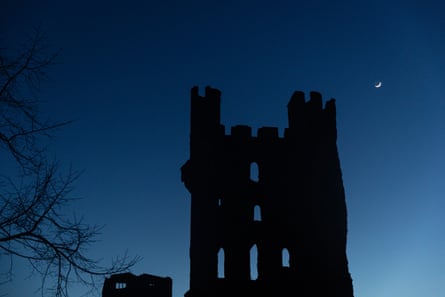
I’m wandering around a walled garden on the edge of the North York Moors at dusk. The darkening sky is faintly illuminated by a sharp sliver of crescent moon and the first stars. Bats are swooping in search of supper, an owl is softly hooting and the dark outline of a ruined castle looms beyond the walls.
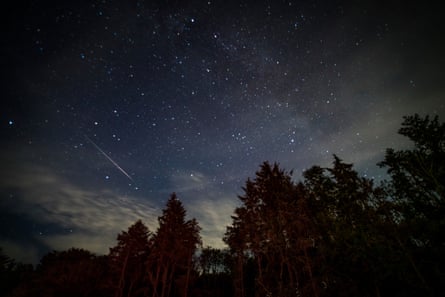
But what is really striking about the scene is what’s missing: artificial light. There are no solar lamps or electric bulbs; no torches or phone screens. As parts of the garden recede into the gloom, others are thrown into sharp relief: the bare branches of winter trees; a russet-coloured hedge; clumps of snowdrops, glowing bright in the moonlight.
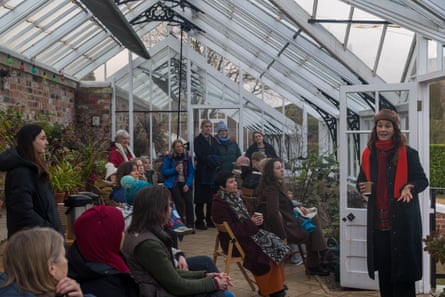
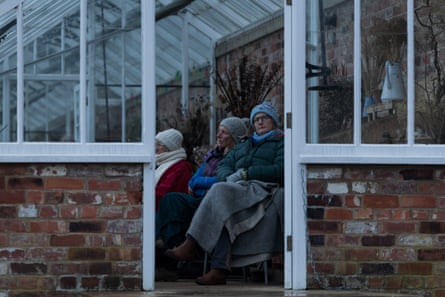
I’ve spent the past hour at the UK’s first “dusking” event. About 20 of us gathered in a glasshouse at twilight to watch darkness descend. In the Netherlands, dusking, or schemeren, was once an everyday ritual, with families sitting together to observe the end of the day and the coming of night. The custom had all but died out until it was revived by Dutch poet and author Marjolijn van Heemstra a few years ago. Now she is encouraging other countries to adopt dusking, running events in Ireland, Germany and here in Yorkshire.
We wrap up warm and settle on chairs as van Heemstra introduces the practice and gives us some pointers. “Dusking is about looking at one point and seeing it fade. Don’t look around too much; focus. Trees are very good – they rise up for a moment and then fade away.” I dutifully fix my eyes on a distant tree as an audio recording about dusking begins to play. Over it, I can hear a last burst of birdsong from the garden. Night falls gradually, then suddenly.
Van Heemstra learned about dusking from a Dutch woman in her 80s, who remembered sitting with her parents each evening to watch the world go dark before they lit the lamps. Van Heemstra had never heard of it, and was intrigued. When she researched the practice, she found newspaper records dating back to the 18th century, including a how-to manual. “Dusking used to be so normal; a pause moment in the day,” she says.
She began writing about dusking, and received responses from older people who remembered it. “It had disappeared, but now memories are coming back,” she says. “It’s strange that something so common can be forgotten. What else have we forgotten?”
Van Heemstra started organising guided dusking events, which became increasingly popular – 150 people gathered by the Amstel River to watch night fall in Amsterdam; 400 people took a twilight timeout at a music festival. The Park theatre in Eindhoven now holds regular dusking sessions, and next year four regional partners will help expand the custom further across the Netherlands. “We’ll be doing outreach, working with schools, bringing back dusking as a practice people know about,” she says. She has already tried dusking with teenagers. How did that go? “At first, they were giggling, but they got into it,” she says. “It really resonates with people.”
Dusking is a form of mindfulness, says Van Heemstra. “The focus is like meditation, and people always need that. But dusking is about focusing on the outside world, not closing your eyes. It’s not just about your own wellbeing; it’s a conversation with the world around you.” She particularly values dusking’s Dutch heritage. “Dusking is so local. People feel they have to find rituals in other cultures – yoga [from India], Japanese forest bathing – but this is suitable at this latitude. Why not use that?”
I wonder if dusking is just the latest wellbeing fad, 2026’s cold-water plunge or sound bath? “The real fad is the way we live now, estranged from the world,” she says. “It makes us unhappy. There is an attention crisis in the Netherlands. How can we solve it? It’s obvious! Slow down. Stop being on our phones so much.”
How has regular dusking changed her? “It has made me conscious of this in-between time. I leave the lights off on dark mornings, too, and let it get light. The downside is that I’ve become very sensitive to light. I shout at cars that turn their lights on too early!”
People have always watched the sunset – what’s so different about dusking? “You need a horizon for a sunset, and a lot of people don’t have that, especially in urban places,” she says. “There is a grandeur with sunset, but it’s still a spectacle of light. Dusking is much more subtle: it asks more of your attention, but triggers your imagination. Twilight has always been that way – it’s a time of shape-shifting.”
Van Heemstra is a big fan of the dark. “I’m always looking to engage people in a positive way with darkness,” she says. “There is so much prejudice against it.” She has led hundreds of night walks in the Netherlands, but likes the way dusking is accessible to everyone. “You don’t have to go into a dark forest. All you need is a chair and a view. It’s cheap, easy and a nice thought exercise – we live on a planet, miracles are happening every day and we can witness them.”
She is extremely concerned about the effects of light pollution. “The Netherlands is one of the most light-polluted countries in the world. It’s small and flat, so light is everywhere.” She has even been known to turn off lamp-posts near her home in Amsterdam. (“It’s very easy and it makes you feel in control, but I’m not allowed to do it any more.”) Light pollution is not just a Dutch problem – according to research published in the journal Science in 2023, the average night sky worldwide got 9.6% brighter every year from 2011 to 2022. Last year, a study found that only 10% of people in the western hemisphere experience dark skies with no artificial light.
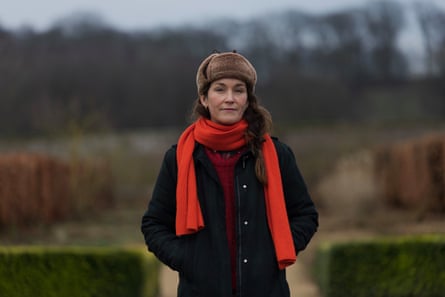
“People miss darkness, even if they don’t know it. On my night walks, people are amazed at how calm they feel,” Van Heemstra says. “It’s something so big that we’ve lost; half the world has gone. Darkness is a time of dreams, fears, stars, stories … So many connections are lost when we don’t have darkness in our lives. Dusking brings a little bit back.”
Light pollution has tangible health impacts, too. A 2023 review by University College London found that it suppresses melatonin and disrupts circadian rhythms, “which might contribute to sleep disorders, mood and mental health disorders, obesity, cancer, cardiovascular disease and difficulties with fertility and reproduction”. While Van Heemstra agrees that the effects on humans are damaging, “the real victims are the birds, the trees”.
This is undeniable. Jenny Hall, a professor of cultural geographies at York St John University, wrote in the Conversation last month that artificial light at night “impairs some species’ ability to find their way around and is a cause of declining populations of insects, bats and other nocturnal fauna. There is also evidence that outdoor lighting generates needless emissions and ecological harm that is intensifying at an alarming rate.” A study published in January found that LED lights reduced the night-time activity of moths – important nocturnal pollinators – by up to 85%. Other research has found negative impacts across a wide range of species, from hatchling turtles and migrating birds to nocturnal mammals, while a 2022 study found that light pollution disturbs the spring development of trees and shrubs.
It’s not all doom and gloom. Awareness is growing of the problem of light pollution and the need to safeguard the night sky. Since 2001, 250 locations in 22 countries have been certified as “dark sky places” and are protected from excessive artificial light at night. There are 22 in the UK, including the North York Moors national park, which was given the highest classification of dark sky reserve in 2020 – one of only 25 “gold tier” parks globally. It is implementing small changes that make a big difference to wildlife, such as dimming lights, directing them only to where they are needed, replacing fittings to minimise glare and switching street lights off at midnight.
The North York Moors and the Yorkshire Dales hold an annual Dark Skies festival in February – which the dusking event was part of – and a fringe festival in October. Recent research has found that visitors to the festivals subsequently feel more comfortable in darkness and are more likely to change their lifestyles, “including using low-impact lighting in their homes, asking neighbours to switch off lights in their gardens at night and monitoring neighbourhood light levels”.
After the dusking event, I walk back to my hotel in the dark, resisting the temptation to light the way with my phone. I am forced to slow down. With no distractions, I notice a viewpoint over the castle, silhouetted against the starry sky. In the latest UK Star Count, half of participants could see 10 stars or fewer in the Orion constellation. In parts of this dark sky reserve, 2,000 stars are visible. I don’t attempt to count them, but I’m pretty sure I can see them all.