3 months ago
146
3 months ago
146
Anyone following Israeli media discourse in recent days may be experiencing a severe case of deja vu. Alongside euphoric reactions to the US-Israeli pummelling of Iran (backed by 93% of the Jewish-Israeli population), politicians and prominent commentators are now clamouring for an escalation in Lebanon – hoping to see a repeat of the devastation Israel has wreaked in Gaza.
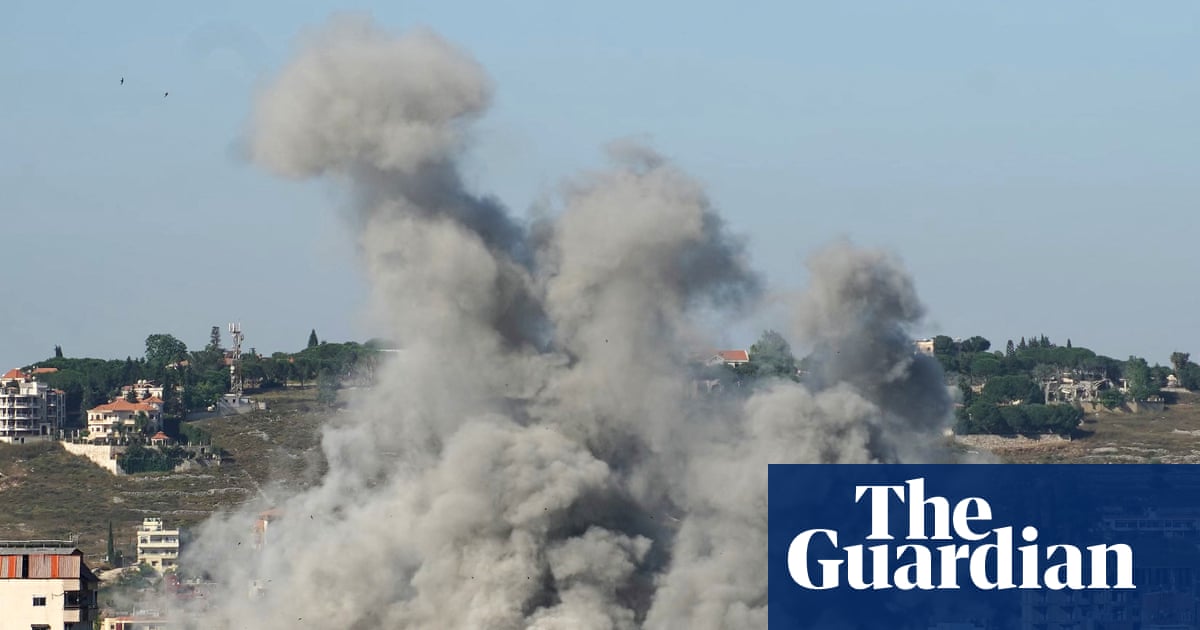
Israeli airstrikes on Lebanon have already killed close to 1,000 people in the past two weeks, after Hezbollah resumed its rocket fire into northern Israel in support of Iran. The Israeli army has issued blanket evacuation orders covering a vast area in the country’s south, displacing over a million people from their homes. On Monday, it announced the launch of a “targeted” ground invasion, and officials have briefed the media that they are preparing to mobilise hundreds of thousands of reservists in order to implement “the Gaza model, but in Lebanon”.
Israel’s leaders are not hiding what comes next. “Very soon, Dahiyeh will resemble Khan Younis,” warned Israel’s finance minister, Bezalel Smotrich, earlier in March, referring respectively to a Hezbollah stronghold in Beirut and a city in southern Gaza that the Israeli army has almost completely razed to the ground. Zvi Sukkot, a member of the government from Smotrich’s party, urged: “We must conquer territory in southern Lebanon, destroy the villages there and annex the territory to the state of Israel.”
Amit Halevi, a member of Benjamin Netanyahu’s Likud party, vowed that the Litani river – located 30km from Israel’s border with Lebanon – “must become the north’s new yellow line”, alluding to the boundary marking the current occupation by Israeli forces of more than half of Gaza’s territory.
The defence minister, Israel Katz, announced on Monday that he and Netanyahu had “instructed the IDF to destroy the terrorist infrastructure in the villages near the border in Lebanon, just as was done against Hamas in Rafah [and] Beit Hanoun”, referring again to cities in Gaza that no longer exist. Under his command, the Israeli army is also engaging in psychological warfare against the Lebanese people, dropping leaflets over Beirut last week with the mocking text: “In light of the remarkable success in Gaza, the newspaper ‘The New Reality’ arrives in Lebanon. Where is your country heading?”
Leading opposition figures are joining in, too. Gadi Eisenkot, a former chief of staff of the Israeli army who aspires to replace Netanyahu as prime minister in the forthcoming election, tweeted: “The Dahiyeh doctrine has never been more relevant than right now, and it must be implemented.” This doctrine refers to an Israeli military strategy of deliberately inflicting disproportionate force on civilians as a form of collective punishment designed to deter future attacks, which originated in Israel’s 2006 war on Lebanon.
And it’s not just politicians. Similar rhetoric from political commentators is flooding Israeli TV and radio stations, as it did in the early days of the war on Gaza, laying the ideological groundwork for what follows.
The prominent Channel 12 journalist Amit Segal, considered a Netanyahu mouthpiece in the media, has called on Israeli forces to “advance to the Litani river, and announce: We will not leave until Hezbollah is disarmed [and until then] not a single resident returns”. Another Netanyahu mouthpiece, Channel 14’s Yinon Magal, weighed in: “I suggest by the morning, there will be no more Dahiyeh at all.”
The chorus keeps growing. Eager to see a repeat of the war crimes in Gaza that earned him an arrest warrant from the international criminal court, Israel’s former defence minister, Yoav Gallant, has urged the army “to strike and eliminate everything that’s in Dahiyeh, Baalbek, Tyre, Sidon, Nabatieh, everywhere”. And Itamar Fleischmann, a commentator on Channel 14, implored: “We need to destroy Dahiyeh … We need to destroy the country in terms of infrastructure. There’s no more civilian infrastructure in Lebanon.”
Statements like these form a central part of South Africa’s ongoing genocide case against Israel at the nternational court of justice, offering proof of genocidal intent in Gaza. It is therefore no surprise that the Lemkin Institute for Genocide Prevention and Human Security has issued a “red flag alert” for Israel in Lebanon.
There are, of course, important differences between Gaza and Lebanon. Israel does not control all of Lebanon’s borders, so unlike Gaza, the population cannot be caged in. This also means the world’s media can enter Lebanon; international networks should be rushing there now in advance of Israel’s ground invasion to support the work of local journalists.
But the past two and a half years in Gaza have provided ample evidence of what Israel, drunk on impunity, will do in Lebanon. First, the army will seek to seize control of the country’s southern region, recreating – or perhaps exceeding – the “security zone” Israel occupied between 1982 and 2000, after invading during the Lebanese civil war. While the air force decimates Beirut from above, proceeding through an AI-generated list of targets, troops on the ground will move from village to village in the south, destroying everything in their path as warplanes shower residential areas with white phosphorus.
Many residents will refuse to leave – either because they have nowhere to go, or because they fear, with good reason, that they will never see their homes again if they do. Israel will declare anyone who remains a terrorist, authorising soldiers and drone operators to shoot on sight. Thanks to the success of the Israeli-US crusade to undermine fundamental tenets of international law over recent years, attacks on all manner of civilian infrastructure will be legitimised with the claim that it is being used by Hezbollah. Indeed, this has already begun in recent days with attacks on bridges and health facilities.
The fate that awaits Lebanon is clear. So where is the international community? As the Gaza case should have made abundantly clear, negotiations – which French president Emmanuel Macron is now pushing for – will only provide Israel with a smokescreen for stalling a ceasefire while seeking to “finish the job”. This is not a time for empty condemnations, but for sanctions and arms embargos that will impede Israel’s ability to keep escalating its aggression.
Despite all the warnings, the world failed to prevent genocide in Gaza. Will it make the same mistakes again?
-
Ben Reiff is deputy editor at +972 magazine
-
Do you have an opinion on the issues raised in this article? If you would like to submit a response of up to 300 words by email to be considered for publication in our letters section, please click here.