3 months ago
146
3 months ago
146
A bomb cyclone produced freezing temperatures across a large portion of the US from the Gulf coast to New England, bringing heavy snow to North Carolina where two were killed in storm-related conditions, and setting records in Florida, where officials warned of ice and falling iguanas.
About 150 million people were under cold weather advisories and extreme cold warnings in the eastern portion of the US, with wind chills near zero to single digits in the south and the coldest air mass seen in south Florida since December 1989, said Peter Mullinax, a meteorologist with the weather prediction center in College Park, Maryland.
Meanwhile, the bomb cyclone, known to meteorologists as an intense, rapidly strengthening weather system, contributed to nearly a foot (30cm) of snow in and around Charlotte, North Carolina’s largest city. The snowfall represented a top-five snow event all time there, Mullinax said.
North Carolina’s governor, Josh Stein, said that more than 1,000 collisions on snowy roads had resulted in two fatalities across the state over the weekend. He did not give any details on the victims.
Flight cancellations exceeded 2,800 in the US on Saturday, with another 1,800 on Sunday, according to FlightAware, a flight tracking and data company. More than 800 of those Sunday cancellations were for flights departing from or arriving to Charlotte Douglas international airport.
The frigid weather brought temperatures as low as the 20s F to Florida’s panhandle and the 30s in south Florida, Mullinax said. Snow flurries were seen in Tampa and low temperature records were broken in Daytona Beach (23F), Melbourne (25F), and Vero Beach (26F). Miami saw its coldest morning since 2010 at 35F (2C).

The cold caused iguanas to fall from trees and prompted the Florida fish and wildlife conservation commission to issue an executive order asking the public to bring any iguanas found on Sunday or Monday to the agency.
On Friday, the conservation commission set special regulations that temporarily allow residents to remove cold-stunned green iguanas from the wild without a permit as temperatures plummeted over the weekend.
“Green iguanas are an invasive species in Florida and have adverse impacts on the state’s environment and economy,” the commission said in a statement.
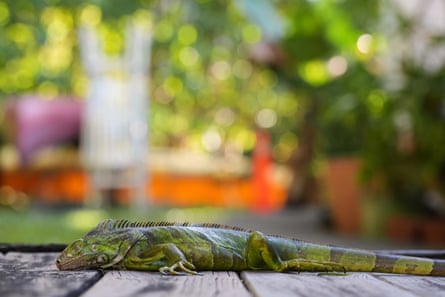
In November, residents were warned of the serious hazard of iguanas, paralyzed by the cold, falling from trees as temperatures started to plummet. The executive order issued on Friday allows for the removal of “cold-stunned iguanas from properties where they have landowner permission to conduct these activities and, on any commission-managed property”.
The executive order temporarily waives the requirement of a hunting license, management area permit, or other commission permits to collect and transport the live iguanas. Residents have until Monday 2 February at 4pm to transfer the live, cold-stunned iguanas to different drop-off locations in Florida.
According to the FWC, sustained near-freezing temperatures can send reptiles and amphibians, including non-native green iguanas, into torpor – a temporary state that causes them to lose muscle control.
The cold also left ice on strawberries and oranges in the state. Farmers in Florida sometimes spray water on fruit trees and berry plants to protect them from the cold.
In Florida, temperatures started to plummet over the weekend to levels not observed since 2010, 1989, 1977 and 1966, according to AccuWeather. A bomb cyclone across the south-east brought low temperatures, knocked out power to tens of thousands of homes and businesses, and led to hundreds of flight cancellations on Sunday.
Further north, in parts of North Carolina, snowfall totals were over a foot, according to the National Weather Service.
More than 110 deaths connected to the wintry weather and storms have been reported around the US since late January. In Mississippi and Tennessee, two states that were struck last weekend by a storm carrying snow and ice, more than 87,000 customers were still without electricity on Sunday, according to the outage tracking website poweroutage.us. Another 8,000 didn’t have power on Sunday in Florida.