3 months ago
115
3 months ago
115
With the best vacuum cleaners perfectly capable of cleaning both carpet and hard floors, investing in a second device that specialises in one or the other might seem like an unnecessary luxury. While Dyson’s £429.99 PencilVac Fluffycones looks positively affordable next to its £749.99 V16 Piston Animal, it’s a hard-floor specialist that can’t tackle carpets or particularly big cleans, and it won’t replace your existing vacuum. However, indulge me for a moment, because if you have any hard floor that needs regular sweeping for dust, hair and crumbs, it’s an accessible, flexible and friendly little cleaner.
The PencilVac is small for a Dyson and comes with a free-standing charging dock rather than the usual wall mount. It’s clearly designed to sit in the corner of a kitchen or dining area and be brought out for a quick sweep-up whenever needed. It’s also handy for a quick nip around a pet’s favourite hangouts, or for a sweep of your bathroom floor.
Dyson has experimented with hard-floor cleaners previously, and the PencilVac has a clear lineage back to the Omni-glide, which is still available, though only in refurbished form. The brand has streamlined the design to a significant degree, however, with a much sleeker body, a vastly improved emptying experience and excellent dust-detecting floor lights.
How I tested
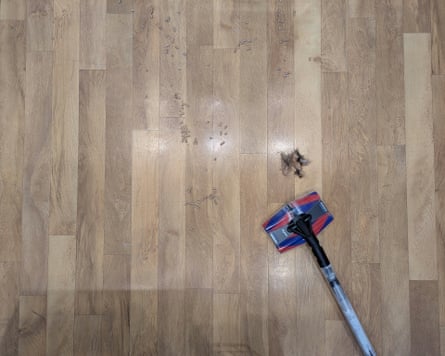
Because the PencilVac Fluffycones is designed for hard floors only, I didn’t put it through my usual barrage of carpet tasks, but I did test it exhaustively on hard floor. I put it through its paces with the usual trio of troublesome spillages – I measured specific quantities of flour, cat litter and pet hair, and recorded how much of each spillage the floor head picked up, by weighing the collection bin before and after use. I give all vacuums one forward and backward motion to pick up as much as they can, so this doesn’t test how much a vacuum could ultimately collect, but it is a good guide to how efficient the floor head is in various difficult circumstances. It’s a good comparator to use against all the other vacuums I’ve tested.
I also measure the suction power using a vacuum gauge, though Dyson’s vacuums have a tendency to cut out if their tubes are blocked, so this metric is slightly less useful here.
I tested battery life by leaving the vacuum switched on to run down from a full charge. This was done on a hard floor, using the device’s most economical setting, then again on its most powerful mode.
What you need to know
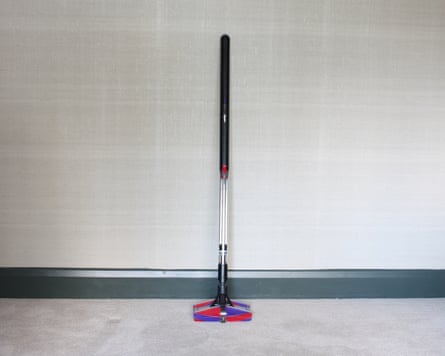
The PencilVac Fluffycones has an odd name, but it’s descriptive of two of its key features. PencilVac is fairly self explanatory: you can’t write with it, but it’s long, slender and pencil-like in appearance. Except for the floor head, the entire device is squeezed into a long (940mm) pole with a diameter of just 40mm, which doesn’t feel much bulkier in the hand than a standard 25mm broom handle.
This isn’t just a hollow extension wand: it incorporates everything that isn’t in the floor head, including the collection bin, the miniaturised Dyson vacuum motor, the battery and the control buttons. There’s no bulky additional unit to attach to the top. While at 1.8kg it’s heavier than it looks, it feels much lighter once it’s switched on and the clever design comes into play.
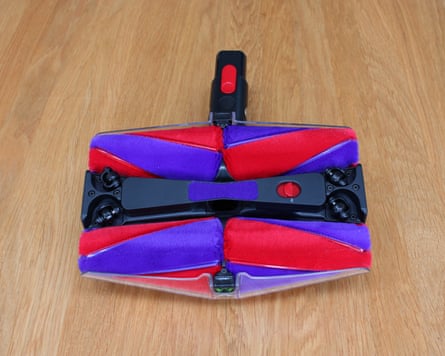
The floor head is where the Fluffycones are located. Fluffy rollers aren’t new to Dyson vacuums, but previous fluffies have tended to be single rollers. Here you have four, arranged in a grid with two cones at the front and two at the back. The front and back pair rotate in opposite directions, so any dirt beneath the floor head is swept into the path of the suction tube, connected at the centre.
The vacuum sits on four tiny caster wheels located between the Fluffycones. These make the floor head fairly mobile on their own, but start the rollers spinning and the unit lifts slightly, still resting on its casters but providing a feeling of weightlessness. Push the PencilVac around the floor, and it glides as though it were sitting on a cushion of air.
Looking at the included combination crevice tool and dusting attachment, you might think that this can also operate as a handheld. It can, but it’s not perfect. When you remove the floor head, you’re left with a long wand, with the collection bin at the base and the battery unit at the top, and no way to shorten it further. That makes the attachment good for whipping around skirting boards and removing cobwebs from ceiling corners and light fittings, but cumbersome to use at regular handheld distance.
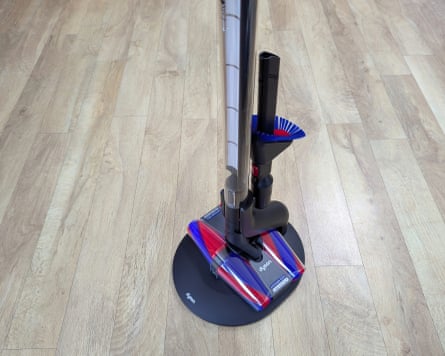
The last thing you get in the box is the charging dock. This has a larger footprint than the vacuum cleaner, measuring 25 x 29cm, and a connection at the back to plug in the charging cable. The vacuum cleaner snaps into an upright arm and is held in place using magnets, with a space behind it to store the included attachment.
Dyson PencilVac Fluffycones specifications
Weight: 1.8kg
Max suction power (quoted): not specified
Max suction power (measured): 21kPa
Battery life (quoted): 30mins
Battery life (measured): 23mins
Charge time (quoted): 3hrs 30mins
Dust capacity: 0.8 litres
Additional filters supplied? No
Dimensions (measured): 23 x 16 x 116cm (WDH)
What we love
The best thing about the PencilVac is how flexible the Fluffycones floor head is. It’s truly omnidirectional thanks to the clever joint that connects the head to the wand, and the broom handle grip, which can be held in any orientation. There are detection lights that genuinely help you spot dusty sections of floor, and they’re located on both the front and back, so it doesn’t matter which way it’s facing. It can even be twisted and pushed sideways, which is brilliant for weaving between the legs of chairs and breakfast-bar stools.
I wasn’t immediately convinced about the dust compartment because it looks tiny, though it claims to be 0.8 litres. That’s larger than Dyson’s 0.54-litre Car+Boat handheld vacuum (as featured in my roundup of the best cordless vacuums), which looks like a much bulkier unit. In using it, however, I was sold. It cleverly uses its suction to compact dust at the top of the compartment, so it keeps working without getting blocked as it fills, and it’s easy to see when it’s getting full.
Emptying is cleaner and better than any Dyson I’ve seen to date. Remove the floor head and point the base of the wand into the bin, then release a catch on the back and start drawing the collection bin’s outer tube down towards the bin. It picks up the dust and dirt from inside and starts pushing it down through the empty tube. By the time you’ve pushed it all the way down, the contents of the tube should be in the bin, without the dust cloud that’s often produced when emptying a Dyson.
My floor-head tests were deeply divided in terms of success, but I was impressed with its ability to pick up flour. Because the cones meet in the middle, it left a slight but visible trail of flour behind on the first pass, though it wasn’t enough to register its absence on my kitchen scales, which reported a clean sweep. It cleaned up the smudge on a second pass.
This carried across into general use. I found the PencilVac did an exceptional job of collecting dust, fluff, crumbs and a light scattering of cocker-spaniel hair when performing a regular sweep of my hard floors. The detection lights aren’t a gimmick: the green glow genuinely illuminates dirt and dust that lies ahead of it, and reassures you that it’s gone once the rollers have passed over.
What we don’t love
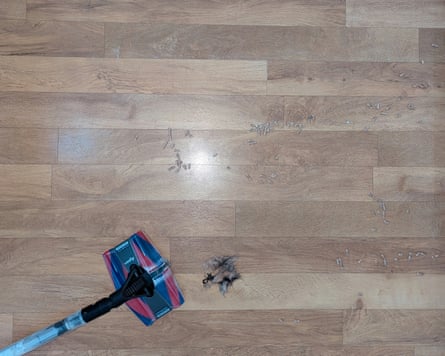
Where the floor head wasn’t so good was when attempting to pick up larger objects, including the cat litter and the pet-hair clippings that I regularly perform tests with. The cat litter was scattered by the floor head, which is unusual in a fluffy roller, but might have been due to the conical shape ejecting problematic debris to the side. It made it impossible to clear the litter in one pass, and I found it was much easier to pick up afterwards with the crevice tool rather than the floor head.
I also found it didn’t pick up clumps of dog hair particularly well, no matter how much I spread it out, as the narrower tube and close-fitting cones were prone to clogging. Again, it was better if I avoided using the floor head completely here, but such heavy-duty cleaning work is best performed with a heavier-duty device.
I also have a slight problem with the irregular shape of the floor head. While it cleans up to the edges of walls well, it can’t quite make it into the corners of rooms, which will leave you reaching for the crevice tool.
Warranty, repairability and sustainability
As with all Dyson cordless vacuum cleaners, the PencilVac Fluffycones comes with a two-year warranty. This covers parts and labour for repairs to faulty products, but not general wear and tear, filter replacements or the battery. Repairs come with an additional 12-month warranty.
The vacuum doesn’t come with a printed manual, but there’s one available online as a pdf, or you can download the MyDyson app and access the manual from there. Both the website and the app have a good selection of videos and tips on maintenance and cleaning. Dyson recommends emptying the collection bin regularly and performing a full rinse of the filter at least once a month.
If you’re using the PencilVac to replace another device, Dyson will recycle it for you, if you can take it to a Demo Store (London, Manchester or Birmingham) within 28 days. Otherwise, you should take it to your nearest recycling centre.
Most Dysons come packaged in recyclable cardboard packaging.
Dyson PencilVac Fluffycones: should I buy it?
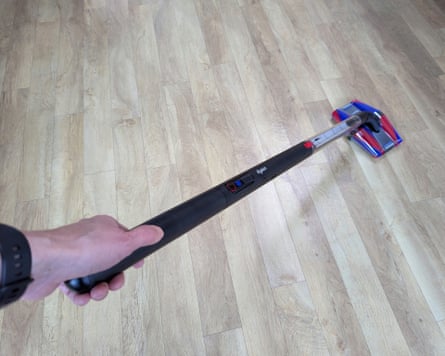
If you have plenty of hard floors and sweep them regularly, you’ll get a lot of use out of this nimble device. It’s light and enjoyable to use, and the more chair legs and obstacles you have, the more satisfying it is to work your way around them. It won’t replace your regular vacuum for a whole-house deep clean, though, especially if you have carpets or pets. At £429.99, that makes it an expensive, if useful, luxury.
For more:
Dyson V16 Piston Animal review
The best cordless vacuum cleaners, tested
The best robot vacuums to keep your home clean and dust free
Andy Shaw is a consumer journalist and technology addict. Having reviewed tech products professionally for more than 30 years, his favoured working environment is a small desk surrounded by big boxes. His greatest weakness is that he never, ever remembers how things came out of their packaging, so they rarely fit back in again when it’s time to return them.