2 months ago
58
2 months ago
58
The talks have started and the jockeying for position in the boardrooms has begun. In the coming weeks, we will find just how strong an offer Australia’s National Rugby League is prepared to make to invest in Super League and potentially transform the fortunes of the competition.
There is a school of thought, perhaps perpetuated more by those in Australia than in Europe, that Super League is flailing and in desperate need of help. In terms of the financials there may be some merit in that, with wealthy club owners losing tens of millions between them each year. As business models go, it is hardly sustainable.
But if NRL executives are looking at Super League and wondering what kind of competition they are investing in, they should be heartened by the fact that on the field, there really isn’t much tinkering required. From the opening eight rounds, few results have shown that more than this one.
Any healthy competition thrives on unpredictability and uncertainty; the NRL has had it for years and there is a fair argument, with only four clubs winning the first 30 editions of Super League, that the game in the northern hemisphere does not. The gulf between the best and the rest has always felt big – until the past year or so that is.
Super League has developed a sense that almost any game can provide any outcome, which is attractive for neutrals, broadcasters and, in the end, potential investors such as the NRL. Had you said two years ago, when Wigan were dominating the sport, that they would lose back-to-back home games against the team at the bottom of the table, you would have been laughed at. But after collapsing at home to Huddersfield, the Warriors did it again, with Castleford the latest to come to the Brick Community Stadium and upset the odds.
The Tigers have had their struggles in the early weeks of 2026 but this was perhaps an afternoon that could spark their season into life after a fairly morose opening under Ryan Carr. They were worthy winners here against an albeit injury-hit Warriors, who were the pacesetters after a month but due to the even-handed feel across Super League are now just another defeat away from falling out of the playoff places. Wigan have not lost three in a row in the league since the summer of 2021, incidentally.
“We got a reminder against Huddersfield that anything can happen but we don’t need it,” their beaten coach, Matt Peet, reflected. “You’re in a game every week and you have to be at your best every week.”
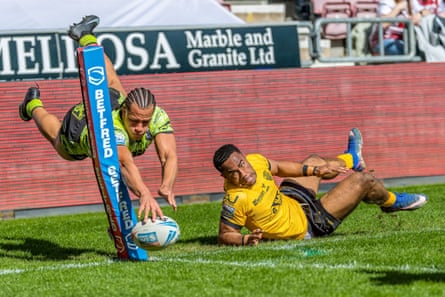
There is a bluntness to his side without the imperious Bevan French, one of few stars in Super League who could walk into most teams on either side of the globe.
But Castleford deserve immense credit. Having trailed 14-6 at half-time, they scored 18 unanswered points thanks to tries from Jack Ashworth, Krystian Mapapalangi and George Lawler. Some critics have questioned where clubs such as Castleford may sit in the NRL’s vision if it wishes to streamline Super League. This result perhaps showed why they still have their place.
The mood around the clubs to the visit from the NRL’s chief executive, Andrew Abdo, this week is largely positive. Abdo will likely return next month with a formal offer that will be put to the clubs, who have to relinquish their decision-making rights and allow the NRL to form an independent commission that would govern the sport.
That is long overdue. Clubs have run the sport in their own interests for too long but simultaneously, they do not have to roll over to all of the NRL’s demands. Crowds are up, TV figures are up and there is a title race which could arguably include as many as five or six teams. Sure, money is tight and the NRL’s overtures are not to be ignored; this could be a gamechanging moment for rugby league in Europe.
But do not be fooled into thinking Super League has a weak standpoint in terms of negotiations. This competition has a lot to offer.