6 hours ago
9
6 hours ago
9
Apple has just launched a range of new iPhones, including a foldable handset, just as you decide it is time to replace your own ageing mobile. But you balk at the £1,199 price tag for the cheapest of the new options.
Searching online for a better price with the words “cheap”, “iPhone” and “deal”, you come across a website which offers an iPhone 18 Pro for a couple of hundred pounds less than the Apple site. You pay for the new phone via a bank transfer and wait for it to arrive.
But the website is a fraud - one of hundreds set up in the days before the new Apple phones were announced – and is designed to scam money out of people eager to get their hands on one of the new handsets.
Apple unveiled the iPhone Duo, the company’s first foldable phone, on Wednesday, as well as two new iPhone 18 Pro models.
At the same time, criminals were building up networks of fake sites. Security researchers found a large spike in the number of scam sites registered with “Apple” and “iPhone”, among other keywords, in their domain names.

It is expected that the number will proliferate into the hundreds.
Alexandre François, who investigates scams for the intelligence company WhoisXML API, says the days before and after the announcement of the phones typically see a glut of domain names being registered by criminals. Some are then developed into phishing sites in order to dupe people.
“Some are flagged as dangerous by dozens of security engines, yet they are still absent from the blocklists that browsers and security tools rely on, so for most people nothing stops the page from loading,” he says.
“In each of the last four iPhone launches, domain registrations referencing the new model peaked on ‘keynote day’ – the launch day itself: more than 200 new domains within 24 hours, against zero or one on a normal day.”
What it looks like
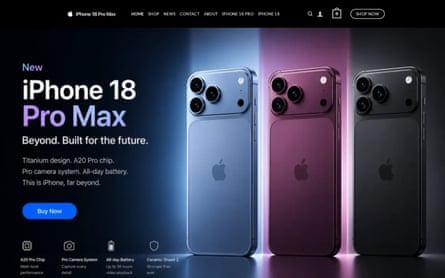
The domain names will often include words such as “Apple” and “iPhone 18”. The content of a developed site will look convincingly realistic as fraudsters frequently use AI to mimic genuine retailers.
One site found by François, an iPhone Pro Max, in three different colours, was advertised with claims of an “all-day battery”.
The release of technical specifications following the launch allows fraudsters to build more convincing websites. François says it then “becomes much easier to convince people that what they are looking at is a real iPhone”.
The sites may also claim to offer early access to the devices, as well as cheaper prices. The new iPhone 18 Pro starts at £1,199 officially, while the 18 Pro Max at £1,299, so expect the scam sites to quote prices substantially lower.
As with many scams, fraudsters may give people a deadline to buy – such as a few hours – to encourage them to abandon caution in a bid to land a bargain.
The sites will often only take payment via bank transfer to avoid giving people the protections available when you pay with a debit and credit card.
What to do
Remember what is on sale. So far, the iPhone Duo and the 18 Pro and 18 Pro Max have been announced – but not the standard iPhone 18. Pages which claim to be selling it now or taking deposits are fakes.
François says Apple does not operate lotteries and does not recruit people to test phones.
Legitimate websites will offer consumers a variety of ways to pay – debit and credit cards among them. Some fraudulent sites will insist payment is made using cryptocurrency, which should act as an immediate red flag.
Apple says its Safari browser has a warning for fraudulent websites that alerts users to phishing or malware sites.
If you find you have given out your financial details, contact your bank and Report Fraud. And then change your passwords.