6 hours ago
15
6 hours ago
15
In the polluted waters of Marina Palamós on Spain’s Costa Brava, Manuel Maldonado, a sponge biologist, noticed something unusual last month: red starfish had started settling in the area.
Nearly two years earlier, the Spanish National Research Council scientist and his colleagues had begun transplanting sea sponges into the port to study whether they could survive in its polluted waters.
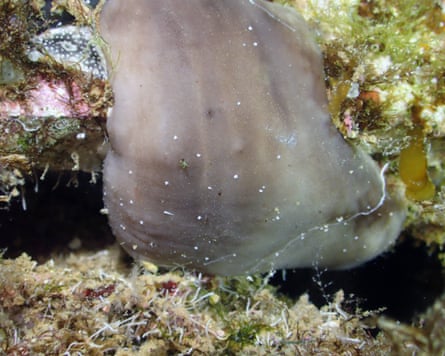
Only one species, the chicken liver sponge (Chondrosia reniformis, also called the kidney sponge), which is found along the Mediterranean coast but rarely seen in the harbour, managed to survive. Its resilience, and the arrival of the red starfish, suggests sponges could be used to clean up pollution in ports.
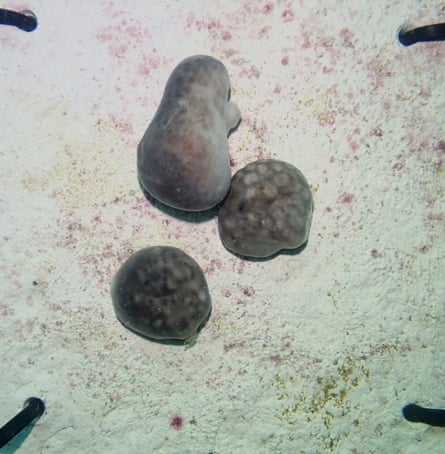
Sea sponges are some of the Earth’s oldest ecosystem engineers. Previous research has shown that abundant communities can reshape their surroundings in positive ways. They can filter pollutants from enormous volumes of water, cycling nutrients in the process. They also enhance biodiversity by attracting marine animals that live within and around them, such as worms and crustaceans.
All of this points to their potential as a tool for renaturalising harbours, some of the most disturbed marine environments in the world. The accumulation of pollutants such as rubbish and oil, the introduction of invasive species from ships and persistent noise pollution make it incredibly difficult for marine life to thrive there.
But first, it has to be proved that sponges can survive in harsh environments. “So we tested different Spanish species with the idea of finding some that could survive in a harbour environment,” says Maldonado, who led the research.
The team focused on five sponge species commonly found on the coast, chosen because their abundance suggests they are good survivors. “You also don’t want to use a very sensitive or protected species,” he says. “It has to be something you can handle and transport to the harbour.”
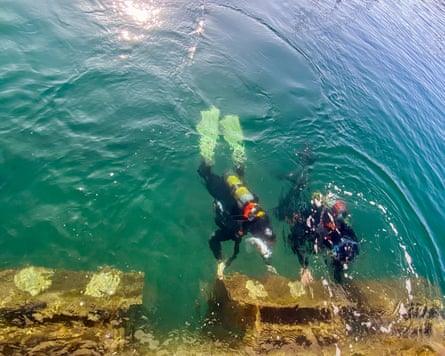
The sponges were collected from a site about 18 miles (30km) south of the harbour where they were transplanted. Maldonado’s student and study co-author, Carlota Escarré, monitored their health using underwater photography and inspection.
Escarré conducted dives every 20 to 64 days over the course of 15 months, braving early hours and cold waters at the harbour.
All the red encrusting sponges (Crambe crambe), leather sponges (Scalarispongia scalaris) and stinker sponges (Ircinia oros) shrank and eventually died during the study. But almost 92% of the chicken liver sponge specimens survived the polluted water.
“It was a surprise for all of us,” says Escarré. Some even managed to reproduce asexually, bringing their numbers up to 40 from 24.
Experts hope the study finally puts sea sponges, long overlooked in favour of the more charismatic coral, on the map.
“This study shows what we in the sea sponge community have known for years,” says Andreu Santín Muriel, a marine biologist at the University of Porto’s Interdisciplinary Centre of Marine and Environmental Research, who was not involved in the work. “Sponges are excellent potential species for bioremediation and habitat recovery.”
He adds: “A lot of effort has been put in the past decades for coral restoration; we understand the importance of corals very well. But sponges provide more ecosystem services, yet they’re not as attractive, so they have received way less money.”
David Amptmeijer, a doctoral researcher at Helmholtz-Zentrum Hereon, who was not involved in the research, says it is important to note how localised the study is. It is unclear if these same sponges could survive, for example, in a harbour in Maine.
Though Amptmeijer believes sea sponges have great potential for pollution management, he says a lot more research is needed before scientists can fully understand how they interact with pollutants.
Maldonado suspects the chicken liver sponge – a high-microbial-abundance sponge (hosting diverse communities of symbiotic microorganisms within its tissues) that takes ammonium from seawater and releases nitrate – is able to cope with pollution thanks to its diverse microbiome. “We will start working on this after the summer,” he says.
He and his team will continue monitoring the sponges over several years, but they also hope to study other organisms: he has written a proposal for a project that combines sponges with oysters, which are also powerful filter feeders.
Santín Muriel says sponges have been around for at least 600m years. “They have survived at least five mass extinctions, and they’re still thriving in today’s oceans. That means they’ve most likely already encountered a lot of environmental problems throughout their existence.”
It’s not so strange, then, to think that sea sponges may already have the solutions to many of the problems humans face today.
“We tend to look more to technology to solve environmental pollution,” Santín Muriel says. “But marine organisms most likely have already developed toolkits that could help us clean the oceans.”