2 hours ago
10
2 hours ago
10
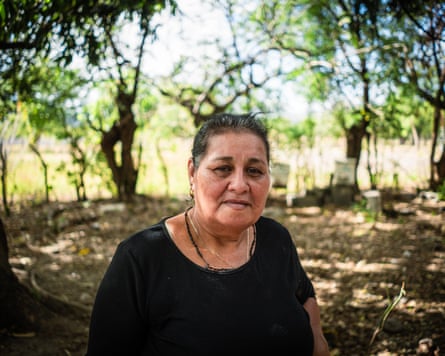
In the community of La Lima in Guatemala, Elda Dinora Ramírez, 58, looks towards a small well at the back of her home. Dusty wooden planks lie across the opening, concealing the faint gleam of water far below. “The well is drying up again,” she says.
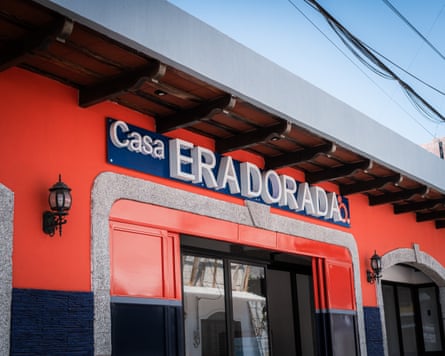
Ramírez’s home lies less than a mile from Era Dorada – a goldmining project acquired by the Canadian multinational Aura Minerals in January 2025. After years of inactivity, the project was reactivated this year when the Guatemalan government granted Aura a construction licence.
Exploration began in 1997 under the then-owners Entre Mares, a subsidiary of Goldcorp, and the project has faced a significant backlash throughout its 29-year history.
“Until all this started happening, we had a happy and peaceful life here,” says Ramírez. “There was no talk of mining; everything was calm.”
After initial excavation began in 2007, residents such as Ramírez reported water shortages. They blamed the mine for pumping out large quantities of geothermal water that was filling the tunnels during excavation.
“The machines they use draw from deep down; they take all the water and the springs dry up,” she says.
Although the mine’s development was suspended in 2013 due to unfavourable market conditions, the project site continued to have water extracted in subsequent years.
With operations temporarily halted, locals around the mine reported that water levels in their wells began to recover. Then known as Cerro Blanco, the project was sold by Goldcorp to the Vancouver-based Bluestone Resources in 2017. In 2021, Bluestone announced a controversial plan to convert the project into an open-pit mine.
A year later, a community referendum in nearby Asunción Mita rejected the project, with 88% of voters opposing it.
“It was a great victory for the people,” says Yony Barrera, 51, owner of a hardware store in Asunción Mita and vice-president of an activist group campaigning against the mine.
In 2024, Guatemala’s new government annulled the environmental licence for Bluestone’s proposed open-pit mine, just months after it had been approved by the previous administration. But activists feared that work on the project would not remain dormant for ever.
“I knew it wouldn’t be over,” says Barrera. “This will only stop when they take the gold.”
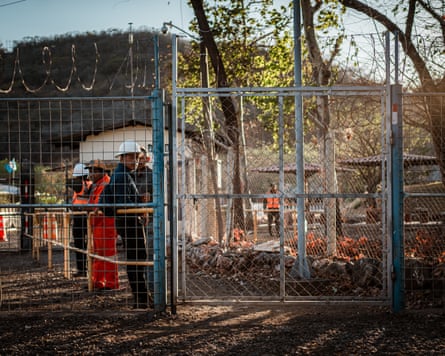
Today, the mining site hums with life once again. Heavy vehicles judder past the rusted coils of barbed wire that mark the site’s borders, clouds of dust rising in their wake. Workers in hard hats and navy-blue overalls gather around the entrance.
The company predicts an annual production of 111,000 ounces of gold in the first four years of operation. In a statement, Aura says industrial operations have not yet begun, although construction and site preparation work are under way, and that vegetation clearance is authorised under its licence and is being carried out within limits set by the project’s EIA.
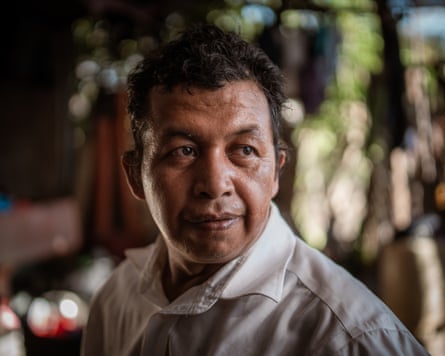
“They are advancing a lot, and very quickly,” says Arnulfo Díaz, 43. “At the same time, we are advancing towards our own destruction.”
Díaz worked on the project in 2008 as part of the excavation team under Entre Mares, where he says he sustained an injury that left him deaf in his right ear. He fears the project’s return may bring wider consequences for his community.
“Our fear is that we will lose everyday access to water,” he says. “Where are we going to go?”
Ramírez says the effects are already being felt. As well as her well drying up since the project was reactivated in January, her fruit trees are losing their harvest to drought and her livestock are suffering from respiratory illness she attributes to dust from the mine.
“When I lie down at night I start to think: there is no hope left,” she says.
Aura Minerals says measures are being taken to suppress dust at the site and monitoring has so far shown that the work has had no impact on air quality.
Aura says it is approaching the project with a renewed focus on sustainability, pledging to develop it as an underground mine after more than 1,000 hours of dialogue with local communities. In a company statement, Aura’s president and chief executive, Rodrigo Barbosa, points to plans for a water-purification plant and the use of 100% recycled water.
“This ensures we not only do no harm, but go beyond and create positive value for the communities and environment,” he says.
after newsletter promotion
Aura says it will recycle water used in the industrial process in a closed-loop system with no discharge and treat excess natural water from the mine to a drinkable standard for local communities. The company also points to continuous water-quality monitoring upstream and downstream of the operation and says hydrogeological studies and monitoring show no evidence of reduced water availability for local communities.
But activists claim that the environmental guardrails in place, designed to limit the project’s harmful impact, fall short of what is required.
According to Era Dorada’s opponents, the project continues to operate under a widely criticised Environmental Impact Assessment (EIA), which was approved in 2007.
A 2023 report commissioned by the Central American Alliance Against Mining (Acafremin) says experts from Guatemala’s ministry of environment and natural resources rejected the EIA in 2004 and 2005, but the ministry replaced them in 2007, and the new head of the unit approved the EIA shortly afterwards.
Julio González, of the Guatemalan environmental organisation Madre Selva, and other activists say these changes are evidence of past corruption and have criticised the EIA for failing to account for key environmental considerations, such as the safe disposal of cyanide – a highly toxic chemical commonly used to separate gold from rock.
A 2022 report by Steven Emerman, a geophysicist and independent mining expert, recommended that all of the mine’s permits be revoked.
In its statement, Aura says the current underground project falls within the scope of the original EIA and its active environmental licence, which it describes as being fully valid and adequate for the operation. Aura confirms it plans to use cyanide in the Era Dorada project, but says the mine is designed to manage it in line with relevant standards, with the process operating in a closed-circuit system and a detoxification stage at the end of the process to neutralise cyanide in the solution.
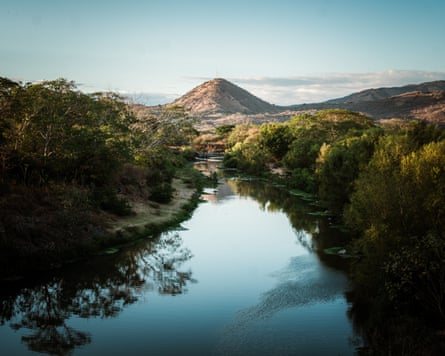
The mine is in the protected biological corridor of the Ostúa dry forest, and environmentalists fear that inadequate governance could expose crucial ecosystems to contamination by heavy metals. Aura says the project is not located in an area with legal restrictions, and claims to have plans in place to maintain the ecological integrity of the surroundings.
Scientists also warn that geothermal water discharged during tunnel excavation carries high levels of arsenic. A 2019 study by a biologist, Cidia Cortes, reported elevated arsenic levels at points on the Ostúa River where the mine discharged geothermal water.
The company says, however, that arsenic occurs naturally at higher than normal levels in the region and that all of the water pumped from the underground workings is treated to reduce arsenic. Era Dorada also says it is investing to upgrade treatment to improve water to drinkable standards.
The Ostúa River feeds into Lake Güija, a protected site that straddles the Guatemala-El Salvador border. Here, communities fear that reactivating the mining project could jeopardise their livelihoods.
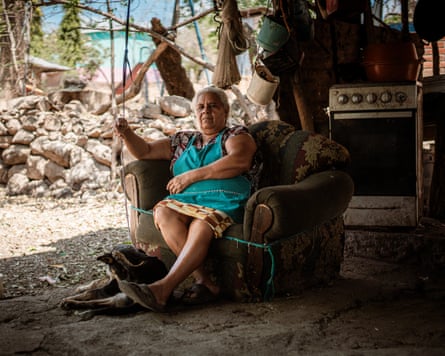
“We have eight children,” says Mirna Margarita, 58, who lives in the lakeside community of Cuevitas. “We fished just to sustain them and put them through school.”
Looking out over the blue waters of Lake Güija, she leans back on a lopsided sofa. “These times are very worrying, with all this contamination that could come to us.”
Her husband, Maximiliano Pérez, 59, who has fished all of his life, sits opposite her. “It worries us greatly that the mine might become active again and start working, with how much we stand to lose,” he says. “We look at the lake like a mother – she is what gives us our food.”
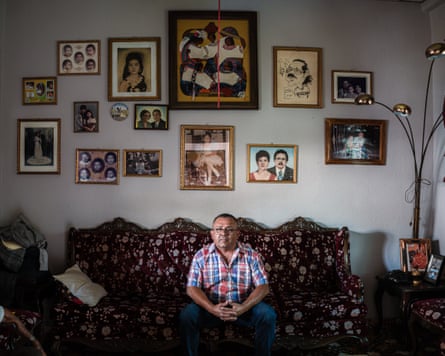
Amid ongoing uncertainty, many who live close to the mine share concerns about the future. Pedro Arrieta, 55, is a baker from Asunción Mita. He sits in his family home, where a small plate of home-cooked pastries is passed around the room. “What mining brings is contamination, corruption and death,” he says.
A collection of family photos is arranged on the wall behind him. Generations of faces look out from within the gold-rimmed frames. “What are we going to leave to our next generation?” he asks.