2 months ago
84
2 months ago
84
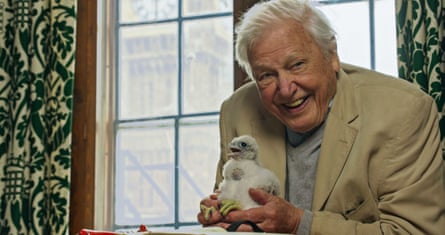
Filming the wildlife of London requires an intrepid, agile presenter, willing to lie on damp grass after dark to encounter hedgehogs, scale heights to hold a peregrine falcon chick, and stake out a Tottenham allotment to get within touching distance of wary wild foxes.
Step forward Sir David Attenborough, who spent his 100th summer seeking out the hidden nature of his home city for an unusually personal and intimate BBC documentary.
Wild London, which will be broadcast on BBC One on New Year’s Day, features 99-year-old Attenborough in front of the cameras more than in any of his recent natural history blockbusters as he demonstrates he has lost none of his affectionate rapport with wild creatures.
He gently cups a tiny, jumpy harvest mouse in his hand before releasing it into a meadow in west London, admires beavers making their home in Ealing, and watches, enraptured, as young foxes gambol around his deckchair at dusk in north London.
“He’s a 99-year-old man but I would say he’s still one of the easiest TV presenters to work with,” said the director Joe Loncraine. “He’s incredibly professional. He gets the job done quickly.”
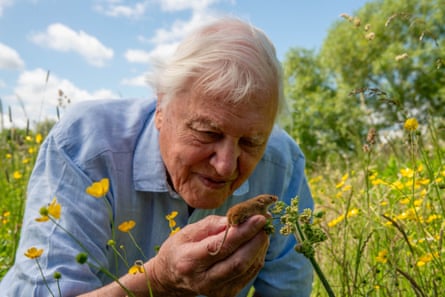
According to Loncraine, the film-making team ruled out certain ideas for “pieces to camera” on account of Attenborough’s age but then discovered that their presenter was more than willing to try them.
“We’d have these ideas and think, ‘OK – can’t do that’ and then discover he was up for it and it was really great. I’ve worked with presenters in their 30s who would moan about that. He’s fantastic.”
In the documentary, Attenborough takes viewers to one of his favourite buildings, the Natural History Museum, to find emperor dragonflies, as well as visiting parliament for peregrines and the ancient oaks of Richmond Park.
But it is the new iterations of the “two-shot” – where Attenborough is pictured interacting with foxes, hedgehogs, harvest mice, peregrine chicks and even parakeets – that are likely to most delight viewers.
“He has a calmness around animals,” said Loncraine. “As we’ve all seen with his encounters with blue whales and mountain gorillas he can do exactly what he’s there to do – deliver information – but still react to what the animal is doing in the most perfect way. That enthusiasm and his own natural curiosity is infectious.”
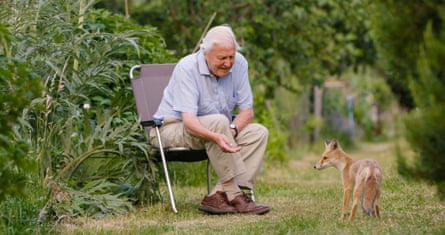
The wild foxes were filmed by Matt Maran who has followed a fox family near his home for a decade, and knew exactly when and where to find them. But remarkably, the scene where Attenborough meets the foxes was shot in just one evening.
“We were lucky with the weather this year and we just got lucky that not only one fox came up to him but we had another one,” said Loncraine.
Attenborough is as enthusiastic about the humble tube-riding pigeon and leopard slugs as he is about the much-loved hedgehogs he watches after dark, lying down in an Ealing back garden.
According to Loncraine, Attenborough was most keen to tell stories of rewilding and nature restoration in the film. In 1936, aged 10, Attenborough attended a lecture by the conservationist Grey Owl (Archibald Belaney), and was struck by his determination to save the Canadian beaver.
Eighty-nine years later, Attenborough reflected upon the amazing sight of Eurasian beavers in Europe’s largest city, after they were reintroduced to fenced wetlands in Ealing and Enfield.
In a piece to camera, Attenborough said: “If someone had told me when I first moved here that one day I would be watching wild beavers in London, I would’ve thought they were mad but there they are, right behind me, going about their own business.”
According to the film-makers, Attenborough was keen that the documentary carry a clear message: people, and cities, need nature to be happy and healthy.
“The importance of appreciating nature wherever it is and making space for nature in urban environments as key for him,” said Loncraine. “It isn’t just a collection of stories. We needed to make sure it was saying something about the benefit of these urban green spaces and the need to protect them and have more of them in cities.”
In an elegiac final scene, Attenborough discusses how important Richmond Park has been in his life.
Will this be Attenborough’s natural-history presenting swansong? “People have been asking that question for at least 10 years,” said Loncraine. “Anyone who makes the bet that this is his last would be foolish. I have no idea – but hopefully not.”
-
Wild London airs on New Year’s Day at 6.30pm on BBC One