1 month ago
112
1 month ago
112
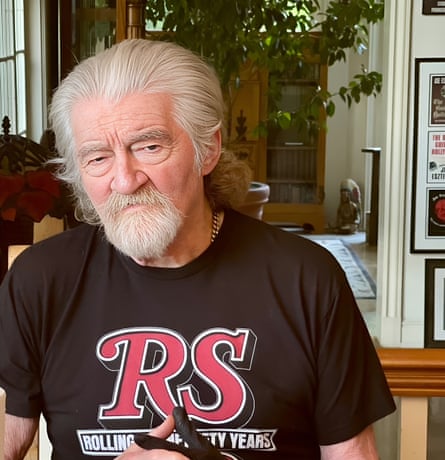
Joe Eszterhas was the swaggering pitchman of 80s and 90s Hollywood; the king of the high-concept, precision-tooled blockbuster. He wrote Jagged Edge, co-scripted Flashdance, and pocketed a then record $3m for his Basic Instinct screenplay. Writers typically skulk near the bottom of the industry food chain but Eszterhas flipped the script to make himself a boss and a brand. ABC called him a “living legend”, while Time magazine posed a breathless rhetorical question: “If Shakespeare were alive today, would his name be Joe Eszterhas?”
Pride, as any hack writer will tell you, usually comes before a fall, and so it was with Eszterhas, who confused success with excess and barely got out of the business alive. “The coke and the booze,” he says, remembering. “Those weren’t helping my creativity, they were holding it back.” His best years in Hollywood were conversely his worst.
Eszterhas is now 81, gravel-voiced after surviving a bout with throat cancer, and living in Cleveland, Ohio, with his second wife, Naomi. But he never retired, and recently plotted a Hollywood comeback with his idea for a rebooted, re-energised Basic Instinct. Eszterhas received a reported $2m from Amazon MGM studios for his script and stands to make a further $2m if and when it is filmed. Which it will be, the writer insists. “There’s a great demand for it. It’s trending all the time.”

The 1992 original was a box office smash and a political hot potato, loved and loathed in equal measure. It starred Sharon Stone as Catherine Tramell, a bisexual seductress and potential ice-pick murderess. Eszterhas had nothing to do with the flop 2006 sequel. His new story, he explains, juggles copycat serial killers with elements of the supernatural.
What stage is it at? Mostly done, he declares. “The producers are negotiating with a really interesting director – a Brit, Emerald Fennell – who did Promising Young Woman and Wuthering Heights. Her sensibility is exactly right. She’s someone who is not afraid of controversy and sexuality. So I’m thrilled by that. I hope it works out.”
Sometimes, admittedly, Eszterhas gets out over his skis. He initially planned to get Stone back on board but the actor was having none of it. “There’s not going to be a Basic Instinct reboot,” she said last August. “I hate to break it to you, but Joe Eszterhas couldn’t write himself out of a Walgreens drug store.”
Screenings of Basic Instinct were famously picketed by members of Labia, a lesbian and bisexual activist group. The National Organisation of Women called it “the most blatantly misogynistic film in recent memory”. And while Eszterhas disputes that, he has always relished a good public scrap. Studio pictures today, he feels, are too deodorised, too polite, too scared of causing offence. “People are terrified of confrontation and disagreement. That’s a communication loss. That’s a human loss.”
Fair enough. But he has also described his reboot as being “anti-woke”, which makes it sound like a culture-war flashpoint, part of the pushback against Hollywood’s perceived liberal bias. This past year we’ve seen Donald Trump personally stumping for the production of Rush Hour 4 and Amazon MGM paying $40m for the Melania documentary. So there is a danger of Eszterhas being co-opted, lumped in, and becoming a political football.
“Yeah, there’s a danger,” he says. “But let me put it facetiously. If you move to Cleveland, live beside a little lake and just go into your room to make stuff up, that danger diminishes. I mean, your work may become a political football, but you don’t have to be involved in it.”
Politically speaking, Eszterhas has swung both left and right. He briefly liked Trump but has since turned against him, what with Epstein, ICE and the daily assault on the first amendment. “So if Trump’s now muscling studios and directors to treat him kindly, that’s wrong,” he says. “It’s despotic and undemocratic.” Recent events, he admits, also touch on old scars. “I was involved in the civil rights movement and the anti-war movement. I was a refugee in America – a displaced person, a foreigner. So I have immediate sympathy with people who are bullied and discriminated against.”
Eszterhas’s life story might make a decent film script itself. It’s a harrowing, rollicking immigrant’s tale that whisks its hero from his birth in war-torn Hungary through the refugee camps of Allied-occupied Austria to the US rust belt, where he landed at the age of six. As a cub reporter in his 20s, Eszterhas covered the Kent State massacre. Later, as a feature writer for Rolling Stone magazine, he wrote about labour disputes and claims to have interviewed Charles Manson in prison.
“I felt the chills go down my back,” he says. “I covered serial killers, murders, lots of ugly things. But I never felt anything like I felt with Manson. I walked into the room and there was an immediate chill. He had the most amazing eyes. They bored into my soul.”
Actually, he says, it was Hunter S Thompson who first recommended him for the Rolling Stone job. “Hunter was my running buddy. It was the alcohol that destroyed Hunter. The alcohol and the drugs. When he needed surgery he had booze fed to him through his IV drip.”
He shakes his head and unearths a memory. “The only time I did acid was on a beach in San Francisco. Hunter was there and I really flipped out. All the refugee camp stuff came back. It was Hunter who held on to me for an hour and settled me down. That’s ironic, given the man’s reputation. But he was a calming influence on me that day.”
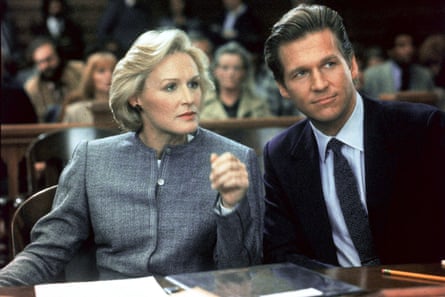
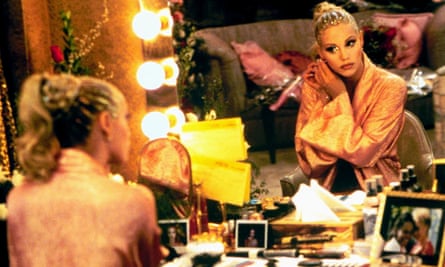
Eszterhas carried the air of gonzo journalism to Hollywood. He looked like a roadie and wrote like a demon. Years of journalism had taught him the value of a good hook, tight structure and a sensational splash. Flashdance, the tale he co-wrote about a welder who dreams of being a ballerina, earned its budget back nearly 30 times over. Jagged Edge created the template for the neo-noir legal thriller. Even 1995’s Showgirls – a risible flop on first release – has since been reframed as a gaudy cult classic.
As for Eszterhas, though, he wasn’t faring too well. He says: “I had an issue with drinking. I had an issue with drugs. I discovered cocaine. I was endlessly unfaithful to my first wife. And I have a semi-alibi for all that, which was that the countercultural revolution was still going on. Rolling Stone and Hollywood was at the vortex of all that. And I’d come from Cleveland, which was at the vortex of nothing. I was in California looking for heavenly bliss, and it was all there, it was all happening.”
Possibly he never fitted in. Even when he was an insider, he felt like an outsider. He had married Naomi by this point; they eventually had four sons together. “When the boys were little, they’d go to these Hollywood parties. Will Smith would bring in fake snow. Kids would show up with their fathers’ Oscars. And Nick Nolte and Gary Busey would be standing out back. Naomi and I, we’re both from Ohio. Neither of us wanted to raise our kids in that setting.”
Cleveland is his home. That’s why he eventually went back. Being a writer, he says, means you can base yourself anywhere. He still writes film treatments and occasionally lands a big deal. But he has also written a 750-page memoir (Hollywood Animal) and told his Tinseltown war stories on a recent multi-part media podcast, Ugly, Irresponsible, & Childish. He has been clean and sober for decades; his boys are fully grown. Mostly his past takes the form of corny scenes in old movies.
The other month, for instance, one of his sons made a big announcement. He was going to move to LA and try to make it as a rock star. So Eszterhas did what any respectable parent would do. He explained that LA is a tough town, that rock music is a gamble and that the kid should at least have a solid profession to fall back on. “And he looked straight at me and said, ‘Didn’t you write a line in Flashdance that says, If you give up on your dreams, you die?’”
Hoist with his own petard, as Shakespeare wrote. But Eszterhas is his own man and speaks his own language. “Wow,” he says. “What a fucking checkmate.”