3 months ago
125
3 months ago
125
The word bryophyte refers to a group of plants that may have colonised terrestrial Earth almost half a billion years ago. They need water to reproduce sexually and they love rain. So it’s hardly surprising that Britain is an important archipelago for them, with the two main groups, liverwort and mosses, represented by nearly 300 and 770 species respectively. This is a 20th of all the world’s bryophytes.
Perhaps the best summary of the British public’s sense of the group was offered by a friend recently, who said that he hadn’t been aware that there was more than one bryophyte. Moss doesn’t occupy our conscious minds. It lives at the periphery, trembling on the edge of our sense of things. Especially when it rains, because moss is then even more luminous.
It is the thick-pile pullover clothing many tree trunks and branches; it’s the carpet across the woodland floor; it fills out our lawns; it makes the winter denser and more vibrant. However, if mosses ever become a focus of attention, something to enjoy and investigate, they can populate your world with astonishing riches.
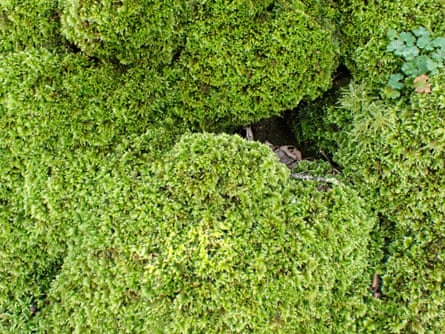
In Derbyshire, there is a particular joy in the way they have colonised the region’s limestone walls, which are often swollen and curvaceous with life. Some of the most impressive I know are in the parish of Priestcliffe.
A trickier aspect to these encounters is that moss leaves are just millimetres long, and it is the 1,000-fold variations with which they grow, twist, interleave or wax and wane with the weather that are the only means to work out their identities.
For beginners like me, a Priestcliffe wall might divide into a dozen species – undoubtedly an underestimate of what is present. Yet even their sweet names bring pleasure: silky wall-moss, frizzled crisp-moss, comb-moss, glittering wood-moss or the rather weird flat neckera and wall scalewort (a beautiful liverwort). Separating one from another is fun, but it is when – as my friend proposes – they merge into one continuous serpent of shining green that they are most affecting and, in a sense, most truly themselves.