3 months ago
227
3 months ago
227
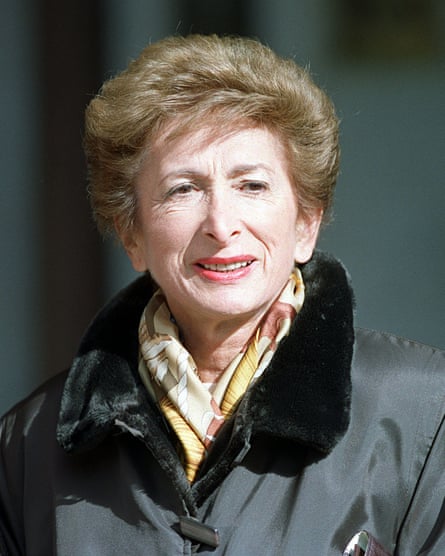
There was a time in the late 1980s when Shirley Porter was the second most famous and powerful female politician in Britain: “the Iron Lady of the town halls”. Like her heroine, Margaret Thatcher, she was a grocer’s daughter, though the family business, Tesco, was somewhat bigger than the prime minister’s corner shop. Porter’s eventual fall from grace was devastating both for her personal reputation and for Thatcherism’s perceived way of doing things. She was, simply, the most corrupt politician of her time.
Porter, who has died aged 95, was pursued by the district auditor from her power base at Westminster city council, where she was leader for eight years, 1983-91, and eventually found to have acted illegally in selling council houses with the aim of increasing Conservative votes, in what became known as the “homes for votes” scandal.
In the words of the House of Lords, there had been “a blatant and dishonest misuse of public power (and) wilful misconduct”, their verdict on her in 2001. It took 15 years of investigation and litigation to reach a settlement of her liabilities: a £12.3m repayment to the council in 2004 following an investigation that started in 1989 – and even that was only a fragment of the sum the law lords had ruled she owed three years earlier.
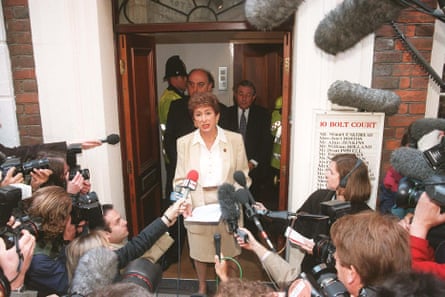
She once told the journalist Jay Rayner: “People either like or hate me. I regret having gone into politics and having put my whole life and soul into it.”
Porter could easily afford the repayment: even though she had tried to claim her private wealth was just £300,000, her assets, eventually tracked down to offshore companies in the Virgin Islands, were found to be at least £20m. Yet it was not for personal enrichment that she had acted, but to secure Westminster for the Conservatives in perpetuity.
Born in London, she was the younger daughter of Sir Jack Cohen, the founder of the Tesco supermarket chain, and his wife Cissie (nee Fox). Cohen had started the company the year before Shirley arrived and within a decade had more than 100 stores, though the family did not move from their home in Hackney, which he had bought from the council.
Shirley was sent to a boarding school in Worthing, then, briefly, to La Ramée, a Swiss finishing school in Lausanne, before returning to study at a north London secretarial college. In 1949, at 18, she married Leslie Porter, then working in his family’s textiles business but later Tesco’s managing director.
Bored as a stay-at-home wife bringing up two children and with golf her only outlet, Porter began a campaign to expose the then pervasive antisemitism in north London golf clubs. Later she became a magistrate and, when her children left home, took up the challenge of the rubbish-laden streets of central London, where the family lived.
She became a Tory councillor for the Hyde Park ward on Westminster council in 1974, later claiming that she had thought about joining the Liberal party but found the Tories more dynamic. She told an interviewer that her activism gave her confidence: “For the first time I was not someone’s daughter, somebody’s wife, somebody’s mother. That is a mind-boggling feeling.”
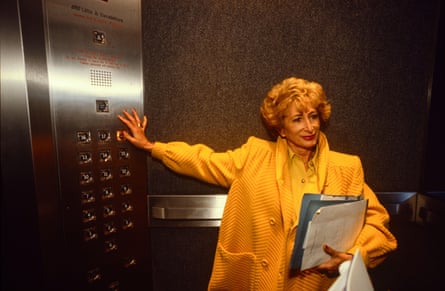
On the council, her energies were channelled into campaigns against litter, drugs, the pornographers of Soho and, crucially, waste in council bureaucracy. After she became the council’s leader in 1983 there was the Wars (Westminster Against Reckless Spending) campaign and the rationalisation of frontline services so that members of the public visiting City Hall in Victoria could find all the departments they needed clustered together on one floor.
This was all in line with her father’s philosophy of making his shops as accessible as possible to customers. It did not make her popular with the council’s senior staff – 15 chief officers left in her first four years, some with large pay-offs. Her allies would be invited to breakfast meetings at her home to plot strategy and tactics. Her deputies continued to receive orders from her even as she left from Heathrow to go on holiday: “I don’t want you slacking while I’m away,” she said.
Her dynamism and flair for self-publicity gained her a high profile in the Tory press, particularly the Evening Standard and the Daily Mail. There would be confidential telephone calls to reporters – I was one – that were both flattering and disconcerting.
In the local elections of 1986 however, Porter got a shock as the Tories retained power in Westminster, the richest borough in the country, by only four seats: 1,000 extra votes would have placed Labour in control. The threat of a Labour majority in 1990 seemed real: “Imagine socialists running Buckingham Palace, militants lording it over parliament … a horrible nightmare,” as an internal memo of the time stated.
Porter and her allies launched a covert campaign to ensure that this would not happen. Eight wards with potential Labour majorities were targeted with the intention of moving council tenants out and selling their homes to buyers more likely to vote Tory, a policy disguised by the slogan “Building Stable Communities”.
Once the scandal became clear, the alternative title of homes for votes seemed more appropriate. Families were offered £15,000 to move and 122 were placed in two dilapidated tower blocks on Harrow Road already known to be riddled with asbestos. Council money was additionally directed to the improvement of Conservative and marginal wards, leaving Labour ones neglected.
Meanwhile, another scandal was unfolding in 1987 with the sale of three of the council’s cemeteries in Hanwell, East Finchley and Mill Hill to property developers for five pence each. Ostensibly done to save £400,000 a year in maintenance costs, even as the land was disposed of, the council had to pay the developer compensation because it had not secured the eviction of one of the cemetery keepers. Nor did it ensure that the purchaser would redevelop the sites: instead they were sold on within a day for £1.25m.
Relatives of those buried in the cemeteries were understandably outraged, but when they turned up to a council meeting to complain they were jeered by raucous young Conservatives. The council was eventually forced by the local government ombudsman to buy back the land, which had not been built on, for £4.25m.
Despite the scandals, Porter achieved her aim: in 1990 the Tories were returned with a 36-seat majority. Westminster rewarded its voters by gleefully cutting their council tax by 20%. The following year Porter stood down to become lord mayor of Westminster and was made a dame by John Major’s government in 1991. She resigned from the council in 1993 and retired to live in Israel.
In 1989 however, John Magill, the district auditor, began investigating the homes for votes scandal and ordered a halt to the policy. He declared it illegal in 1996 and ordered Porter and five other councillors and council officials to repay £31m. Upholding his decision the following year, the high court centred the liability solely on Porter and her deputy.
Legal challenges and delays in the council’s search for her money not only increased the debt to more than £48m but appeared unlikely ever to be concluded until the leak of private emails between Porter and her son, John. One of the messages, from Porter’s financial adviser, read: “All in all a good year with WCC seemingly making little progress legally and apparently no closer to tracking down assets.”
The leak, to the BBC journalist Andrew Hosken, followed a falling-out between John Porter and a business associate. It revealed that the family was hiding their wealth in a tax haven. The revelation prompted a negotiation to settle the debt that was ultimately concluded in 2004 with the payment of £12.3m, which the Tory-controlled council declared reasonable and satisfactory. It at least enabled Porter to acquire a property in Mayfair in 2006 to add to family homes in Tel Aviv and Florida.
Porter complained that she had been the subject of a huge injustice and claimed she had written her memoirs to restore her reputation and set the record straight, only refraining from publishing them at her son’s request that she should not revive the scandal.
Reviewing Hosken’s 2006 biography of Porter, Nothing Like a Dame, Nicholas Lezard wrote in the Guardian: “She remains by a considerable margin the most corrupt British public figure in living memory.” Hosken’s book was the inspiration behind Gregory Evans’s radio play Shirleymander, broadcast on BBC Radio 4 in 2009, and staged at the Playground theatre in west London in 2018.
Porter and her husband were generous supporters of charities; galleries at the National Portrait Gallery, the Victoria and Albert Museum and the Royal Academy benefited, as did Tel Aviv University, which established the Porter School of Environmental Studies in 2020.
Leslie died in 2005, and her son, John, in 2021. Porter is survived by her daughter, Linda.