6 hours ago
11
6 hours ago
11
The Franz Beckenbauer Supercup has a modicum more intensity than most of its European equivalents. There are many reasons for this. The Bundesliga’s traditional season curtain-raiser pitting league champions against cup winners is not played on neutral territory, giving it the feeling of a domestic game with proper stakes.
German fans would also never accept it taking place on foreign soil, as the Borussia Dortmund managing director, Carsten Cramer, reiterated in clear terms over the course of the weekend. It feels like a match, rather than a showpiece.
It had one other factor to ratchet up the adrenaline this year. It was the sense the two teams most expect to be the season’s best, Bayern Munich and Borussia Dortmund, were the participants, with last term’s second-placed side hosting the champions. There was enough in the game to suggest the latter may be able inconvenience the former, as Bayern held on to win the season’s first trophy after BVB followed a thoroughly dominant first half from the visitors with a vastly improved second period.
But enough to create genuine jeopardy? That was harder to buy into. We all know what it takes for someone else to win the title in Germany: an exceptional team, like Jürgen Klopp’s Borussia Dortmund or the Xabi Alonso-era Bayer Leverkusen, allied with a below-par Bayern . That second clause is far from being fulfilled.
For every action there is a reaction and in the past 15 years when Bayern have been domestically beaten it was met with a fierce response. So if Dortmund provoked Bayern to hit unimaginable levels with the 2013 treble, the same snap out of a deep funk has happened under Vincent Kompany.
For Klopp’s wins in 2011 and 2012, read 2023 – when Dortmund all but handed Bayern their title back on the final day – and 2024, when Alonso’s Leverkusen finally took it away from them again. Once again, two years of fallibility was enough to make Bayern respond with force.
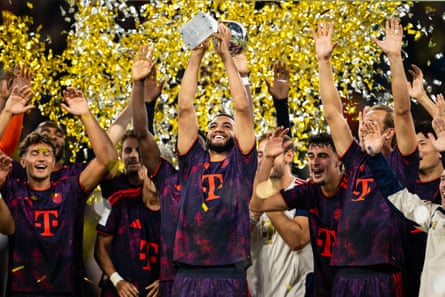
The leadership that has taken the champions there is key. Just as few would have imagined in spring 2012 that Jupp Heynckes would lead Bayern to virtual invincibility, there was not a queue of people scrambling to decree Kompany as the man to inspire the Rekordmeister to heights not reached since peak Pep Guardiola, but here we are.
Kompany has transformed the team in terms of intensity and culture and that they have signed only two senior players – but excellent fits in Nathaniel Brown, who scored the opener in the Super Cup, and Ismaël Saibari – shows how difficult they are to improve.
Harry Kane, in a season opening with Bayern campaigning hard for his Ballon d’Or candidacy, is symbolic of just how relentless this Bayern vintage is. “It’s always about sending a message,” hesaid of Bayern’s intentions going into Saturday’s match. “Our momentum is to keep pushing, to keep pushing each other and to see how far we can go.”
The sentiment among their Bundesliga rivals, both publicly and privately, is that keeping pace with Bayern is probably not a realistic aim. Dortmund have belatedly realised that spending on names to try to keep up is a flawed strategy. It has been a significant summer, shedding the big salaries of Niklas Süle, Julian Brandt and Karim Adeyemi. The young Greek pair of Konstantinos Karetsas and Giannis Konstantelias have arrived to re-energise their midfield, which will suit the demands of the coach, Niko Kovac.
Going young is a smart and overdue move and they showed in the Supercup that even if they are at the foot of the title mountain, they at last have sturdy walking shoes and plenty of drinking water.
What we can expect from Leverkusen and RB Leipzig is a little less clear. For Leverkusen, the 2024 champions, failing to make the Champions League places last season was a failure, but it allowed them to let Kasper Hjulmand go, drawing a line under a chaotic season that began with Erik Ten Hag’s three-match reign.
This pre-season has been “more calm,” the sporting director, Simon Rolfes, said with some understatement, and even if Alejandro Grimaldo left for Atlético Madrid, life at BayArena is now stable. They retain their ambition under the new coach, Carles Martínez, and new signings – including bringing back Moussa Diaby from Saudi Arabia – have underlined that.
after newsletter promotion
Leipzig will participate in the Champions League, but a concrete aim is hard to define. They had planned to hold on to Yan Diomandé, but the money on offer from Real Madrid became too much to resist, with RB receiving more than six times the €20m they paid Leganès for him the year before.
The return of Christopher Nkunku is bold, but signing a player who will be 29 in November is unlike them and it is worth recalling that bringing back Timo Werner, who had been a hero in his first spell at the club, backfired badly. The removal of Ole Werner as coach – sanctioned by Klopp before he took the Germany job – and his replacement with Martín Demichelis, who oversaw Mallorca’s relegation in May, is a risk.
Another item for these clubs to consider could be the recent ruling by the Bundeskartellamt – the Federal Cartel Office – that the 50+1 rule is being applied correctly and justifiably by the Bundesliga in accordance with competition law. In short, this means 50+1 is here to stay and a genuine commitment to the principle, in terms of fans being represented more fully on the boards of clubs from corporate seed, could be demanded.
Stuttgart and Sebastian Hoeness will hope to prove they can compete in Bundesliga and Champions League simultaneously – the final frontier at the club for arguably the league’s most accomplished coach. With the transfer deadline in sight, the sporting director, Fabian Wohlgemuth, has largely kept an excellent squad together and added extra, youthful attacking punch in Dzenan Pejcinovic and Leo Sauer.
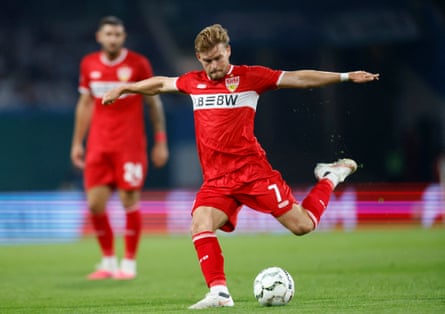
Freiburg, fresh from the experience of reaching an unprecedented Europa League final under Julian Schuster, have smartly invested some of the money from selling Johan Manzambi to Aston Villa to strengthen their squad. They could view this season’s Conference League as a legitimate target. Hoffenheim have spent all of the fee received for Bazoumana Touré as they return to the Champions League, while Eintracht Frankfurt are just glad to see the back of Albert Riera.
Some big boys are probably going to be hanging around the lower reaches of the table again. Schalke, back after a three-year absence, forged a strong identity under Miron Muslic last year and are led by 40-year-old Edin Dzeko after he signed a new deal, but staying up is the main aim. Northern rivals Hamburg and Werder Bremen have bigger name strikers than imagined, but will need to nurse Terem Moffi and Nicklas Füllkrug, respectively, back to form.
Köln have benefited – at least in a sporting sense – from Saïd El Mala’s Dortmund move falling through and he becomes the first Effzeh player since Lukas Podolski to wear the No 10.
Many think they can already ink in first and last – Bayern and first-timers Elversberg, representing a town of 13,000. But as BVB have already showed, a bit of tempo and youthful talent can shake up the expected order, even if just temporarily.