3 months ago
217
3 months ago
217
The third season of Euphoria has been almost impossible to ignore for anyone with a smartphone. The HBO drama, which started off in 2019 following a group of hedonistic, privileged teens, has evolved into television’s answer to rage-bait, creating moments that are specifically designed to dominate the news feed with memes and outrage. Even before we reach the season finale, we’ve seen OnlyFans storylines, pup play, sugar daddies, mummification fetishes, a disastrous wedding, fingers and toes being sliced off, venomous snake attacks, cockatoo assassinations (RIP Paladin), gangster shootouts and (several) characters being buried alive.
In season three, Euphoria picked up its story five years after the characters graduated from high school. At times, the show has felt lost outside of the high school setting, exploring a confusing mishmash of genres and plots, some of which have been called out for glamorising misogyny and violence. Yet despite these criticisms, the show has a track record of taking bold artistic risks, which is becoming rarer in a content landscape that values quantity over quality. It turned Sam Levinson, its creator, into one of Hollywood’s most exciting (and polarising) visionaries, and catapulted a new generation of actors into the A-list to the point where it now seems like they have outgrown the show). As season three concludes, Euphoria represents a strange – and very “2026” – contradiction, where it feels both ridiculous and undeniably influential.
This season of Euphoria has taken me on a journey. For the first three episodes, I was aghast that virtually all of the female characters pursued lines of work that revolved around male pleasure or servitude. Cassie (Sydney Sweeney) begged her husband Nate (Jacob Elordi) to let her do OnlyFans. Jules (Hunter Schaffer) dropped out of art school to become a “sugar baby” who fulfils the fetishes of married men. Rue (Zendaya) started working for a ruthless strip club owner as a drug mule. As I wrote last month, it felt like the show took a group of strong-headed young women and turned them into a shallow, manosphere-inflected fantasy, where women only engage with me to use them for money.
In episode four, my view started to shift when the show began to question the idea that women really can be “empowered” this way. Kitty (Anna Van Patten), a dancer at the strip club owned by Rue’s boss, is sexually assaulted by a group of clients in a private room – an ordeal a horrified Rue watches via the club’s security cameras. Then in episode five – an episode so outrageous that it needs to be seen to be believed, where a giant Sweeney rampaged around skyscrapers like some sort of Thotzilla monster – we see Cassie launching an OnlyFans and going to great lengths to fulfil the fetishes of her customers. Nate, her husband who was once highly possessive over her and determined to provide for her, slowly starts to see her as a cash cow to clear his debts. He even encourages Cassie to film an “erotic” video with a male influencer who has 30 million followers, just so she can send him more money. They both risked so much to be together, but now their relationship is reduced to a transaction.

As Cassie pursues virality at any cost, she and Maddy (Alexa Demie), her former bestie turned manager, purposefully try to create controversy, staging various engagement-bait stunts. “The angrier these idiots get,” Maddy says, “the more money you make.” At this point, I realised that Euphoria was trying to explore the misogyny of the attention economy – the media landscape that we are all participating in to varying degrees, which rewards polarising figures with cultural relevance. Watching the show, I found myself thinking about the generation who have grown up with extreme creators including Andrew Tate and Bonnie Blue, who are both Frankenstein creations of the attention economy. How has that shaped their view of the world?
Euphoria’s choice to zone in on how algorithms are stripping us of our humanity is distinctly “meta”, not least because Levinson has been known for using shock tactics to draw attention to his work. It also feels fitting that Sweeney is right at the centre of the show. In 2025 the actor’s American Eagle ad campaign caused a political firestorm, with critics accusing her of “using whiteness to sell jeans”. The political right – including Donald Trump himself – promptly rallied around her, while American Eagle’s stock price soared. Sweeney has since capitalised on all this attention by launching her own underwear brand, SYRN, which Cassie wore on Euphoria while cosplaying as a dog.
Chloe Cherry, who plays the vulnerable runaway Faye Valentine, also has a life story that foreshadowed the show. When Cherry was 18, she began starring in adult films and she later built a presence on OnlyFans before moving into acting. When I interviewed Cherry earlier this month, I asked her about the fine line that the show treads between glamorisation and critique. “In my opinion, I think Sam [Levinson] is using these young women as a vessel to show how society currently sees young women,” she said. “I think Sam’s trying to say: ‘Look where we have got to in society.’”
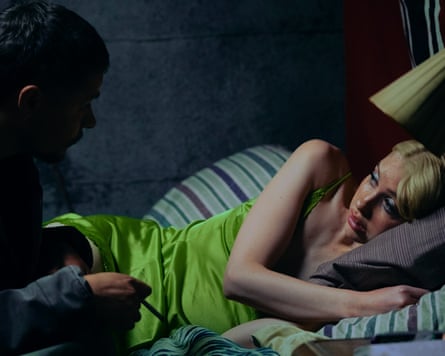
While its portrayal of women is of course subjective, what’s less so is that Euphoria’s third season has struggled thematically. The show is part horror, part gangster movie, part Tarantino thriller, and part soft porn film – sometimes all in the same episode. Watching it has felt like having three separate conversations with the same person, on different messaging apps, at the exact same time, in ALL CAPS. Some of the characters have been infuriatingly flattened, too. Jules was once so central to the story but she’s spent this entire season as a side character who lacks her own voice. Nate was a fascinatingly layered young man who seemed like he might be using the armour of machismo to hide much more complex (and possibly queer) feelings. But in season three he was reduced to his debts.
That said, even the loudest critics of Sweeney would be foolish to argue her portrayal of Cassie hasn’t been masterly. And the return of Cal, Nate’s dad – the final on-screen performance of actor Eric Dane, who died in February – was particularly poignant. At his son’s wedding, Cal was confronted with his secrets, mistakes and squandered potential. But overall Levinson seems to have forgotten that Euphoria was built on the complicated personal relationships between its characters – that is how the show launched a new generation of stars.
If this ends up being Euphoria’s final season, then the show’s legacy is hard to define. The first two seasons existed in their own world, offering a social portrait of teen life that was purposefully made to be more vague and dreamlike, to the point where it was never even confirmed which state the characters lived in. Then came season three, which is hyper-specific to today’s media moment: TikTok houses, OnlyFans and the nihilistic pursuit of online clout. It’s a warning to a generation that has been raised not to expect anything from anyone.
I suspect that the show might end up being gen Z’s equivalent of Lena Dunham’s Girls, which tapped into a sense of generational unease in the 2010s, when my generation of millennials were entering the workforce. But while Dunham’s high-cringe comedy satirised the last gasps of Obama-era optimism, Euphoria drags us deeper into the malaise. It portrays an algorithm-driven Lord of the Flies, where young people are being encouraged to view life as a series of transactions, where “empowerment” can only be achieved by scamming other people. It’s not comfortable viewing, but when the world feels so broken, how could it be?
-
Euphoria’s season three finale is on HBO Max on 31 May in the US and Australia and on 1 June in the UK