3 months ago
114
3 months ago
114
This article is part of the Guardian’s 2026 World Cup Experts’ Network, a cooperation between some of the best media organisations from the 48 countries who qualified. theguardian.com is running previews from three countries each day in the run-up to the tournament kicking off on 11 June.
The plan
Haiti’s World Cup qualification is one of the most inspiring stories of a football generation. More than a sporting achievement, the Grenadiers’ success represents an extraordinary human triumph forged through adversity, sacrifice and resilience.
At a time when the country continues to grapple with deep political instability and a relentless security crisis, the national team had to play every qualifying match away from home, deprived of the passion and energy of their supporters. Yet even in exile, they refused to break. Against all odds they carried the hopes of a nation and secured Haiti’s return to the biggest stage for the first time since the legendary squad of 1974.
Haiti: Group C fixtures
Show13 June v Scotland, Boston (9pm local, 14 June 2am BST, 14 June 11am AEST)
19 June v Brazil, Philadelphia (8.30pm local, 20 June 1.30am BST, 20 June 10.30am AEST)
24 June v Morocco, Atlanta (6pm local, 11pm BST, 25 June 8am AEST)
The French head coach, Sébastien Migné, has created a fierce and disciplined side built on intensity, tactical organisation and rapid transitions. They are able to defend with discipline before bursting forward in dangerous counterattacks. The experience and composure of leaders such as Duckens Nazon, Frantzdy Pierrot and Ricardo Adé give the squad a crucial balance.
Haiti qualified by finishing second behind Curaçao in Concacaf Group C and then winning their third-round qualifying section with key victories against Costa Rica and Nicaragua, establishing themselves as one of the Caribbean’s most respected footballing nations.
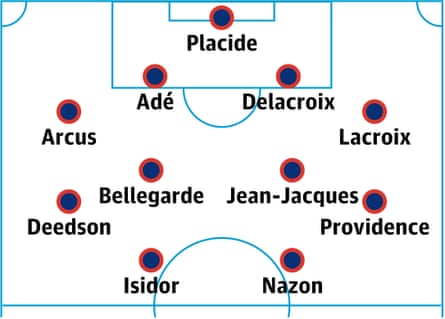
Migné has shaped Haiti into a modern, vertical, transition-based side. His 4-4-2 employs attacking full-backs for width and crossing, often shifting to a 4-2-3-1 in defence. Sometimes the striker drops deeper to create overloads in midfield and, if the midfielders maintain the shape when the full-backs push forward, it gives Haiti a strong platform. Recent results suggest it is working.
Migné has never hidden his ambition. “In one match anything can happen. The idea is to write a new story with these players,” he said as he prepared his team to face Brazil, Scotland and Morocco in Group C. The Frenchman told Fifa.com: “We’ve been handed a tough group … but looking on the bright side, we’ll certainly be in the limelight, which is a tremendous reward for the boys. We’ll now have to go out there and prove that we’re up to the challenge.”
Key players are Johny Placide, the veteran who holds the defence together; Jean-Ricner Bellegarde, who is the midfield engine; and Wilson Isidor, the main attacking threat with his pace, movement and technical ability.
The coach
Since his appointment in June 2024 Sébastien Migné has become more than a head coach: he is the architect of a remarkable national footballing revival. A former assistant to the renowned manager Claude Le Roy, the French tactician sharpened his experience with managerial spells at African national teams including Congo and Kenya, before taking charge of the Grenadiers. Arriving during one of Haiti’s most difficult periods, Migné quickly brought discipline, unity and belief back into the squad. He has never set foot in the country. “It’s impossible because it’s too dangerous,” he told France Football magazine. “I usually live in the countries where I work, but I can’t here. There are no more international flights landing there.”
Star player
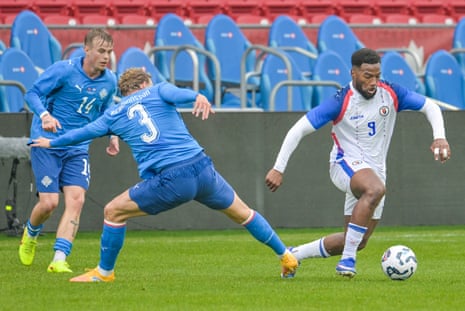
With the explosive Duckens Nazon leading the charge, Haiti are daring to dream. The prolific striker has become far more than a goalscorer, embodying the passion, resilience and pride of a nation that breathes football. The buildup to the tournament has not been smooth because he plays for a club in Iran. “I was about to take a plane to go to Istanbul or Paris, then the steward told everybody to get off because the war had started,” he told BBC. “I was stuck at the border for maybe 48 hours. They refused me, sent me back to Iran and I slept at the border. But I was so lucky because, before the war started I bought an eSIM. After that, they cut the internet in Iran. The eSIM saved my life.”
One to watch
Largely unknown on the world stage, the 24-year-old Ruben Providence could emerge as one of Haiti’s breakout stars. Quick, fearless, and dazzling in one-on-one situations, the young winger possesses the explosive creativity capable of changing a match in seconds. Born in France, he came through some of Europe’s biggest clubs, spending time at Paris Saint-Germain and Roma before finding stability with Almere City in the Dutch second division, where he is turning heads with his technical flair, sharp movement and confidence under pressure.
Unsung hero
Often overshadowed by flashy forwards and headline-grabbing stars, Danley Jean Jacques remains an indispensable engine of Haiti’s national team. Tireless in midfield, he breaks up attacks, dictates tempo and brings balance with a quiet efficiency that rarely gets the spotlight it deserves. Often unspectacular but absolutely vital, he plays his club football at Philadelphia Union, whom he joined from Metz in 2024. “Changing countries and discovering a new culture forces you to step out of your comfort zone,” he told the club website. “I’ve had to take on more responsibilities and grow as a person. I’m calm, respectful, a good listener, and quite reserved. As a teammate, I’m always there for the team, to defend the club’s colors and represent our fans.”
Probable starting XI
What to expect from fans at games?
Fans at Haiti’s matches can expect an atmosphere charged with raw emotion and pride. From Port-au-Prince to Miami, Haitians are preparing to flood stadiums and watch parties dressed in blue and red, transforming every match into a celebration of national identity. Despite insecurity, economic hardship and electricity shortages at home, supporters remain determined to stand behind the Grenadiers as one people. The Haitian diaspora is expected to bring energy, drums, chants and passion.
Relationship with the US/Trump?
One controversy has sparked outrage beyond football. Under travel restrictions tied to the Trump administration, many Haitians without existing US visas may be unable to support the Grenadiers in America. While the Fifa president, Gianni Infantino, promised that “fans from all over the world will be welcome” the US Department of State has confirmed that no special exceptions would be made for Haitian supporters. Ticket prices is another problem. “We are happy Haiti is back in the World Cup after 52 years,” Julio Midy, founder of Boston-based Radio Concorde, which caters to the local Haitian community in the city, told Al Jazeera. “But tickets are very, very expensive and, unfortunately, we cannot afford it.”