2 months ago
81
2 months ago
81
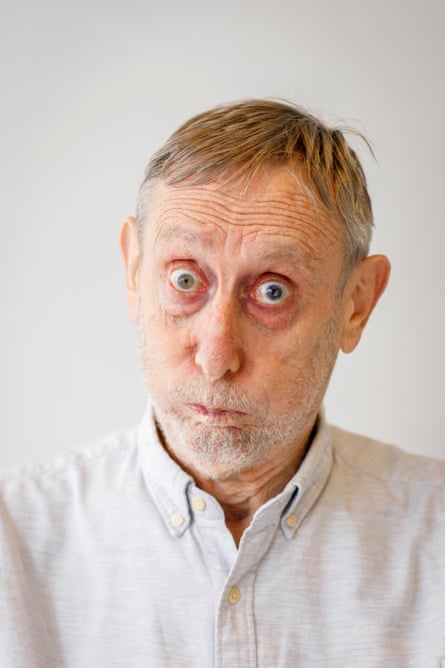
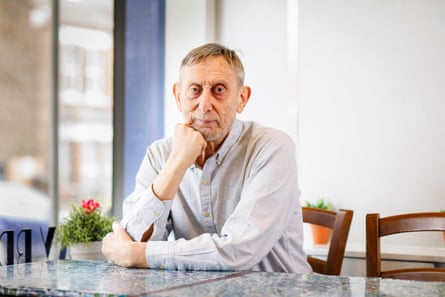
Whether you know him from reading his classic picture book We’re Going on A Bear Hunt as a child, from his viral YouTube videos or his tireless support for children’s literacy and the NHS, Michael Rosen has been a household name in the UK for decades. As he turns 80, we gave his peers and Guardian readers the opportunity to put to him the questions they’ve always wanted to ask.
Which do you prefer, asking or answering questions? Roger McGough, poet
Probably asking. I always worry if I’m answering questions I’m being boring. It feels quite exciting if you ask questions. And, as Roger knows, the moment you pick up a pen and start to write, you’re actually asking questions. You’re saying: “What’s the next word? What’s the next phrase? Why am I writing in this shape? Why am I writing in this tone of voice?”
How did you know you wanted to become a children’s writer? Nabiha, Guardian reader
I thought I was just reflecting on my childhood in a book for adults. And then, because nobody was interested in publishing it as an adult book, somebody said: “Why don’t you try publishing it for children?” [It became Mind Your Own Business, his first poetry collection.]
How are joy, hope, fun and humour sustained in the face of threat or loss? Hugh Montgomery, professor of intensive care
Ah, Hugh, he saved my life. I guess I’ve arrived at a point where I think life is absurd, whether it’s when you pick up something and you drop it by mistake and it breaks, or you can’t find your shoes, to the great big things like losing my son Eddie and so on. It really is just very, very odd that we’re these little creatures crawling about the surface of one planet in the universe and there doesn’t seem to be any logic or reason for it at all. So that’s where I take comfort. There’s no difference: the silly stuff’s no different from the tragic stuff. That’s not to trivialise it, not at all. I think when you explore absurdity, you find that it’s actually wonderfully complex and profound.
What are your favourite foods? Sophie, Guardian reader
Hummus. Raisins. That just about covers it.
Where is the weirdest place you would read books as a child? … Connie Huq, broadcaster and author
When I was 12, my parents thought it would be a great idea to help with my French if I went to stay with a French family. So I went and stayed with this family in Paris, and they were very, very kind to me. They took me to all these famous places – Les Invalides, the Panthéon and the Eiffel Tower. Going up the Eiffel Tower took three or four hours because we had to keep waiting for the lifts, and all the way up I read a book: JB Priestley’s An Inspector Calls. I got to the top and admired the view and took pictures on my little camera. Afterwards, the family asked me: “Did you like it?” And I said yes. And the little boy said, “Yeah, well, you spent the whole time reading a book.” Obviously they thought it was a bit rude.
With the world in such a turbulent and seemingly hopeless state, do you have a favourite line or passage from a poem or story that gives you hope? Andy, Guardian reader
The one that always jumps up is the last lines of Dulce et Decorum Est by Wilfred Owen, where he says: “The old Lie: Dulce et decorum est/ Pro patria mori.” He takes that phrase that was around in the first world war, which translates to: “How sweet and fitting it is to die for one’s country,” and just chucks it away, puts it in the bin.
I love that in just three words, Owen punctures the kind of things that people are saying right now – you know, defending western values or standing by our allies. In that incredible poem he describes the utter degradation of human beings in the face of war. I take hope from the fact he had that spirit and that understanding to be able to say that and say it so profoundly. And we can use and take somebody like Owen and share that with each other. Because, in the end, the only thing that will stop this terrible stuff happening is people collectively preventing it happening.
If you could share an 80th birthday dinner with any three authors, living or dead, who would they be and why? Oliver Jeffers, author and illustrator
Kafka, Langston Hughes and Shakespeare. That’d be an interesting chat, wouldn’t it? From Shakespeare, I want to find out: “Did you write all those plays?” And that’s not the question: “Did somebody else write them?” What I want to know is: “How did you write them? Did you write them in the theatre? Did you write them with other people? Did you share out a bit? Did you improv them?” Some say you can’t write in teams, but people do it all the time. Most of the movies and comedy shows we watch are written collectively quite often.
I’d love to know how Kafka gave himself permission to write this way of almost defeating yourself in a story. And maybe it would be interesting for him to talk about his approach to life. I don’t know, he might turn up as a dinner guest and be quite cheery, which would surprise us all. And Langston Hughes feels like an incredible pioneer to me, since he was able to put into very, very accessible language these powerful ideas to do with inequality and power and racism and the state of the US. I definitely want to learn from Langston Hughes; I want to pick his brains about his writing.
Have you ever felt uncertain about the value of your work? If so, how did you overcome that? Raymond Antrobus, poet
I don’t think you can write unless you doubt the value of it. If you start writing and think, “I am brilliant, I’m absolutely fantastic,” you haven’t got an urge to write. Every time I write something, I’m doubting whether it’ll be any good. And then even when I’ve written it, I think the proof of the pudding is in the eating, so I’m always waiting to hear or see how other people have reacted.
Kiddies quite often come up to me and say, “We love Chocolate Cake,” and part of me goes, “Oh, great, I’m glad you like that.” And then another part of me goes: “Yeah, well, I’ll never write anything as good as that.” And that’s writing. You have to live with that. It’s good, because it makes you think: “Right, how could I?” There’s the next chance.
You’ve inspired so many children to start writing with your simple advice to “talk with your pen”. When was the last time a child inspired you to talk with yours? Kim Hillyard, children’s author
A boy came up to me just the day before yesterday and said: “Oh, I love that poem that ends, moan, moan, moan, moan, moan, moan, moan.” And I went: “Do you? Did I write that?” He said: “Yeah, it’s in A Great Big Cuddle.” He said he knew it off by heart. And I said: “Oh, go on then, can you do it?”
As no one had ever said to me anything about that poem, I sort of tucked it away and thought: “Oh well, maybe it doesn’t work.” But then this little boy did it, and it made me laugh. And I thought: “I’m going to learn this and do this in my performances.”
Thank you so much for your beautiful and moving Sad Book. I know it’s helped lots of people, including me after the death of my husband from cancer last year. Today, more than 25 years after the death of your son Eddie, what are your feelings about and memories of him? Martin, Guardian reader
My new book, Where Are You Eddie? is expressing how I feel about Eddie now, which is that Eddie lives on with all the people who knew him. Just recently, a woman has opened a secondhand bookshop in Muswell Hill. She wrote to me and said she was with Eddie in the sixth form. And she sent me a picture of them in a play together. When people die, they live in the memories and imaginations of other people. It’s very easy and trite to say that, but that’s how I feel now.
You’ve spent years showing children that poems can whisper, shout, wobble, giggle and stomp across a stage. How does that kind of playful performance help turn listeners into readers? Jonathan Douglas, chief executive, National Literacy Trust
Ah, it’s the crucial question. I asked myself a few days ago: what have I been doing these last 50 years? I’ve been writing and performing. And people often think of these as two separate things. What I’ve been doing is trying to make the connection between the oral and the written. What I’ve always thought is if I do stuff that children want to hear, there’s a possibility they’ll also go to the written version of that and read it and repeat it.
What’s your go-to chocolate cake recipe? Matt, Guardian reader
When Emma and I got married, we said: “What kind of wedding cake are we going to have?” And we both agreed it would be a chocolate cake. And then we started looking up recipes and places and people who made different kinds of chocolate cake. And we discovered ganache [a mixture of chocolate and warm cream that is used to ice cakes]. We found this place near Waterloo, Konditor, that made chocolate cake with ganache. And I remember people at the wedding going: “Wow, this is amazing.” It was absolutely incredible. I certainly don’t know how to make it. I quite like that it’s a complete mystery.
Where is your faith? Lemn Sissay, writer
In human beings, and the Earth and the universe – that’s what I believe in. I don’t have a religion, I just have this belief that this is all we’ve got, so we have to make the best of it. And as we’re having this conversation, we’re making the worst of it. We’re not using the wisdoms that we have. In spite of everything, I have faith in human beings, but it is hard.
What do you say to those people who still believe things like art and poetry should be apolitical? Matt Haig, author
It’s a nice wish that people have, to hope that somehow or other there is a place where you can get away from the political. Some people hope that you can escape into music or dance. It’s quite odd, really. I often think about Aesop’s Fables. People think: “Oh, these are just funny little things about universal human values,” and yet they are about power and freedom and the right to choose, and how people with power listen to people who fawn over them. Even the very act of thinking you can escape is political. You can’t, because you still need to eat and breathe and do all the other necessities. It will always catch up with you.
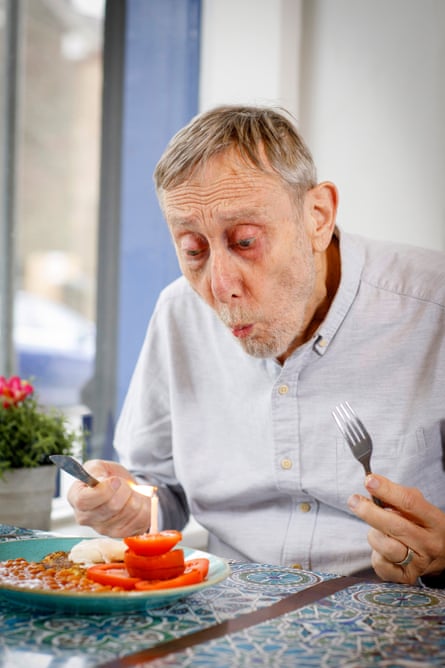
How do you feel about the YouTube poops and memes that get made about you? Anthony, Guardian reader
To start off with, I was a bit bothered by it. I thought people had stolen my stuff, so I was a bit conservative with a small “c” about it. And then I got told off by the poopers, who said: “Well, you put it up there. If you don’t like it, don’t come on to this platform.” And I learned from that: if I’d grown up in a world in which we had YouTube and the rest of it, I’d have been like them and done mashups. So I felt guilty that I was so stroppy to start off with. It’s a wonderful creative subculture.
What I didn’t like was the people who did antisemitic stuff, so I made efforts to get those taken down. But the ones that are just grotesque, and me farting and turning upside down and people making fun of my face and all the rest of it, that’s fine. I put myself out there. Exactly as they said: “If you don’t like it, don’t go on that platform.” So I just think: “Good luck to them. Just don’t be racist about it.”
In 2022, I saw you talk at a conference about your experience of Covid. It was deeply moving and by far the highlight of the day. You mentioned that you had reflected on never having had a chance to make pickled cucumbers. Have you made them yet? Eliot, Guardian reader
No, I haven’t, and shame on me. As a kid, I made pickled cucumbers with my mother, working to her mother’s recipe. It’s just laziness on my part. Instead, I just buy the ones in the shop and go: “This isn’t quite as good.” This is how pathetic you can be, isn’t it, in life? Just bloody make them, Michael. I’ve got no excuse at all. It’s outrageous. Well, anyway, Eliot, thank you for shaming me. I daren’t go out in public now. People are going to spot me and go: “You haven’t made pickled cucumbers.”